Author: prolifewitness

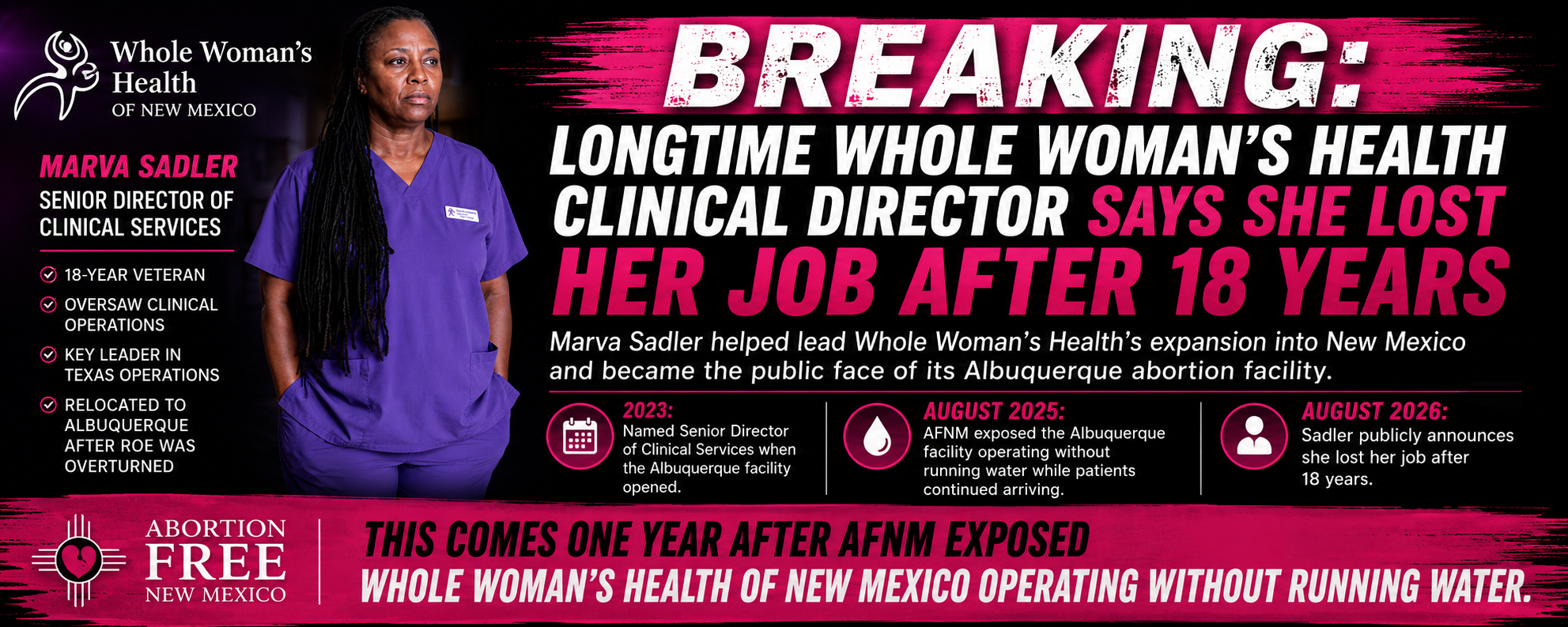
  • BREAKING: LONGTIME WHOLE WOMAN’S HEALTH SENIOR CLINICAL DIRECTOR SAYS SHE LOST HER JOB AFTER 18 YEARS

    BREAKING: LONGTIME WHOLE WOMAN’S HEALTH SENIOR CLINICAL DIRECTOR SAYS SHE LOST HER JOB AFTER 18 YEARS

    By Bud Shaver,


    ALBUQUERQUE, N.M. — 
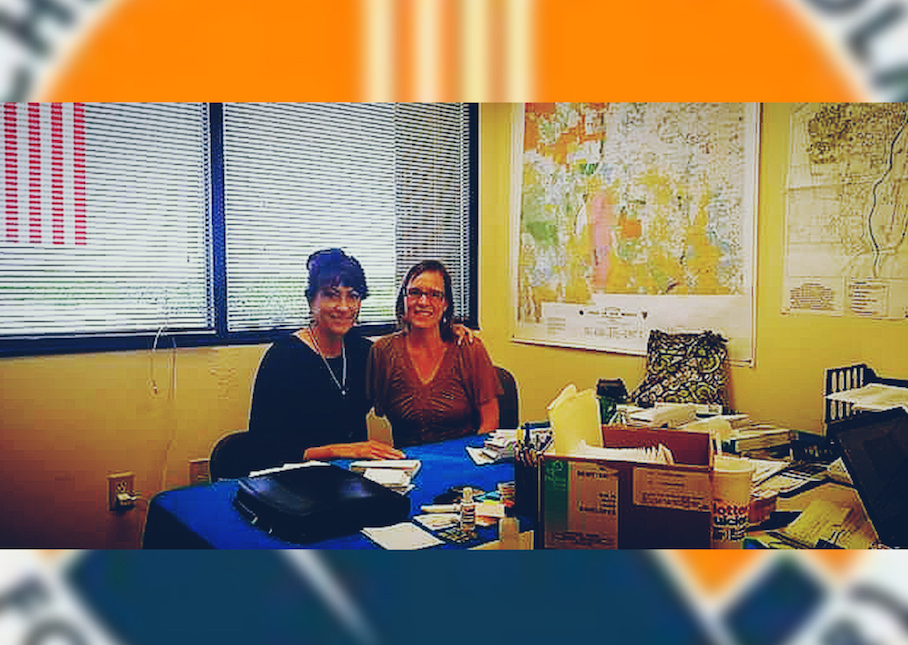
    Marva Sadler, a longtime Whole Woman’s Health senior clinical director who became a key figure in the abortion provider’s expansion from Texas into New Mexico, says she has lost her job after 18 years and does not intend to return to the same line of work.

    Marva Sadler relocated to Albuquerque after Whole Woman’s Health closed its Texas abortion facilities and helped establish the organization’s 

    New Mexico operation.In a recent public 

    Facebook post, Sadler described losing her job as a 

    “bad breakup,” writing:

    “losing my job after 18 years really was harder than I wanted to admit.”

    Days later, while describing cleaning out her closet and getting rid of her medical scrubs, Sadler wrote:

    I absolutely do not intend to return to work in that capacity again.”

    Sadler did not identify her employer in the posts or explain the circumstances surrounding her job loss. However, an extensive public record documents her nearly two-decade career with Whole Woman’s Health and her senior role within the organization.

    WHO IS MARVA SADLER? FROM TEXAS TO NEW MEXICO

    Marva Sadler held significant clinical and operational responsibilities within Whole Woman’s Health for years.

    In federal litigation challenging Texas Senate Bill 8, Sadler was identified as Senior Director of Clinical Services for Whole Woman’s Health and Whole Woman’s Health Alliance. Court filings stated that she oversaw clinical operations at the organizations’ Texas clinics and was personally involved in aspects of patient care.

    Sadler was also present during a pivotal period for Whole Woman’s Health in Texas. In August 2021, as the state’s heartbeat law was about to take effect, Whole Woman’s Health publicly identified Sadler as its Senior Director of Clinical Services and reported that she was working at its Fort Worth facility as staff continued seeing patients ahead of the law’s midnight effective time.

    Following the Supreme Court’s 2022 Dobbs decision, Whole Woman’s Health closed its Texas abortion facilities and expanded into New Mexico. The organization subsequently documented equipment and supplies from its closed Texas facilities being moved into Albuquerque and identified Sadler as its Senior Director of Clinical Services and a new Albuquerque resident.

    When Whole Woman’s Health of New Mexico opened on March 23, 2023, Sadler was prominently involved in announcing the new facility. Whole Woman’s Health again identified her as Senior Director of Clinical Services and quoted her describing the Albuquerque location as the organization’s “next chapter.” The organization said more than $300,000 had been raised to establish the facility.

    Independent reporting further documented Sadler’s lengthy tenure. In 2024, The Wall Street Journalreported that she had worked at Whole Woman’s Health clinics in Texas for 17 years before moving to Albuquerque and photographed her preparing a procedure room at the New Mexico facility.

    Taken together, the public record shows that Sadler was not simply an employee at the Albuquerque facility. She held senior clinical responsibilities, oversaw operations in Texas, represented Whole Woman’s Health publicly and relocated to Albuquerque as the organization established its New Mexico operation.

    ANNOUNCEMENT COMES ONE YEAR AFTER AFNM’S WATER REPORT

    Sadler’s announcement comes approximately one year after Abortion Free New Mexico documented Whole Woman’s Health of New Mexico remaining open to arriving patients while the Albuquerque abortion facility lacked running water.

    On August 16, 2025, AFNM’s team was outside the facility as part of its ongoing presence at the Albuquerque location when Water Authority personnel arrived at the property. AFNM reported that abortion patients continued entering the facility during that period. Photographs taken at the scene show Sadler and her husband working at the property while efforts were underway to get the water back on.

    The incident raised questions about compliance with New Mexico facility requirements concerning safe and sanitary water and hot and cold running water.

    Sadler has not publicly stated why she lost her job or whether her departure is related to conditions at the Albuquerque facility.

    “For nearly two decades, Marva Sadler was deeply involved in Whole Woman’s Health’s clinical operations and became a key figure in bringing its abortion operation from Texas to New Mexico. Now, after 18 years, Sadler says she has lost her job and does not intend to return to this work. Her departure marks a significant change for an organization she helped lead for nearly two decades,” stated Tara Shaver of Abortion Free New Mexico.

    ​”Since Whole Woman’s Health opened in Albuquerque, our team has consistently prayed for Marva, reached out to her with the love of Christ, and encouraged her to leave the abortion industry. We sincerely hope this unexpected change becomes an opportunity for a new beginning—one where she can walk away from the abortion industry for good.

    — Tara Shaver, Leader, Abortion Free New Mexico

    Sadler’s public statements do not say whether she was fired, laid off, whether her position was eliminated, or whether her departure will affect Whole Woman’s Health’s Albuquerque operations.

    What is clear from the public record is that after approximately 18 years with Whole Woman’s Health—including years in senior clinical leadership and a central role in the organization’s move into New Mexico—Sadler says that chapter of her career is over.

    RELATED REPORT

    Abortion Biz Caught Operating With No Running Water

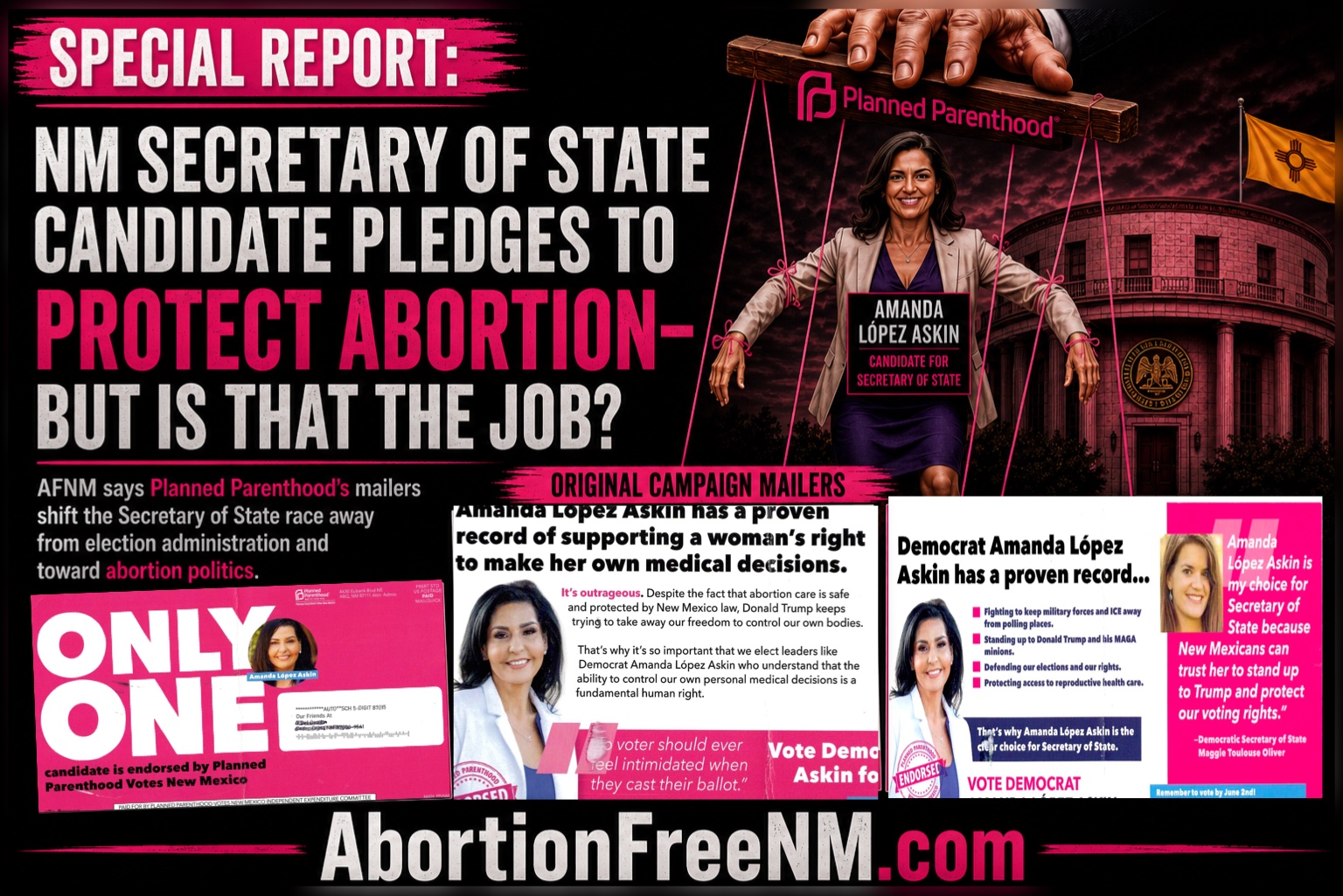
  • SPECIAL REPORT: NM SECRETARY OF STATE CANDIDATE PLEDGES TO PROTECT ABORTION-BUT IS THAT THE JOB?

    SPECIAL REPORT: NM SECRETARY OF STATE CANDIDATE PLEDGES TO PROTECT ABORTION-BUT IS THAT THE JOB?

    By Bud Shaver,

    ​ALBUQUERQUE, N.M.
     — Abortion Free New Mexico (AFNM) is extremely concerned about recently distributed Planned Parenthood Votes New Mexico Independent Expenditure Committee mailers supporting Secretary of State candidate Amanda López Askin.  The mailers raise significant questions about the office of the Secretary of State and about the agenda she is planning to support and promote if elected.

    PLANNED PARENTHOOD MAILER’S

    Mailers obtained by Abortion Free New Mexico

    Rather than focusing primarily on election administration, campaign finance transparency, business services, or the constitutional responsibilities of the Secretary of State, the mailers emphasize abortion and national partisan politics—even though the Secretary of State has no authority to enact abortion laws or regulate abortion providers. ​​

    One of the mailers also prominently features a public endorsement from current Secretary of State Maggie Toulouse Oliver, raising broader questions about ethics, impartiality, and professional conduct

    AFNM is asking whether the use of the sitting Secretary of State’s endorsement constitutes a reportable in-kind contribution or other support under New Mexico campaign finance law, and whether such participation is consistent with the neutrality expected of New Mexico’s chief elections official.

    Separately, Tara Shaver, a leader with Abortion Free New Mexico, recently filed an ethics complaint alleging Amanda López Askin failed to disclose approximately $2,291.44 in Planned Parenthood-funded in-kind support as required under New Mexico campaign finance law. According to AFNM, the complaint raises additional questions about transparency in a race for the very office responsible for overseeing campaign finance reporting and administering New Mexico’s elections.

    AFNM notes that these concerns also influenced its decision to file the campaign finance complaint with the New Mexico Ethics Commission rather than the Secretary of State’s Office. Given the Secretary of State’s public endorsement of Amanda López Askin, AFNM sought review by an independent body.

    “New Mexicans deserve confidence that campaign finance laws are enforced impartially, regardless of political affiliation or public endorsements,” said Tara Shaver. “When the office responsible for administering elections publicly endorses a candidate seeking to succeed the current officeholder, questions about impartiality are inevitable. That’s why we asked an independent body to review our complaint.”

    Beyond campaign finance records, AFNM’s investigation examines voter participation and political engagement in New Mexico, arguing that election outcomes are often determined by relatively low voter turnout combined with substantial spending by well-funded political organizations.

    A Broader Look at Political Influence

    According to a previous article by AFNM, New Mexico had approximately 574,000 registered Democrats, 444,000 registered Republicans, and 390,000 Declined-to-State (DTS) voters during the 2026 election cycle. Primary turnout remained relatively low, with approximately 30% of Democrats, 21% of Republicans, and 9.5% of Declined-to-State votersparticipating. Among DTS voters who cast ballots, approximately three out of four participated in the Democratic primary.

    AFNM argues these figures illustrate how a relatively small percentage of voters—combined with significant independent political expenditures—can have a substantial impact on election outcomes.

    “New Mexicans are repeatedly told these policies reflect ‘the will of the people,’ but the numbers tell a more complicated story,” said Tara Shaver, leader with Abortion Free New Mexico.

    “When only a fraction of voters participate in primary elections, powerful organizations spend more than $1 million influencing who gets elected, and ethics complaints raise questions about undisclosed political support, we should honestly ask: Who is really steering New Mexico’s future? Is it the people—or the special interests financing the political machine?”

    Referencing Governor Michelle Lujan Grisham’s recent “Pink is Power” slogan, Shaver concluded with a challenge to New Mexicans.

    “If ‘Pink is Power,’ New Mexicans should ask what that power represents—and who benefits from it,” Shaver said. “Political power belongs to the people—not to well-funded special interests. We believe New Mexico’s future should be shaped by informed citizens exercising their constitutional right to vote, not by organizations with the deepest pockets or the greatest political influence. The people are the power.”

    AFNM encourages New Mexicans to review campaign finance reports, independent expenditure filings, election turnout data, ethics records, and campaign messaging for themselves. An informed electorate is essential to transparent government, accountable public officials, and public confidence in New Mexico’s elections.

    ​This report comes as Governor Michelle Lujan Grisham has repeatedly promoted the slogan “Pink is Power” while celebrating New Mexico’s abortion policies. AFNM says the slogan raises a broader question: Who actually holds political power in New Mexico—the people, or the special interests financing political campaigns?

    AFNM recently documented that Planned Parenthood-affiliated political committees spent more than $1 million influencing New Mexico’s 2024 elections, helping elect candidates who continue advancing one of the nation’s most expansive abortion agendas. ​

    For supporting documentation, investigative reports, campaign finance analysis, and ethics filings, visit AbortionFreeNM.com.

    Disclosure:  This report was independently produced by Abortion Free New Mexico and was not funded or commissioned by any candidate, campaign, political party, or political committee. Campaign mailers are reproduced solely for news reporting, commentary, and public-interest analysis.

    RELATED REPORTS: ​

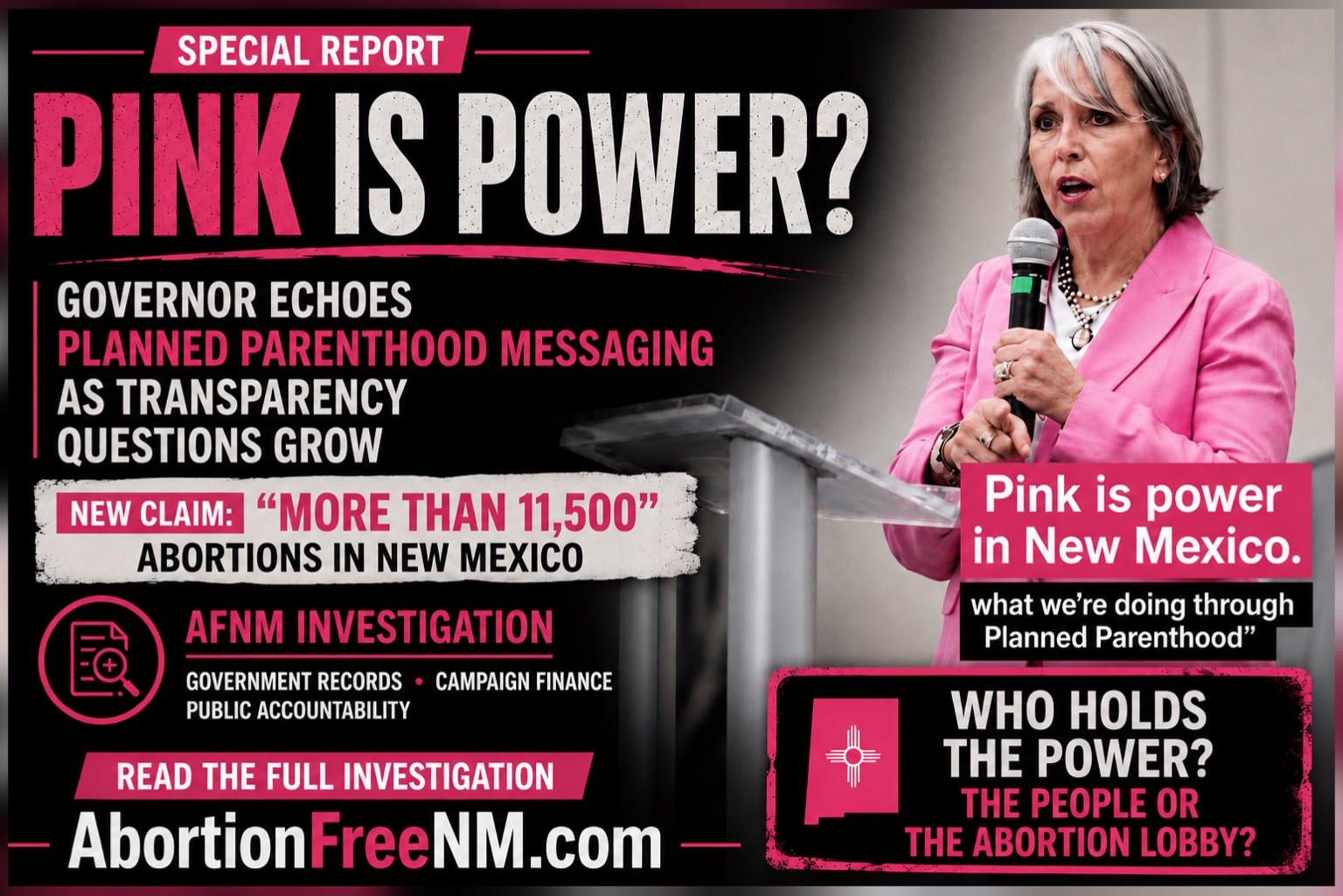
  • PINK IS POWER? GOVERNOR RESPONDS TO SCRUTINY WITH NEW “MORE THAN 11,500” CLAIM AS TRANSPARENCY QUESTIONS GROW

    PINK IS POWER? GOVERNOR RESPONDS TO SCRUTINY WITH NEW “MORE THAN 11,500” CLAIM AS TRANSPARENCY QUESTIONS GROW

    By Bud Shaver,

    ​ALBUQUERQUE, N.M. — After Abortion Free New Mexico’s Inspection of Public Records Act investigation compelled the release of internal records concerning New Mexico’s abortion data, Governor Michelle Lujan Grisham issued a new public statement claiming that “more than 11,500 patients received abortion services in 2024.”

    The Governor’s statement follows AFNM’s investigation documenting conflicting abortion figures and unresolved questions about how the state’s abortion statistics were compiled, verified, and communicated to the public.

    In her latest public message, the Governor stated:

    “Since Roe was overturned, New Mexico has stood firm as a safe haven for reproductive health care. In 2024 alone, more than 11,500 patients received abortion services here. We will continue protecting access and defending providers.”

    ▶️ GOVERNOR’S VIDEO DECLARATION

    In a separate video (above) accompanying those remarks, Governor Lujan Grisham declared that “Pink is power in New Mexico,” while describing “what we’re doing through Planned Parenthood,” portraying Planned Parenthood’s agenda as part of a broader movement centered on democracy, equality, freedom, and choice.Rather than addressing AFNM’s documented questions regarding conflicting abortion statistics, taxpayer-funded abortion policies, or government transparency, the Governor again emphasized themes closely associated with Planned Parenthood’s political advocacy.Governor Lujan Grisham’s declaration that 

    “Pink is power in New Mexico” raises a broader and more consequential question: What does that power represent—and whose interests does it serve?In a representative government, political power ultimately belongs to the people. Yet AFNM says the Governor’s remarks, viewed alongside Planned Parenthood’s political spending and expanding influence in New Mexico, raise legitimate questions about whether public policy is being shaped by the will of New Mexico’s citizens or by one of the state’s most influential political advocacy organizations.AFNM’s recent Follow the Money investigation documented that Planned Parenthood-affiliated political organizations spent more than $400,000 in independent expenditures supporting Governor Michelle Lujan Grisham’s 2022 reelection, while affiliated political committees also contributed $20,000 directly to her campaign.

    The investigation also resulted in a 2026 ethics complaint alleging that Democratic Secretary of State candidate Amanda Lopez Askin failed to disclose $2,291.44 in Planned Parenthood-funded in-kind campaign support, including mailers, staff time, and other campaign services. AFNM says these findings raise broader concerns about campaign-finance transparency, disclosure compliance, and the influence of powerful political advocacy organizations in New Mexico elections.

    AFNM has also documented Planned Parenthood’s continued expansion in New Mexico while affiliates in numerous other states have closed or consolidated facilities. As New Mexico continues funding abortion through taxpayer-supported programs and promoting itself as an abortion destination, AFNM says the Governor’s repeated messaging raises important questions about the influence of one of the state’s most powerful political advocacy organizations.

    AFNM EDITORIAL CARTOON

    The Governor’s latest wording also represents another shift in the administration’s public messaging.

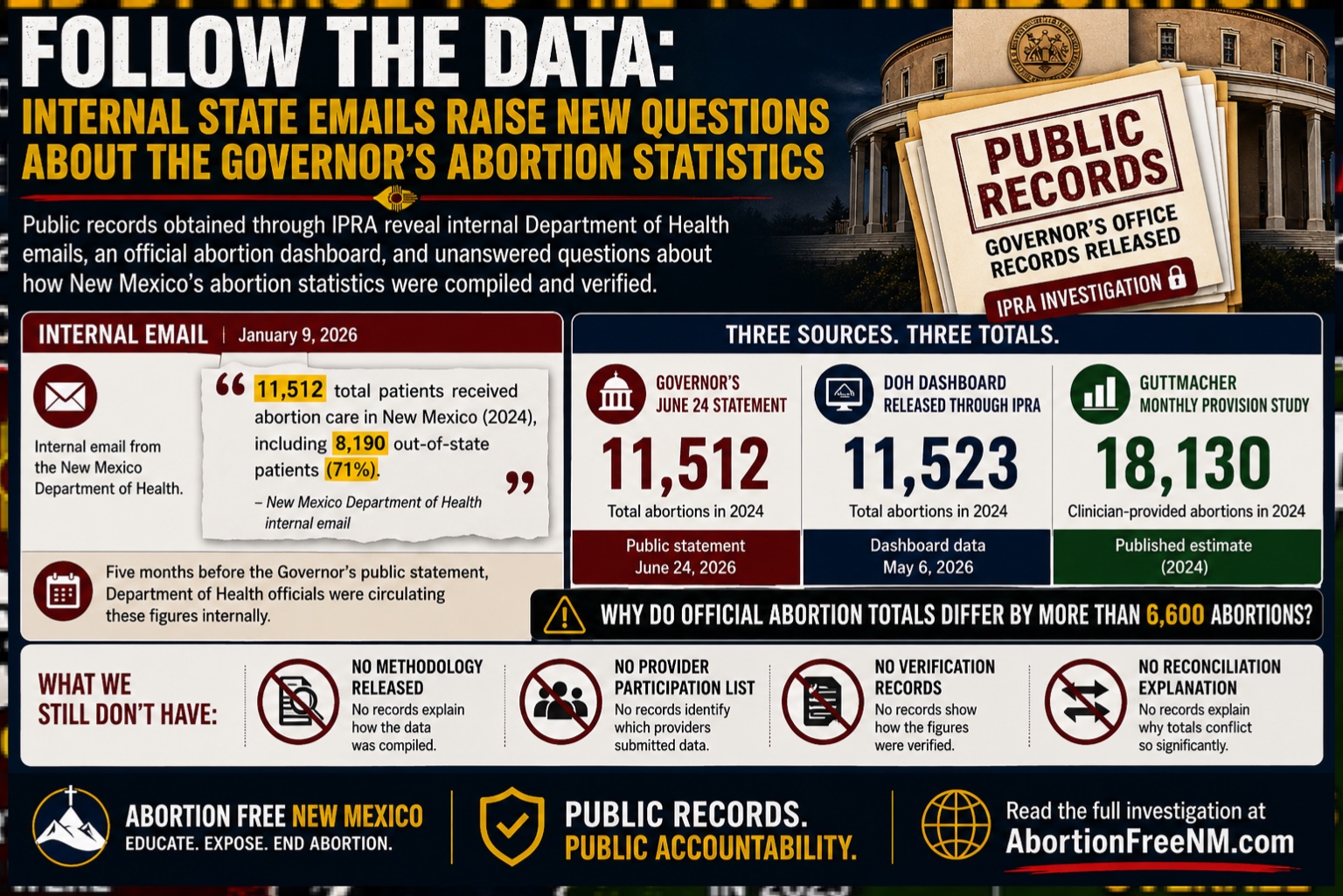
    The Governor previously cited 11,512 abortions in New Mexico during 2024, while a New Mexico Department of Health abortion dashboard reported 11,523. The Governor has now adopted the broader phrase “more than 11,500” without publicly explaining the difference between the previously released figures.

    AFNM’s investigation also highlighted a substantially higher estimate from the Guttmacher Institute, which reported approximately 18,130 clinician-provided abortions in New Mexico during 2024.

    The gap between the state’s reported figures and the Guttmacher estimate raises significant questions about the completeness, methodology, provider participation, and verification procedures underlying New Mexico’s abortion statistics.

    Rather than addressing those discrepancies, the Governor again promoted New Mexico as a destination for abortion and presented the reported number as evidence of her administration’s commitment to protecting the abortion industry.

    When the Governor says ‘Pink is power in New Mexico,’ New Mexicans have every right to ask what that power represents,” said Tara Shaver, a leader with Abortion Free New Mexico. “In our system of government, political power is supposed to belong to the people—not to well-funded special interests. AFNM’s investigation asks whether public policy is being shaped by the will of New Mexico’s citizens or by one of the state’s most influential political advocacy organizations.”

    Internal Department of Health communications obtained through AFNM’s public-records investigation showed that state officials were compiling and communicating abortion statistics to the Governor’s Office.

    The released records also indicated that compiling, analyzing, and confirming more recent abortion data would require additional time. However, the documents did not provide a complete methodology explaining how the publicly reported totals were calculated or verified.

    The records contained no documentation clearly identifying:

    • The methodology used to compile the abortion statistics.
    • Every abortion provider that submitted information.
    • Whether all abortion facilities participated.
    • How the figures were checked for accuracy.
    • Whether duplicate, incomplete, or missing reports were identified.
    • What procedures governed data collection after statutory abortion-reporting requirements were repealed.

    These unanswered questions are particularly significant because legislative testimony concerning Senate Bill 30 indicated that abortion providers had not consistently submitted reports required under New Mexico law since approximately 2019. Rather than restoring compliance and strengthening public accountability, the Legislature repealed the abortion-reporting requirement in 2026.

    This wasn’t about transparency—it was about promoting the abortion industry’s political narrative. Rather than answering the documented questions raised by AFNM’s investigation, the Governor chose to celebrate New Mexico’s growing role as one of the nation’s leading abortion destinations while repeating messaging closely associated with Planned Parenthood’s political advocacy.”

    Tara Shaver continued,

    To announce that more than 11,500 unborn children lost their lives should break our hearts—not become a political achievement. Every child lost represents a profound human tragedy, not a milestone to celebrate.”

    AFNM says the Governor’s latest statement does not resolve the central issue raised by its investigation.

    Whether the correct figure is 11,51211,523“more than 11,500,” or closer to the Guttmacher Institute’s estimate of 18,130, New Mexicans deserve to know how the numbers were gathered and whether they accurately represent abortion activity throughout the state.

    The Governor’s latest remarks also mark an increasingly confrontational posture toward states that have enacted laws protecting unborn children following the overturning of Roe v. Wade. By declaring that “Pink is power in New Mexico” and pledging to continue “the fight,” Governor Lujan Grisham is not merely defending New Mexico’s abortion policies—she is positioning the state in direct opposition to jurisdictions that have chosen to protect unborn children.

    ​AFNM says that escalating rhetoric raises broader questions about the direction of New Mexico’s leadership, the priorities driving public policy, and the influence of the abortion industry’s political allies within state government.

    When the Governor celebrates New Mexico’s abortion industry while attacking states that have chosen to protect unborn children, every New Mexican should ask where this path leads,” said Bud Shaver, Executive Director of Abortion Free New Mexico. “This investigation is about more than abortion statistics. It is about political influence, government transparency, and whether powerful special interests are shaping public policy. New Mexicans deserve leaders who welcome scrutiny and place the public interest above political ideology.”

    Power demands accountability.

    If “Pink is power,” New Mexicans deserve to know: Who is in control—and who does that power ultimately serve?

    Abortion Free New Mexico will continue following the evidence, pursuing public records, and documenting the facts so New Mexicans have the transparency needed to hold government accountable.

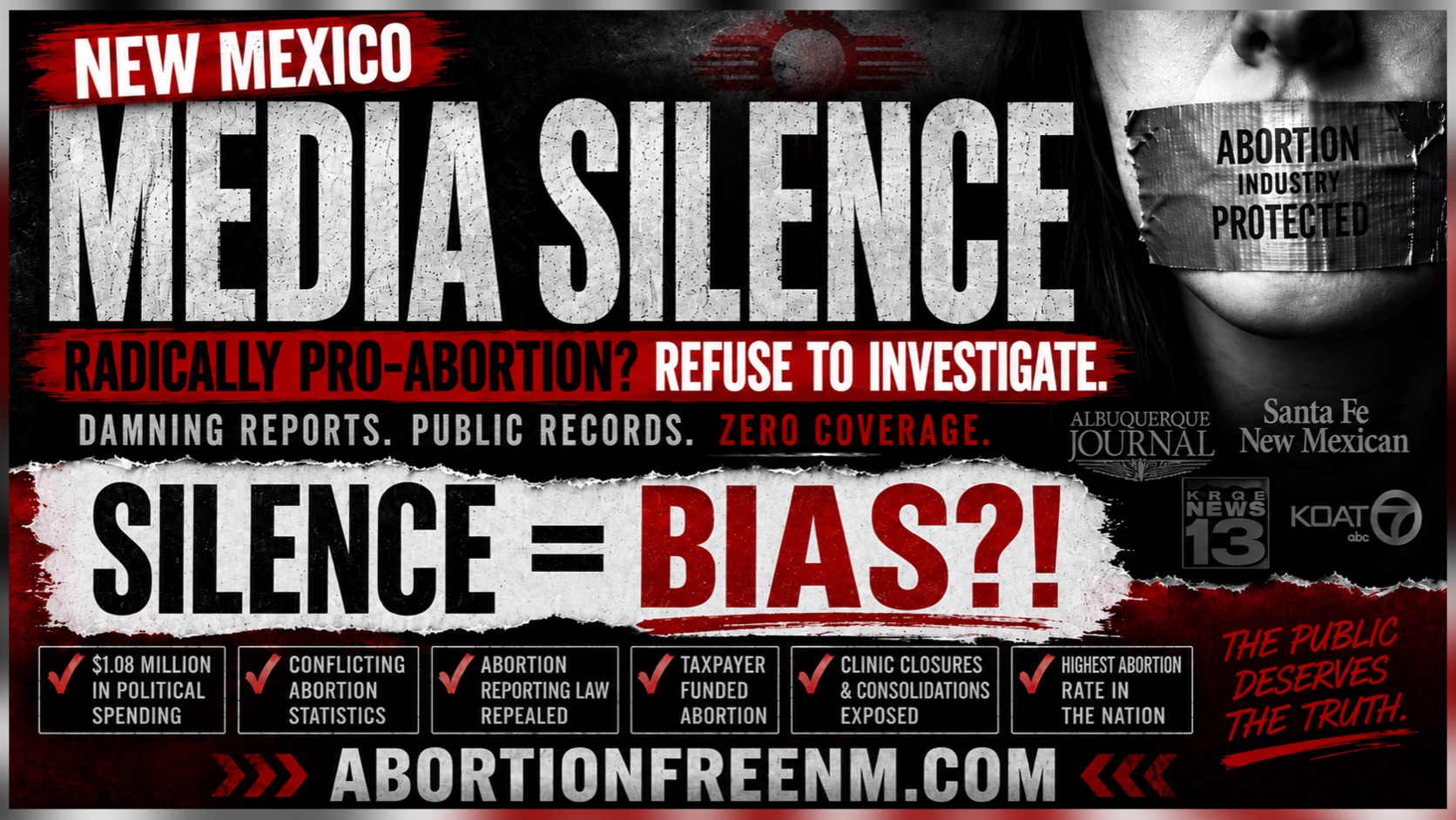
  • MEDIA SILENCE: MAJOR NEW MEXICO NEWS OUTLETS IGNORE DOCUMENTED ABORTION INDUSTRY INVESTIGATIONS

    MEDIA SILENCE: MAJOR NEW MEXICO NEWS OUTLETS IGNORE DOCUMENTED ABORTION INDUSTRY INVESTIGATIONS

    By Bud Shaver,

    ALBUQUERQUE, N.M. — Abortion Free New Mexico is calling out what appears to be a deliberate pattern of media silence from a New Mexico press establishment that has become radically aligned with the abortion industry and the politicians who protect it.

    Over the past several weeks, Abortion Free New Mexico has released a series of documented investigations exposing serious questions involving Planned Parenthood’s political influence, state abortion statistics, taxpayer-funded abortion, abortion-facility operations, government transparency, and the repeal of basic abortion-reporting requirements.

    Yet New Mexico’s largest media outlets have largely refused to investigate, challenge, or even meaningfully report the findings.

    This silence is especially revealing because many of these same outlets routinely promote abortion-industry messaging, celebrate abortion expansion, repeat claims from pro-abortion politicians without serious scrutiny, and frame abortion providers as unquestioned authorities.

    When the abortion industry wants publicity, New Mexico’s media provide a platform.

    When evidence raises questions about that industry’s money, power, statistics, political relationships, or government protection, the media suddenly lose interest.

    Among AFNM’s recent investigations are:

    • Planned Parenthood’s more than $1.08 million in political spending intended to influence New Mexico elections.
    • An ethics complaint raising questions about political expenditures, lobbying influence, and campaign-finance transparency.
    • Internal Department of Health emails exposing unanswered questions about abortion statistics promoted by the Governor.
    • Major discrepancies between state abortion figures and estimates published by the Guttmacher Institute.
    • The repeal of New Mexico’s abortion-reporting law after years of apparent noncompliance.
    • The closure and consolidation of an Albuquerque abortion facility documented through eyewitness investigation and an undercover phone call.
    • Data identifying New Mexico as having the highest abortion rate in the nation.
    • Continued taxpayer funding of abortion through New Mexico Medicaid.
    • The political influence of an abortion industry that has benefited from years of favorable legislation, public funding, reduced oversight, and expanding operations.​​

    New Mexico’s major media outlets do not appear to function as neutral watchdogs when abortion is involved,”said Tara Shaver, of Abortion Free New Mexico. “They operate within a radically pro-abortion culture that protects the abortion industry from the scrutiny routinely applied to almost every other powerful political interest.”

    AFNM’s investigations are based on public records, official government communications, campaign-finance filings, firsthand observations, undercover verification, legislative history, and published data.

    These are not rumors, anonymous accusations, or social media speculation,” Tara Shaver said. “We have published the paper trail. We have released the records. We have identified the discrepancies. We have documented the political spending. Every report is publicly available for anyone to examine. The media’s refusal to investigate is becoming a story in itself.”

    AFNM contends that the issue is not merely ideological bias. It is a failure of journalism that allows politically powerful organizations and elected officials to operate without meaningful public accountability.

    New Mexico reporters frequently scrutinize conservative organizations, Republican officials, churches, and pro-life advocates. 

    ​But when Planned Parenthood spends more than $1 million influencing elections, abortion statistics conflict by thousands, reporting requirements disappear, and taxpayer dollars continue flowing into abortion, the silence becomes deafening.

    The abortion industry has political allies in the Governor’s Office, the Legislature, and throughout state government,” Shaver said. “It also appears to have ideological allies in New Mexico newsrooms. That raises a basic question: Who will investigate the abortion industry when the institutions entrusted with holding power accountable are committed to advancing the same agenda?”

    AFNM is also raising concerns about the responsibilities of publicly funded media outlets. If news organizations receive taxpayer support—whether directly or indirectly—they have an obligation to cover matters of public importance in New Mexico regardless of ideology, political pressure, or editorial preference. Public funding should require a commitment to transparency, fairness, and comprehensive reporting on issues affecting New Mexicans.

    ​Accordingly, AFNM is calling on New Mexico’s journalists, editors, and publicly funded news organizations to answer the following questions:

    • Why have major discrepancies in state abortion statistics received so little scrutiny?
    • Why has Planned Parenthood’s extraordinary political spending not triggered sustained investigative coverage?
    • Why has the repeal of abortion-reporting requirements not been treated as a major government-transparency scandal?
    • Why are abortion-industry claims routinely repeated while documented pro-life investigations are ignored?
    • Do New Mexico newsrooms have ideological conflicts that prevent fair coverage of abortion-related issues?
    • Would the media remain silent if a conservative organization exercised the same political influence and received the same government benefits?
    • If these outlets receive any form of taxpayer funding, what specific policies, editorial safeguards, and accountability measures are in place to ensure they are fulfilling their legal and ethical obligation to provide comprehensive, viewpoint-neutral coverage of all significant public issues affecting New Mexico residents?

    AFNM emphasizes that these questions are not intended to challenge the editorial independence of New Mexico’s news organizations, but to encourage transparency, accountability, and public confidence. When documented investigations involving public records, campaign-finance filings, government data, ethics complaints, and undercover reporting receive little or no sustained investigative scrutiny, it is reasonable for the public to ask whether matters of significant public importance are receiving fair, comprehensive, and independent coverage.

    The media cannot credibly claim to hold the powerful accountable while protecting one of the most politically connected industries in New Mexico,” Shaver concluded. “New Mexicans deserve journalism, not abortion-industry public relations. The evidence is available. The public records have been released. The only question remaining is whether anyone in New Mexico’s media has the courage to follow them.”

    Readers can review the underlying investigations, public records, campaign-finance filings, and supporting documentation referenced in this release at AbortionFreeNM.com and examine the evidence for themselves.

    RECENT REPORTS: ​

    ABOUT ABORTION FREE NEW MEXICO

    Abortion Free New Mexico works to end abortion through investigative research, public exposure, accountability efforts, and direct outreach to women and families. Through sidewalk outreach, pregnancy assistance, and educational initiatives, the organization seeks to build a culture where every preborn child is valued and protected.

  • FOLLOW THE DATA: INTERNAL STATE EMAILS RAISE NEW QUESTIONS ABOUT THE GOVERNOR’S ABORTION STATISTICS

    FOLLOW THE DATA: INTERNAL STATE EMAILS RAISE NEW QUESTIONS ABOUT THE GOVERNOR’S ABORTION STATISTICS

    By Bud Shaver,

    ALBUQUERQUE, N.M. — Abortion Free New Mexico (AFNM) today published its analysis of public records obtained by Tara Shaver through New Mexico’s Inspection of Public Records Act (IPRA). The records, produced by the Governor’s Office, include internal Department of Health emails, an official abortion dashboard, and related communications that raise new questions about how Governor Michelle Lujan Grisham’s administration obtained, compiled and communicated the 2024 abortion statistics she publicly cited on June 24, 2026.

    The records reveal that the Governor’s Office relied on abortion figures that had been circulating internally for months, while a later Department of Health dashboard reflected different numbers. The records released to AFNM provide no explanation for the discrepancy.Following Governor Lujan Grisham’s June 24 social media post stating that 11,512 abortions were performed in New Mexico during 2024, with 71% involving out-of-state patients, Tara Shaver submitted an IPRA request seeking the records supporting those figures.

    The records produced by the Governor’s Office on July 15, 2026, reveal a paper trail spanning nearly six months of internal communications between the Department of Health and the Governor’s Office. Taken together, the documents show how abortion statistics were requested, discussed, updated, and communicated publicly, while raising new questions about the methodology and consistency of the figures used by state officials.

    THE PAPER TRAIL

    Figure 1. Internal emails released through IPRA show the Governor’s Office requested updated abortion data on January 9, 2026. Nearly six months later, on June 24—the same day Governor Michelle Lujan Grisham publicly cited 2024 abortion statistics—the Department of Health responded with updated data through early May 2026.

    Timeline Summary

    The records show that state officials were discussing abortion statistics months before the Governor’s public statement. A January 9 email referenced 11,512 abortions in 2024 and noted that updated 2025 data would require additional time to compile, analyze, and confirm. On May 6, the Department of Health dashboard reflected a different 2024 total of 11,523. The Governor nevertheless cited the earlier 11,512 figure on June 24, and later that same day the Department sent the Governor’s communications staff updated data through early May 2026.

    Exhibit C: Official Department of Health Dashboard

    Figure 2. Official Department of Health abortion dashboard released through IPRA to Tara Shaver on July 15, 2026. The dashboard reports 11,523 abortions in 2024 and includes detailed resident-state data through May 6, 2026, but no accompanying records explain the methodology, provider participation, verification process, or reconciliation with other published abortion totals.

    The records do not explain:

    • Why the Governor publicly cited 11,512 when the Department’s later dashboard reported 11,523.
    • Which figure was considered final.
    • When or why the total changed.

    ​Perhaps most significantly, the January email acknowledges that the Department’s abortion data required additional work before it could be considered complete.

    ​In the email, Nott wrote:

    …the 2025 data will take some time to compile, analyze, confirm, etc.”​

    Records Show 2025 Data Was Still Under Review

    Figure 3. Internal Department of Health email released through IPRA showing that, as of January 9, 2026, the Department advised the Governor’s Office that updated 2025 abortion data was still being compiled, analyzed, and confirmed.

    AFNM says that statement raises broader questions about the Department’s methodology and quality control. 

    These records show that state officials themselves acknowledged abortion data required additional compiling, analysis, and confirmation,” said Tara Shaver, leader with Abortion Free New Mexico. “Yet the public has never been shown the methodology behind these statistics or why different official records report different totals. New Mexicans deserve transparency, not unexplained discrepancies.”

    The released records also contain no documentation explaining:

    • How the Department of Health compiled the abortion statistics.
    • Which abortion providers submitted data.
    • Whether every abortion facility participated.
    • How the figures were verified before being released publicly.


    ​These unanswered questions are especially significant because legislative testimony on Senate Bill 30 indicated that abortion providers had not consistently submitted reports required under New Mexico law since approximately 2019. Rather than restoring compliance and strengthening public accountability, the Legislature repealed the abortion reporting requirement through Senate Bill 30 in 2026.

    AFNM contends that transparent, consistent, and independently verifiable reporting is essential to maintaining public confidence in abortion statistics used to inform public policy.

    Meanwhile, the Guttmacher Institute’s Monthly Abortion Provision Study estimated 18,130 clinician-provided abortions in New Mexico during 2024—thousands more than the Department’s reported total. Guttmacher’s estimates rely in part on voluntary participation by abortion providers and other data sources, creating a troubling contrast: providers appear willing to share abortion data with a private abortion-rights research organization while legally required reporting to the State went largely unfulfilled. The records released by the Governor’s Office do not explain that disparity or reconcile the competing totals.

    This investigation is no longer simply about one number,” said Bud Shaver, Executive Director of Abortion Free New Mexico. “It is about whether New Mexico’s government can demonstrate how abortion statistics are collected, verified, and communicated to the public. When official records conflict and no methodology is released, public confidence suffers. Government data should be transparent, consistent, and independently verifiable.”

    AFNM has published the released records and its accompanying analysis to encourage greater transparency, accountability, and public confidence in the abortion statistics used to inform public policy in New Mexico.

    RELATED:

  • ALAMO WOMEN’S ABORTION CLINIC CLOSES ONE OF ITS ALBUQUERQUE LOCATIONS

    ALAMO WOMEN’S ABORTION CLINIC CLOSES ONE OF ITS ALBUQUERQUE LOCATIONS

    By Bud Shaver,

    ALBUQUERQUE, N.M.
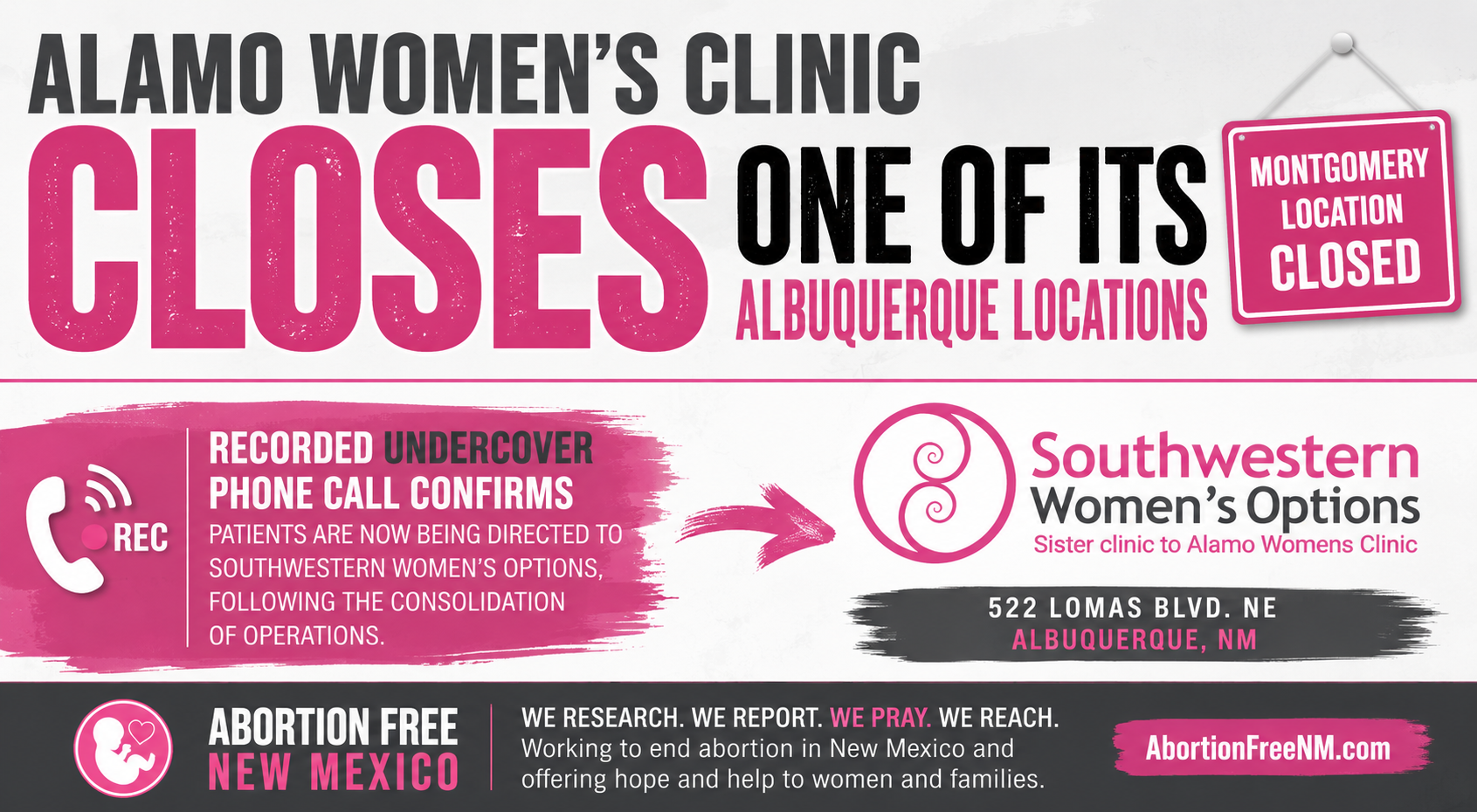
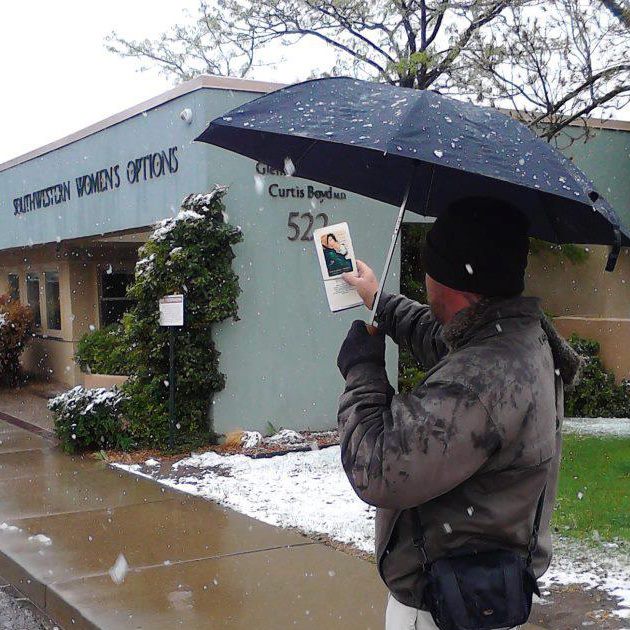
     –Abortion Free New Mexico (AFNM) has confirmed that Alamo Women’s Clinic has closed its Montgomery Boulevard location in Albuquerque after clinic staff stated during a recorded undercover telephone call that patients seeking appointments are now being directed to Southwestern Women’s Options at 522 Lomas Blvd. NE.The discovery began during Abortion Free New Mexico’s weekly prayer walk on Saturday, July 11, when volunteers observed furniture, equipment, and other items being removed from the Montgomery abortion facility, indicating the clinic was vacating the property.

    To verify what volunteers had witnessed, Tara Shaver, a leader with Abortion Free New Mexico, placed the undercover call call to Alamo Women’s Clinic on July 14, posing as a prospective patient seeking an abortion appointment at the Montgomery location.

    Shaver asked:

    I was wondering about scheduling an abortion appointment at your Montgomery location.”

    An Alamo Women’s Clinic employee responded:

    “I can definitely help you get scheduled, but just some upfront kind of knowledge on our recent changes—we’ve recently merged with the Southwestern clinic (Southwestern Women’s Options), so we are down the street now at 522 Lomas. Same doctor, same staff owns both of them. So now it’s one location.”

    The employee confirmed that patients seeking appointments at the former Montgomery location are now being directed to Southwestern Women’s Options, where the two operations have been combined at a single Albuquerque facility.


    Although Alamo Women’s Clinic’s website continued to list both Albuquerque locations at the time of publication, the staff confirmed that the Montgomery office is no longer serving patients. Southwestern Women’s Options currently describes itself as the “sister clinic to Alamo Women’s Clinic.”

    It remains unclear whether the Alamo Women’s Clinic name will continue to be used as a separate brand. What has been confirmed is that the Montgomery location has closed and operations have been moved to the Lomas facility.

    Consolidation Under Common Ownership

    Abortion Free New Mexico previously 

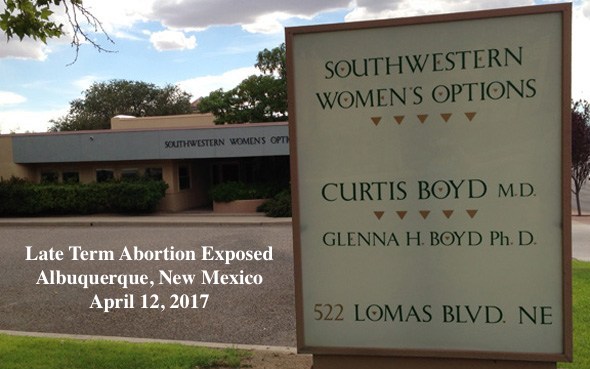
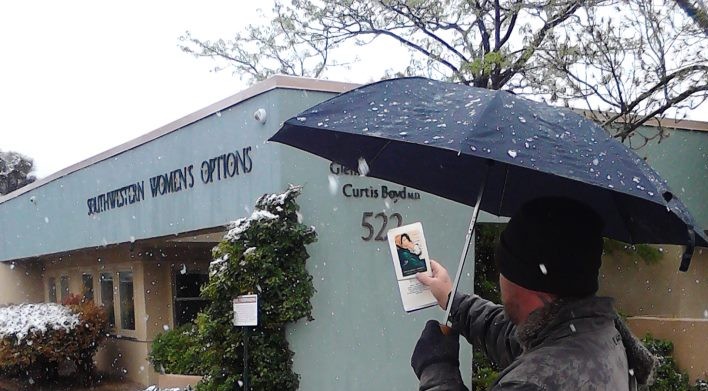
    reported in 2024 that abortionist Alan Braid became the owner of both Alamo Women’s Clinic of Albuquerque and Southwestern Women’s Options, the late-term abortion facility formerly owned by abortionist Curtis Boyd.According to clinic staff, the two facilities now operate under the same ownership with the same physician and staff from a single Albuquerque location.The closure marks another significant development in New Mexico’s abortion industry, with abortion services previously offered at two Albuquerque locations now operating from a single facility under common ownership.

    This undercover call confirmed what our volunteers first observed during Saturday’s prayer walk,” said Tara Shaver, leader with Abortion Free New Mexico. “After witnessing the Montgomery clinic being emptied, we sought to verify what was taking place. The clinic itself confirmed that patients are now being directed to Southwestern Women’s Options, where operations have been consolidated into one location.”

    Years of Faithful Sidewalk Ministry

    For years, Abortion Free New Mexico maintained a weekly sidewalk outreach ministry outside the Montgomery facility, offering women prayer, compassionate support, practical resources, and life-affirming alternatives to abortion.Located in a commercial strip mall alongside two dental offices and adjacent to First Christian Church of Albuquerque, the facility became the site of thousands of sidewalk conversations, prayers, Gospel presentations, and offers of assistance to women facing unexpected pregnancies. Through this faithful outreach, Abortion Free New Mexico witnessed numerous mothers choose life and provided practical assistance, prayer, and ongoing support to many other women and families 

    during some of the most difficult moments of their lives.

    Abortion Free New Mexico also experienced ongoing challenges at this location. While some neighboring businesses expressed frustration over the activity surrounding the abortion facility, AFNM volunteers remained committed to peaceful, constitutionally protected prayer and sidewalk counseling. AFNM maintains that the recurring disruptions associated with the property stemmed from the abortion facility’s operations and the public response they generated—not from the ministry’s peaceful outreach.

    The closure of this location marks the end of years of faithful ministry outside the Montgomery facility,” Shaver added. We thank God for every opportunity to pray, share the Gospel, offer practical support, and encourage women to choose life. While this chapter has come to a close, our mission has not. We will continue serving women and families with compassion, truth, and the hope of Jesus Christ wherever abortion facilities continue to operate until every preborn child is valued and protected.”

    AFNM Will Continue Monitoring the Transition

    Abortion Free New Mexico will continue monitoring the transition, including any changes to licensing, corporate records, branding, and the number of abortion facilities operating in Albuquerque.

  • FOLLOW THE MONEY: AFNM EXPOSES PLANNED PARENTHOOD’S $1.08 MILLION POLITICAL MACHINE IN NEW MEXICO

    FOLLOW THE MONEY: AFNM EXPOSES PLANNED PARENTHOOD’S $1.08 MILLION POLITICAL MACHINE IN NEW MEXICO

    By Bud Shaver,

    ​ALBUQUERQUE, N.M.
     — Abortion Free New Mexico (AFNM) today released a new investigative analysis revealing that Planned Parenthood’s political committees spent more than $1.08 million to influence New Mexico elections while simultaneously announcing it has filed an ethics complaint against Democratic Secretary of State candidate Amanda Lopez Askin over alleged campaign finance disclosure violations. AFNM says the findings raise serious questions about the abortion industry’s growing political influence and the need for greater transparency in New Mexico elections.  ​

    According to AFNM’s analysis, Planned Parenthood’s political committees spent $1,080,122.89 influencing New Mexico elections by financially supporting at least 31 candidates while spending hundreds of thousands of dollars defeating their opponents.  

    The analysis comes as AFNM has filed an ethics complaint with the New Mexico State Ethics Commission against Democratic Secretary of State candidate Amanda Lopez Askin, alleging violations of New Mexico’s Campaign Reporting Act and campaign finance disclosure requirements. According to the complaint, Planned Parenthood Votes New Mexico Coordinated Committee reported $2,291.44 in in-kind contributions to Askin’s campaign–$2,171.30 in mailers and $120.14 in staff time provided on May 26, 2026—while Askin’s Third and Fourth Primary Campaign Finance Reports allegedly failed to disclose those contributions. 

    Askin is seeking to become New Mexico’s chief elections officer, responsible for enforcing campaign finance laws, administering elections, and protecting public confidence in the electoral process. Her Republican opponent, Ramona Goolsby, is a strong pro-life candidate who has campaigned on election integrity, transparency, and accountability and has not benefited from Planned Parenthood’s political spending. AFNM encourages voters to carefully examine the stark contrast between the candidates and to follow the money behind New Mexico’s Secretary of State race.  

    New Mexicans deserve to know whether those entrusted with enforcing our election laws are independent public servants or beneficiaries of one of the most powerful political organizations in our state,” said Tara Shaver, leader with Abortion Free New Mexico. “The Secretary of State’s office should inspire confidence—not raise questions about political influence from an industry that has invested more than a million dollars shaping New Mexico elections.”

    31 Candidates Financially Backed by Planned Parenthood in 2022

    AFNM’s review found Planned Parenthood’s political committees directly financed at least 31 New Mexico candidates, including:

    Statewide & County Offices

    • Michelle Lujan Grisham (Governor) — $20,000.05 in direct support (Total race spending: $442,078.33, including $422,078.28 opposing Mark Ronchetti.)
    • Stephanie Garcia Richard (Commissioner of Public Lands) — $25,000.00
    • John Allen (Bernalillo County Sheriff) — $20,000.00 (Total race spending: $191,639.13, including $171,639.13 opposing Pacheco.)


    New Mexico House of Representatives
    ​G. Andres Romero, Javier Martinez, Dayan Hochman-Vigil, Antonio Maestas, Cynthia Borrego, Gail Chasey, Jonell Anyanonu, Meredith Dixon, Christine Trujillo, Eleanor Chavez, Marian Matthews, Pam Herndon, Joy Garrett, Natalie Figueroa, Angelica Rubio, Nathan Small, Joanne Ferrari, Tara Jaramillo, Susan Herrera, Kristina Ortez, Christine Chandler, Kathleen Cates, Andrea Romero, Reena Szczepanski, Matthew McQueen, Willie Madrid, Charlotte Little, and Ambrose Castellano all received financial support from Planned Parenthood political committees, with support ranging from $54.66 to $20,304.08.  ​

    Political Spending, Political Returns

    AFNM argues that Planned Parenthood’s unprecedented political investment has coincided with years of legislative victories benefiting the abortion industry, including:

    • Repeal of New Mexico’s abortion reporting law.
    • Continued taxpayer funding of abortion through Medicaid.
    • Expansion of abortion facilities across the state.
    • Recruitment of out-of-state abortion providers.
    • Policies allowing minors to obtain abortions without parental notification or consent.

    According to AFNM’s research, New Mexico has gone from being known as the nation’s late-term abortion capital to becoming the nation’s abortion capital, following unprecedented growth in abortion, out-of-state abortion tourism, and abortion facility expansion.

    AFNM’s analysis also found that Planned Parenthood frequently spent significantly more money defeating candidates it opposed than directly supporting its preferred candidates. Independent expenditures opposing candidates often dwarfed the direct support provided to Planned Parenthood-backed campaigns.

    Examples include:

    • Governor Michelle Lujan Grisham: $20,000.05 in direct support and $422,078.28 opposing Mark Ronchetti.
    • John Allen (Bernalillo County Sheriff): $20,000.00 in direct support and $171,639.13 opposing Pacheco.
    • Kathleen Cates (HD 44): $7,194.93 in support and $24,098.44 opposing Powdrell-Culbert.
    • Pam Herndon (HD 28): $7,603.05 in support and $24,144.60 opposing Chavez.
    • Marian Matthews (HD 27): $7,863.67 in support and $23,924.52 opposing Godshall.
    • Joy Garrett (HD 29): $14,174.96 in support and $21,929.76 opposing Cunningham.
    • Natalie Figueroa (HD 30): $13,975.79 in support and $21,914.96 opposing Johnson.
    • Meredith Dixon (HD 20): $7,930.25 in support and $21,840.36 opposing Salazar.
    • Charlotte Little (HD 68): $8,348.38 in support and $19,568.68 opposing Moss.
    • Nathan Small (HD 36): $6,222.28 in support and $18,907.88 opposing Skaggs.
    • Tara Jaramillo (HD 38): $20,304.08 in support and $13,301.84 opposing Hammack.
    • Willie Madrid (HD 53): $9,504.60 in support and $12,726.28 opposing Winterrowd.  ​​

    The abortion industry isn’t spending this kind of money out of charity,” said Shaver. “It’s an investment in political power. When politicians receive the support of Planned Parenthood and then consistently advance the organization’s legislative agenda, New Mexicans have every right to ask whether they are representing their constituents or the special interests that helped elect them.”

    AFNM Files Ethics Complaint with State Ethics Commission

    The complaint against Democratic Secretary of State candidate Amanda Lopez Askin requests a full investigation, findings of violations if warranted, amended campaign finance reports accurately disclosing the alleged in-kind contributions, any appropriate civil penalties authorized by law, and any additional relief the Commission determines is appropriate to ensure transparency and accountability in New Mexico elections. 

    I filed this complaint directly with the New Mexico State Ethics Commission because the current Secretary of State has publicly endorsed this candidate,” said Shaver. “To protect public confidence in the process, we believe these allegations should be reviewed by an independent body. Regardless of political affiliation, every candidate—especially one seeking to become New Mexico’s chief elections officer—should be held to the same campaign finance disclosure standards.”

    Public Trust Requires Transparency

    The issue before New Mexicans is larger than one complaint or one candidate,” Shaver said. “When a powerful special interest can spend more than $1.08 million to influence elections and financially support at least 31 candidates, the public must have confidence that campaign finance laws are being faithfully followed and fairly enforced. Transparency isn’t optional—it’s essential to preserving trust in our elections.”

    Tara Shaver continued,

    The contrast in this race could not be clearer,” Shaver continued. “One candidate benefited from Planned Parenthood’s political machine, while Ramona Goolsby has stood for election integrity, transparency, and the protection of innocent human life. We encourage New Mexicans to examine the facts, follow the money, and support leaders who will serve the people rather than powerful special interests. The office of Secretary of State should never be influenced by organizations that have invested millions to shape New Mexico’s political landscape.”

    Disclaimer: This communication is published by Abortion Free New Mexico for educational and informational purposes. It is not authorized by, or paid for by any candidate, campaign or candidate committee.

    ABOUT ABORTION FREE NEW MEXICO

    Abortion Free New Mexico works to end abortion through investigative research, public exposure, accountability efforts, and direct outreach to women and families. Through sidewalk outreach, pregnancy assistance, and educational initiatives, the organization seeks to build a culture where every preborn child is valued and protected.

  • NEW MEXICO VS. COLORADO: GREEN CHILE RIVALRY ECLIPSED BY RACE TO THE TOP IN ABORTION

    NEW MEXICO VS. COLORADO: GREEN CHILE RIVALRY ECLIPSED BY RACE TO THE TOP IN ABORTION

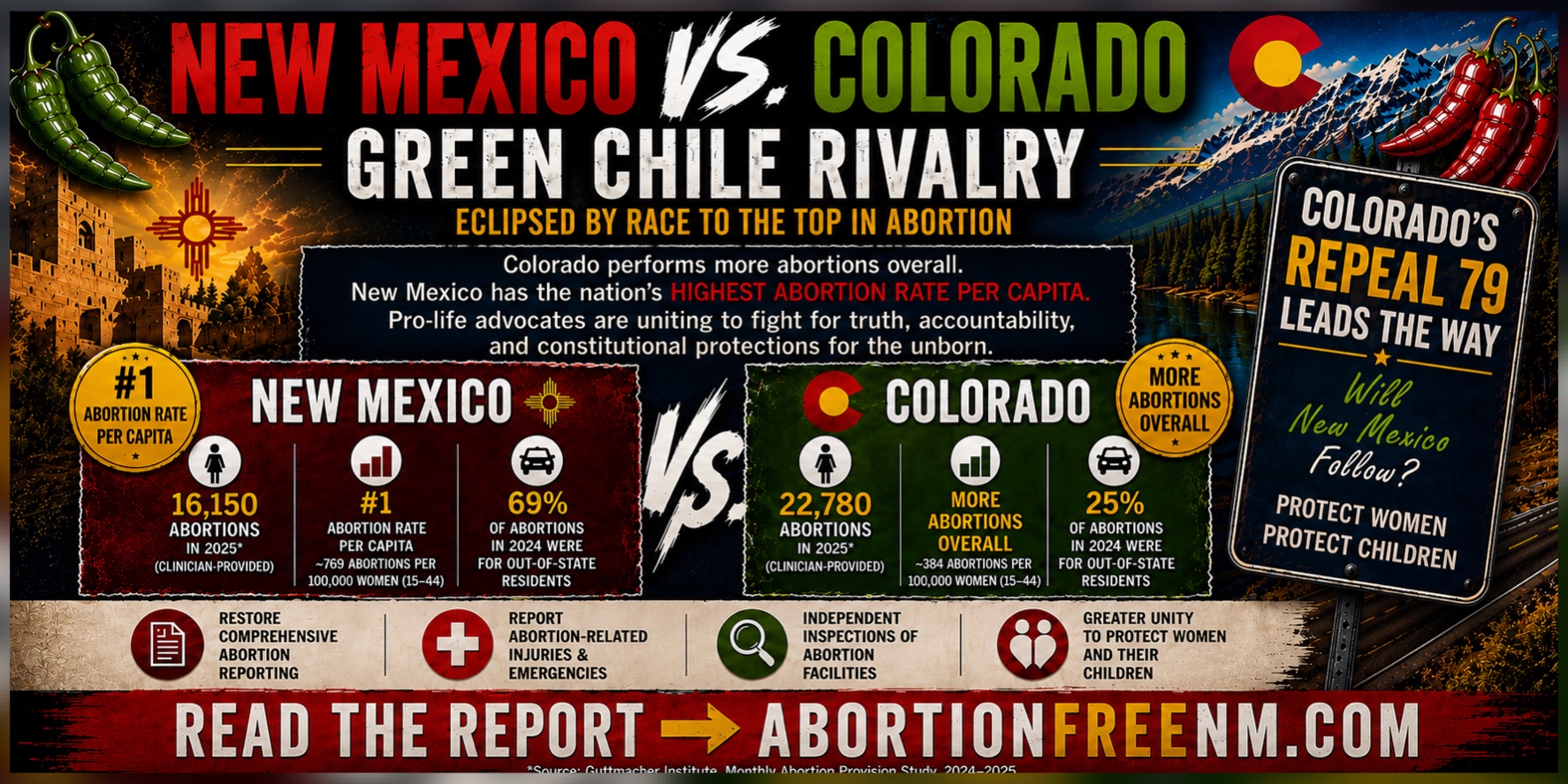
    By Bud Shaver,​ALBUQUERQUE, N.M. — For generations, New Mexico and Colorado have enjoyed a friendly rivalry over green chile. Today, that rivalry has taken a far darker turn.

    According to Guttmacher’s 2025 Monthly Abortion Provision Study, Colorado performed an estimated 22,780 clinician-provided abortions, while New Mexico performed an estimated 16,150. However, Colorado’s population is nearly three times larger than New Mexico’s. When adjusted for population, New Mexico now has the highest abortion rate per capita in the nation. In 2024, Guttmacher estimated that 69% of abortions performed in New Mexico were for out-of-state residents, compared to 25% in Colorado.

    Abortion Free New Mexico recently documented how New Mexico has transitioned from being known as the nation’s late-term abortion capital to becoming America’s abortion capital per capita.While New Mexico has been governed by Democrat majorities for generations, Colorado’s political transformation into a Democratic stronghold was famously chronicled in The Blueprint: How Democrats Won Colorado (and Why Republicans Everywhere Should Care). Today, both states have embraced some of the nation’s most expansive abortion policies while continuing to struggle with violent crime rates that rank among the highest in the country.

    Women Continue to Be Injured

    The race does not end with abortion numbers.

    Operation Rescue’s recent report, Three More Women Injured by Planned Parenthood in Colorado, and Lexi’s Death Still Unanswered, documented three additional ambulance transports from a Planned Parenthood facility in Denver and reported eight abortion-related medical emergencies at that location in less than two years.

    Likewise, Abortion Free New Mexico has documented more than 50 abortion-related medical emergencies and injuries at New Mexico abortion facilities since 2010, raising continuing concerns about transparency, oversight, and patient safety.

    “Colorado may perform more abortions because it has nearly three times New Mexico’s population, but New Mexico still holds the nation’s top spot when population is considered,” said Bud Shaver, Executive Director of Abortion Free New Mexico. “The next question is just as disturbing: Which state is leading in abortion-related injuries? Women deserve transparency—not political protection for the abortion industry.”

    Tara Shaver, leader with Abortion Free New Mexico, added:

    “For decades, New Mexico and Colorado have debated green chile. Sadly, that rivalry is being eclipsed by a race to the top in abortion. No state should aspire to become America’s abortion destination. Real leadership protects both women and their children—not an industry that profits from ending one life while too often putting another at risk.”

    Despite Colorado’s expansive abortion laws, there is hope. Across the state, a growing coalition of pro-life advocates, physicians, churches, pregnancy resource centers, and abortion abolitionists are working together to restore legal protections for unborn children. Organizations such as the Colorado chapter of the American Association of Pro-Life Obstetricians and Gynecologists (AAPLOG), the Repeal 79 campaign, and national watchdogs like Operation Rescueare promoting medical accountability, exposing abortion-related injuries, and advancing constitutional protections for the unborn.

    A Growing Movement for Constitutional Protection

    While Democrats have successfully taken political control of the state state, pro-life advocates and abortion abolitionists are increasingly working together with a common purpose: restoring legal protections for unborn children through constitutional change.
    The Repeal 79 at effort is working to place a constitutional amendment before Colorado voters. The campaign seeks to restore legal protections for unborn children by changing Colorado’s constitution while encouraging churches, families, and citizens to work together in defense of life. Learn more at GotAHeart.org.Abortion Free New Mexico applauds the growing unity among Colorado’s pro-life movement—including abolitionists, pregnancy resource centers, churches, physicians, and pro-life organizations—who are standing together in pursuit of a culture that values every human life.

    “The abortion industry didn’t become this powerful overnight, and restoring a culture of life won’t happen overnight either,” said Bud Shaver. “But history shows that determined citizens can peacefully change the direction of a state.”

    Shaver continued:

    “We applaud the remarkable unity taking place in Colorado as pro-life advocates and abortion abolitionists stand together with one goal—to restore legal protections for unborn children through peaceful, constitutional means. Abortion Free New Mexico stands in solidarity with these efforts because every child deserves equal protection under the law. My hope is that New Mexico will one day restore constitutional protections for preborn children. While New Mexico’s Equal Rights Amendment has been interpreted by the courts to protect abortion access, we affirm that the law should recognize the equal worth, dignity, and protection of both mothers and their unborn children.”

    Abortion Free New Mexico Calls For:

    • The restoration of comprehensive abortion reporting in New Mexico.
    • Mandatory public reporting of abortion-related injuries and emergency transports.
    • Independent inspections of abortion facilities.
    • Meaningful state and federal oversight to ensure transparency and accountability.
    • Greater unity among New Mexico’s pro-life community in advancing peaceful, constitutional efforts that protect both women and their unborn children.

    Read Abortion Free New Mexico’s latest related report:

  • STATE OF EMERGENCY: GUTTMACHER CONFIRMS NEW MEXICO AS THE NATION’S ABORTION CAPITAL

    STATE OF EMERGENCY: GUTTMACHER CONFIRMS NEW MEXICO AS THE NATION’S ABORTION CAPITAL

    By Bud Shaver,​

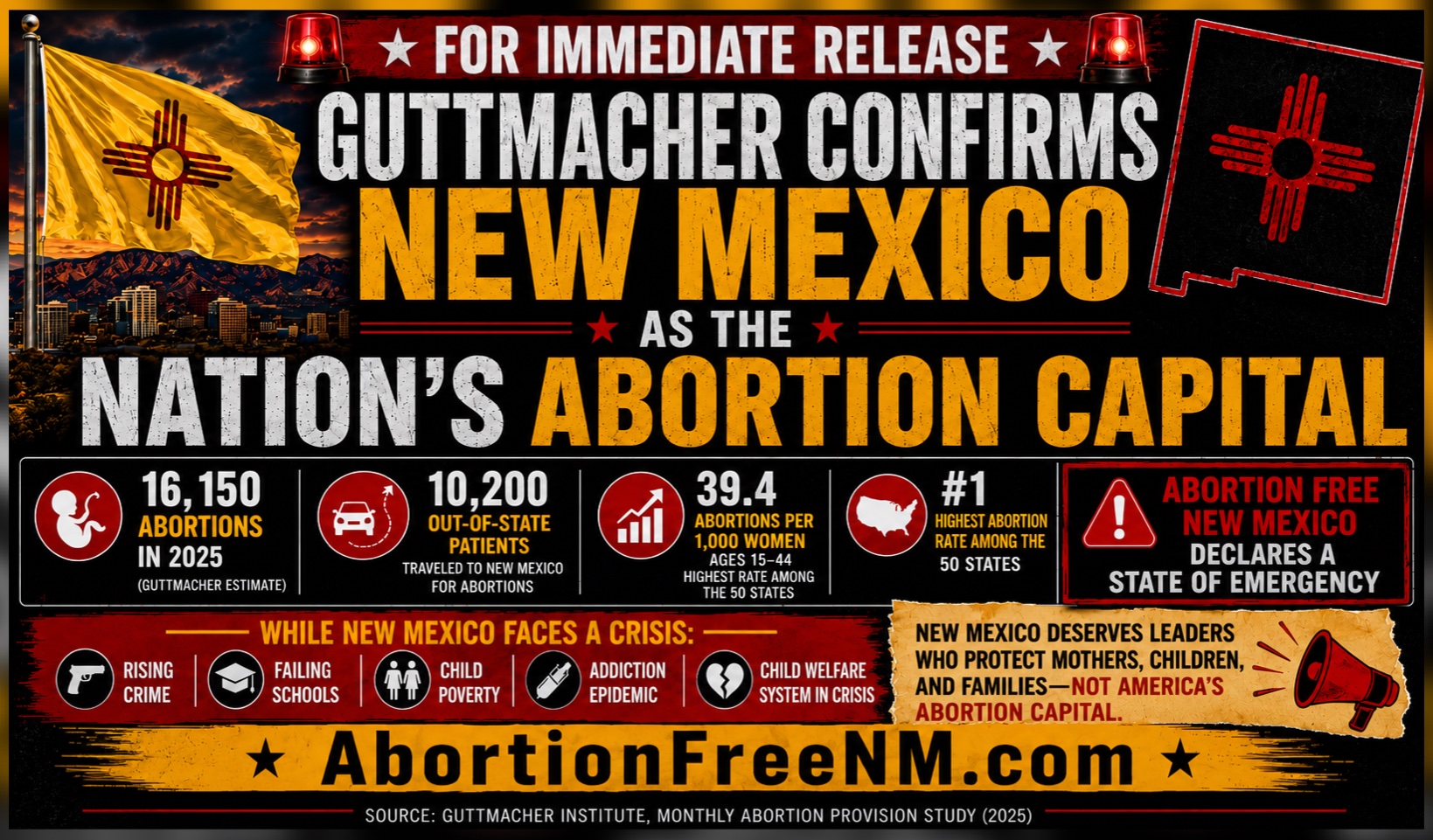
    ALBUQUERQUE, N.M. — According to the Guttmacher Institute’s Monthly Abortion Provision Study (2025)New Mexico had the highest estimated abortion rate among the 50 states, with 16,150 abortions and a rate of 39.4 abortions per 1,000 women ages 15–44. Guttmacher also estimates that approximately 10,200 patients traveled to New Mexico from other states to obtain abortions.

    Source: Guttmacher Institute, Monthly Abortion Provision Study (2025)⁠
    New Mexico:16,150 abortions • 39.4 abortions per 1,000 women (ages 15–44) • #1 abortion rate among the 50 states • Approximately 10,200 out-of-state patients

    Abortion Free New Mexico says these findings confirm what the organization has warned for years:

    NEW MEXICO HAS BEEN CONFIRMED AS THE NATION’S ABORTION CAPITAL

    Abortion Free New Mexico Declares a State of Emergency

    In response to the latest Guttmacher Institute estimates ranking New Mexico #1 in abortion rate among the 50 statesAbortion Free New Mexico is declaring a state of emergency.Tara Shaver, leader with Abortion Free New Mexico, issued the following statement:

    “Abortion Free New Mexico is declaring a state of emergency. New Mexico has become the nation’s abortion capital. While our state struggles with violent crime, failing schools, child poverty, addiction, and a child welfare system in crisis, state leaders continue making abortion their defining public policy priority. New Mexicans deserve leaders committed to protecting children, strengthening families, and restoring public accountability—not expanding the abortion industry.”

    Bud Shaver, Executive Director of Abortion Free New Mexico, added:

    Since 2010, we have warned that New Mexico was becoming the nation’s Late-Term Abortion Capital. Today, the latest Guttmacher estimates show New Mexico has become the nation’s abortion capital. What began as a destination for late-term abortions has evolved into the nation’s highest abortion rate through years of abortion expansion, taxpayer support, and diminished public accountability.”

    Conflicting Abortion Numbers Demand Answers

    The latest Guttmacher estimates also raise new questions about abortion figures recently promoted by Governor Michelle Lujan Grisham.Just weeks ago, Governor Lujan Grisham publicly cited11,512 abortions performed in New Mexico during 2024. Abortion Free New Mexico publicly called on the Governor to identify the source of those figures and provide the underlying data supporting her claims.

    Now, Guttmacher estimates 16,150 abortions during 2025 while ranking New Mexico first in the nation for abortion rate.

    Although these figures represent different reporting years, the latest Guttmacher estimates significantly exceed the Governor’s publicly cited totals and reinforce the urgent need for transparent, comprehensive, and independently verifiable abortion reporting. Since New Mexico eliminated comprehensive public abortion reporting, New Mexicans have increasingly been forced to rely on outside estimates rather than complete official state data.

    Abortion Free New Mexico previously documented these concerns in its investigative report, 

    Governor’s Abortion Numbers Raise Questions After Thousands of Abortions Appear Unaccounted For

    Abortion Free New Mexico publicly calls on Governor Lujan Grisham to identify the source of the abortion figures she promoted because New Mexicans deserve transparency,” said Tara Shaver. “The 2025 Guttmacher estimates only reinforce why comprehensive public abortion reporting must be restored. Transparency should never be optional.”

    Federal Review Has Become Necessary

    New Mexico’s abortion regime has reached the point where meaningful reform should no longer be expected from the officials who created it. After years of expanding abortion access while weakening transparency and public accountabilityfederal review has become necessary. When a state refuses to police itself, outside oversight becomes essential to protect the public interest and ensure compliance with applicable federal law.

    Responding to the State of Emergency

    The 2025 Guttmacher report reinforces years of investigative reporting by Abortion Free New Mexico documenting New Mexico’s transformation into the nation’s leading destination for abortion.Although Guttmacher’s 2025 estimate of 16,150 abortions is lower than its 2024 estimate of 18,130, New Mexico still recorded the highest abortion rate among the 50 states, underscoring that the state remains the nation’s abortion capital despite year-to-year fluctuations in estimated totals.

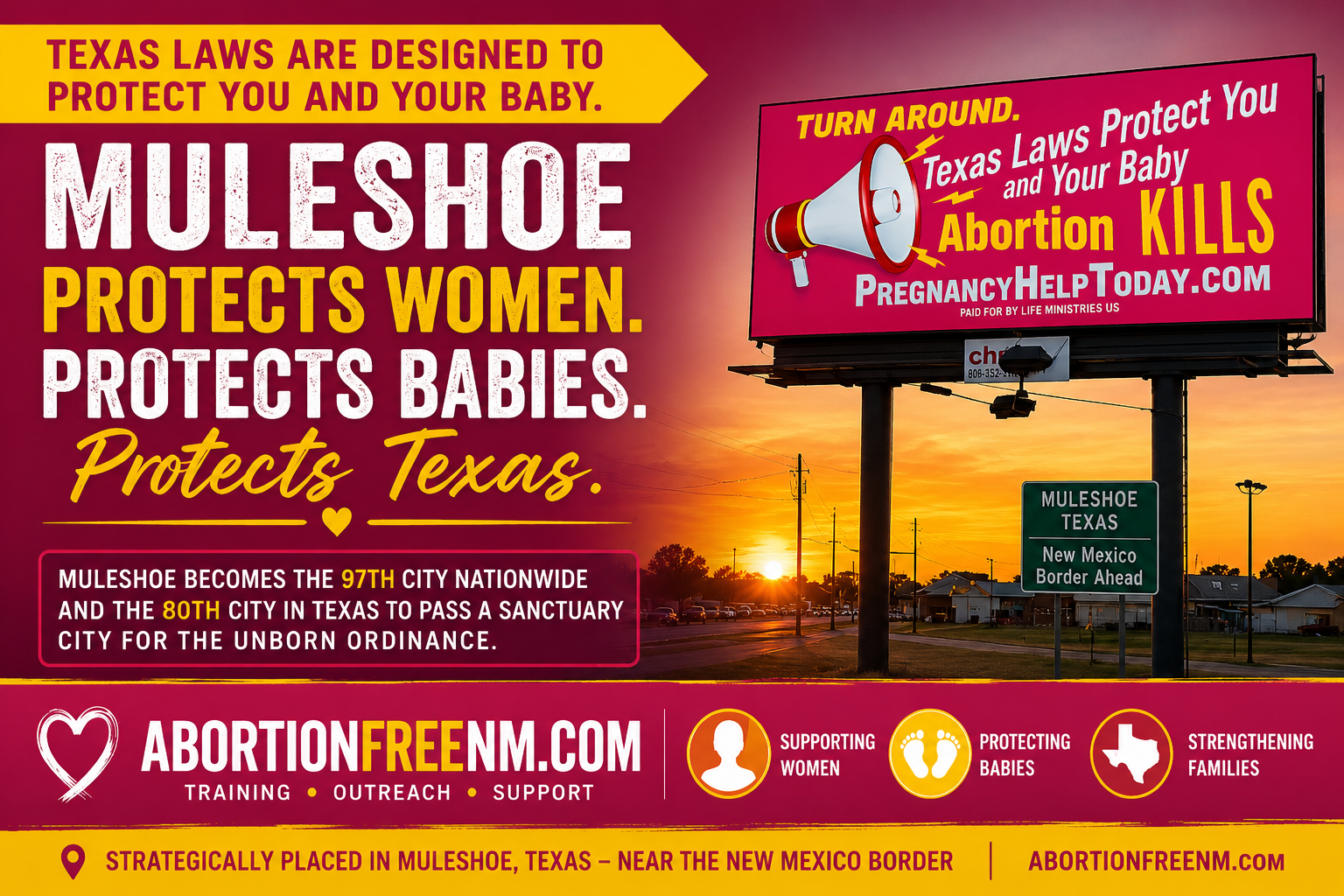
    In response, Abortion Free New Mexico has expanded its public awareness efforts through billboard campaigns, investigative reporting, statewide media outreach, and weekly sidewalk ministry outside all seven Albuquerque abortion facilities.

    Each week, trained volunteers offer prayer, practical assistance, pregnancy resource referrals, financial support, and life-affirming alternatives to women facing unexpected pregnancies.

    Abortion Free New Mexico Calls for Immediate Action

    Abortion Free New Mexico calls for:

    • Immediate restoration of comprehensive, anonymous abortion reporting.
    • Independent inspection of every abortion facility operating in New Mexico.
    • Public disclosure of abortion-related injuries, complications, and adverse events.
    • An end to taxpayer-funded abortion expansion.
    • Federal review of taxpayer funding, interstate abortion practices, and applicable federal health and safety requirements.

    Closing Statement by Tara Shaver

    Abortion Free New Mexico believes the evidence demonstrates that the state’s current leadership has abandoned meaningful oversight of the abortion industry. Until New Mexico restores comprehensive reporting, independent inspections, and public accountability, federal authorities should investigate whether interstate abortion practices, taxpayer funding, abortion-related injuries, and applicable federal health and safety requirements are being properly enforced. New Mexicans deserve leaders focused on addressing the real crises facing our state—not continuing to expand an industry that already operates with diminished transparency.”

    References

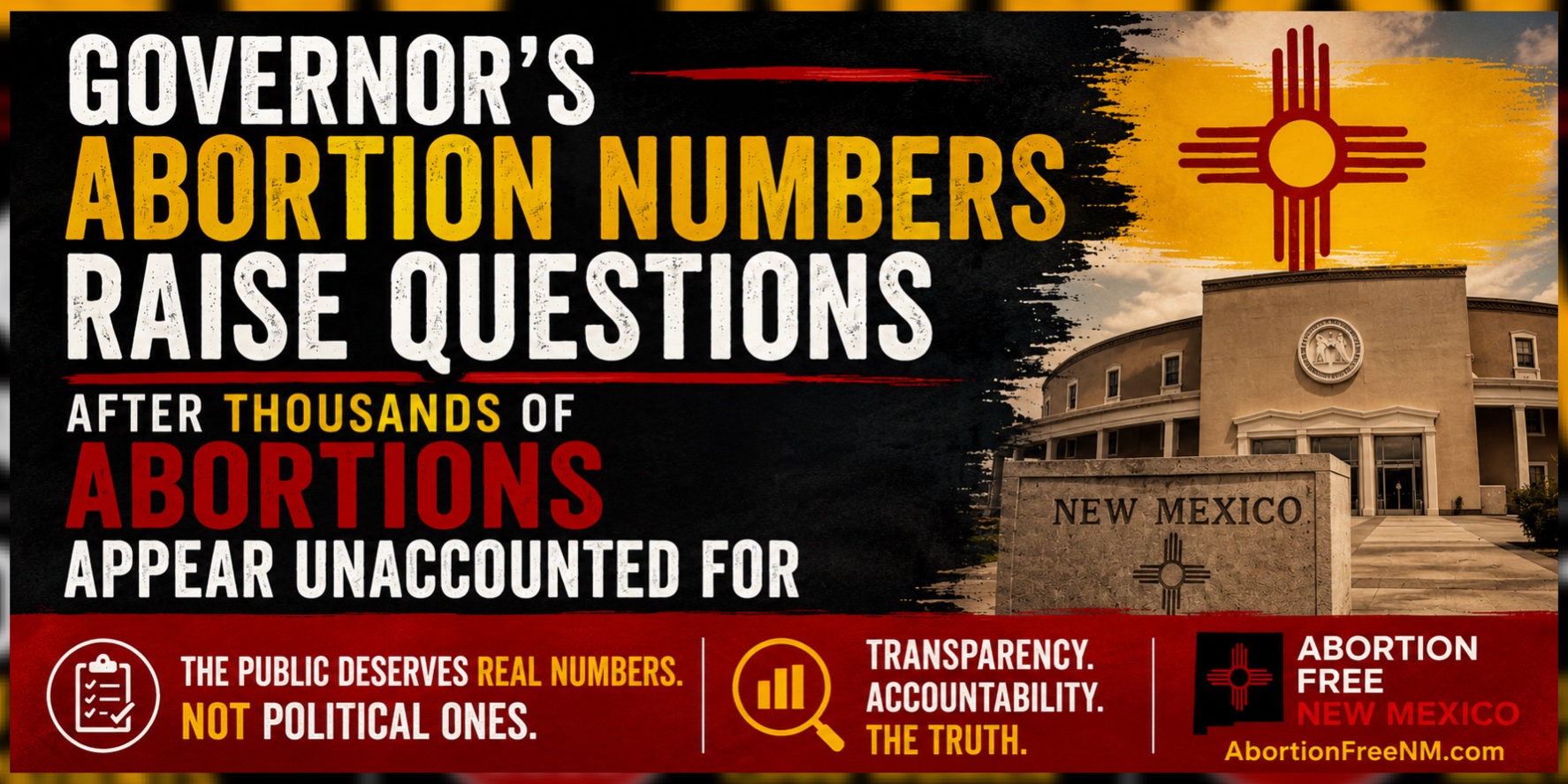
  • GOVERNOR’S ABORTION NUMBERS RAISE QUESTIONS AFTER THOUSANDS OF ABORTIONS APPEAR UNACCOUNTED FOR

    GOVERNOR’S ABORTION NUMBERS RAISE QUESTIONS AFTER THOUSANDS OF ABORTIONS APPEAR UNACCOUNTED FOR

    By Bud Shaver,

    ALBUQUERQUE, NM — Abortion Free New Mexico is calling on Governor Michelle Lujan Grisham to publicly identify the source of the abortion statistics she cited in her June 24, 2026, social media post commemorating the fourth anniversary of the U.S. Supreme Court’s Dobbs decision.

    In that post, the Governor stated that 11,512 patients received abortion care in New Mexico in 2024, with 71% traveling from outside the state, while celebrating New Mexico’s abortion policies.

    ​However, publicly available estimates tell a different story.

    The Santa Fe New Mexican, citing the Society of Family Planning’s #WeCount Projectreported an estimated 18,600 abortions were performed in New Mexico during 2024, with 69% involving out-of-state patients. Likewise, the Guttmacher Institute’s Monthly Abortion Provision Studyestimatedas many as 18,130 clinician-provided abortions in New Mexico during 2024 using its monthly provider reporting methodology, while another Guttmacher report, using a different methodology, estimated approximately 12,700 abortions—further illustrating why New Mexico needs one universal, mandatory state reporting system rather than competing estimates.

    ​“Whether the number is 11,512, 18,130, or 18,600, New Mexicans are being presented with conflicting abortion statistics,” said Tara Shaver, leader with Abortion Free New Mexico. “The Governor should explain where her numbers came from and why they differ so dramatically from other publicly available estimates.”

    ​Reporting Is Not a Burden — It Is Accountability

    Abortion Free New Mexico said the conflicting estimates demonstrate exactly why New Mexico needs a universal, mandatory abortion reporting system administered by the state.

    Both the Society of Family Planning and the Guttmacher Institute rely on abortion providers voluntarily supplying abortion data, supplemented by statistical methodologies where necessary.

    ​“During debate on SB 30, legislators argued that mandatory reporting to the State of New Mexico was too burdensome,” Shaver said. “Yet abortion providers are already voluntarily reporting abortion data to private organizations like the Society of Family Planning and the Guttmacher Institute. If providers can report to private organizations every month, they can report to the people of New Mexico. Reporting is not a burden—it is accountability.”

    During House committee testimony on SB 30, a Planned Parenthood representative acknowledged that New Mexico’s abortion statistics have not been publicly reported since 2019, despite state law requiring annual reports. The representative stated that responsibility for publishing those reports rested with the New Mexico Department of Health Registrar and indicated reporting ceased during the COVID-19 pandemic.

    Representative Alan Martínez questioned why the reporting law had not been followed. Rather than restoring compliance, the Legislature ultimately repealed the reporting statute through SB 30.

    ​“That testimony exposed the problem,” Shaver said. “If abortion providers have been voluntarily reporting abortion data to private organizations while the state’s own reporting system has gone unused since 2019, how can New Mexicans independently verify any of these numbers?”

    ​A Glaring Contradiction

    ​Abortion Free New Mexico also questioned why state leaders argued against mandatory reporting while the Governor now publicly releases abortion statistics when promoting New Mexico’s abortion policies.

    ​“If the Governor is going to release abortion numbers on social media to advance her political agenda, then the public deserves access to the underlying data,” Shaver said. “You cannot eliminate transparency and then expect New Mexicans to simply accept whatever numbers politicians choose to release.”

    ​Shaver also criticized what she described as a double standard surrounding abortion data.

    ​“When organizations like ours publish abortion statistics or document the expansion of the abortion industry, we’re accused of violating confidentiality or engaging in harassment,” Shaver said. “But when the Governor releases abortion numbers, those same statistics are presented as achievements to celebrate. New Mexicans deserve one standard of transparency—not selective transparency.”

    ​Questions for the Governor

    Abortion Free New Mexico is calling on Governor Lujan Grisham to answer three questions:

    • What is the source of the 11,512 abortion figure cited in the June 24 social media post?
    • Why does that figure differ from other publicly reported estimates for 2024?
    • Will the Governor support restoring universal, mandatory abortion reporting so every abortion provider reports standardized data directly to the State of New Mexico?

    ​“This debate is larger than one statistic,” Shaver concluded. “It is about whether New Mexico will have one transparent, accountable reporting system that everyone can trust. The public should not have to choose between competing private estimates and political press releases. If the Governor is going to publicly celebrate abortion numbers, then every New Mexican deserves access to complete, verifiable data collected through a universal, mandatory state reporting system.”

    ​About Abortion Free New Mexico

    Abortion Free New Mexico works to end abortion through investigative research, public exposure, accountability efforts, and direct outreach to women and families. Through sidewalk outreach, pregnancy assistance, and educational initiatives, the organization seeks to build a culture where every preborn child is valued and protected.

  • ABORTION FREE NEW MEXICO RESPONDS TO GOVERNOR LUJAN GRISHAM’S CELEBRATION OF EXPANDED ABORTION PILL ACCESS

    ABORTION FREE NEW MEXICO RESPONDS TO GOVERNOR LUJAN GRISHAM’S CELEBRATION OF EXPANDED ABORTION PILL ACCESS

    By Bud Shaver,

    ALBUQUERQUE, N.M. — Following Governor Michelle Lujan Grisham’s June 8 social media statement celebrating expanded abortion-pill access and New Mexico’s abortion policies, Abortion Free New Mexico is challenging the Governor’s characterization of abortion expansion as a public health success.

    According to AFNM’s previous reporting63% of all abortions performed in New Mexico in 2023 were committed using abortion pills, making chemical abortion the dominant method of abortion in the state.
    ​AFNM argues that the Governor’s statement omitted critical facts about abortion-pill risks, ongoing litigation surrounding their distribution, and New Mexico’s continued efforts to reduce public accountability.

    Abortion Pills Carry the FDA’s Strongest Warning

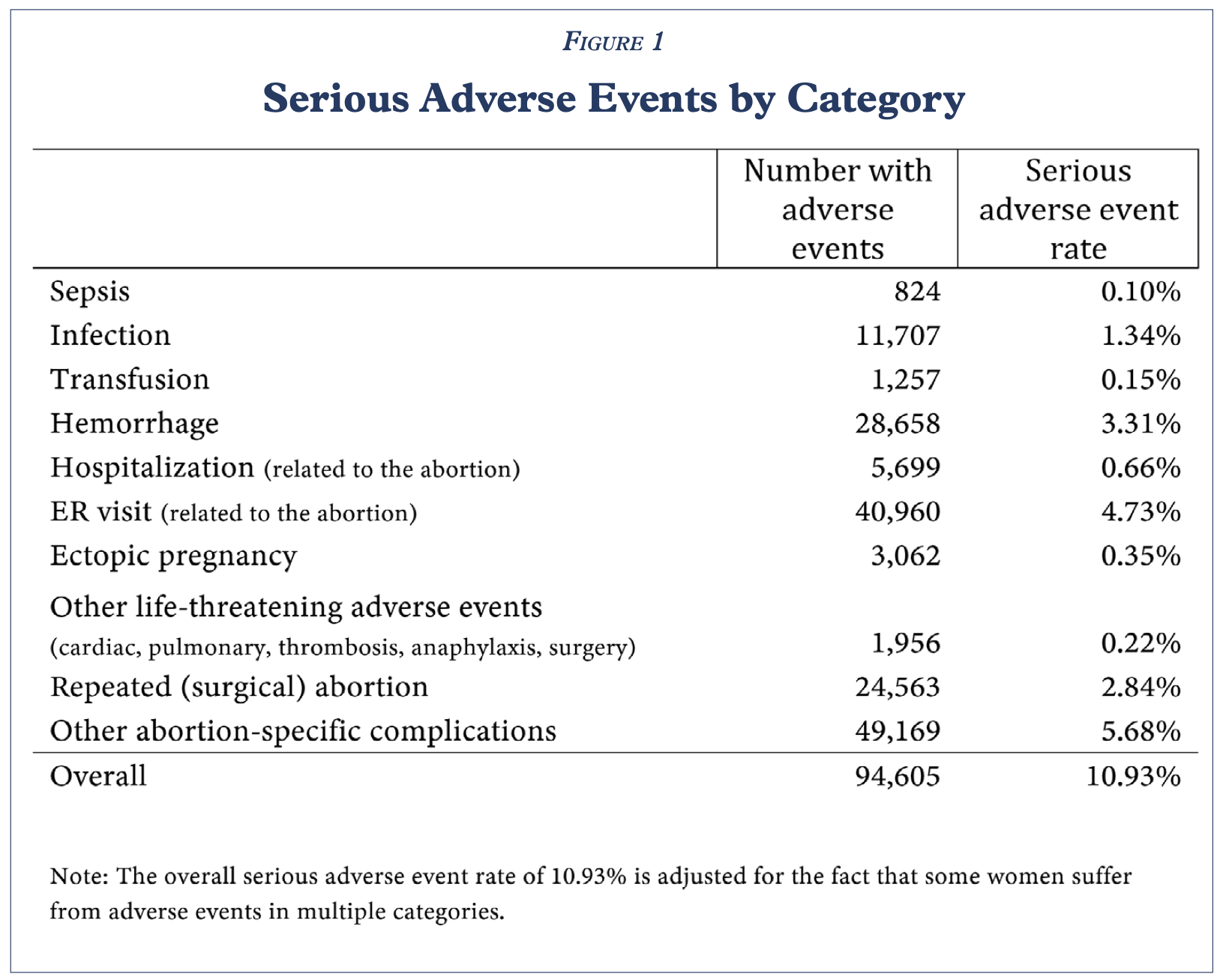
    Although mifepristone has been FDA-approved for more than twenty years, the abortion pill carries the FDA’s Black Box Warning—the agency’s strongest safety warning—due to risks including 

    hemorrhage, serious infection, sepsis, and other potentially life-threatening complications.

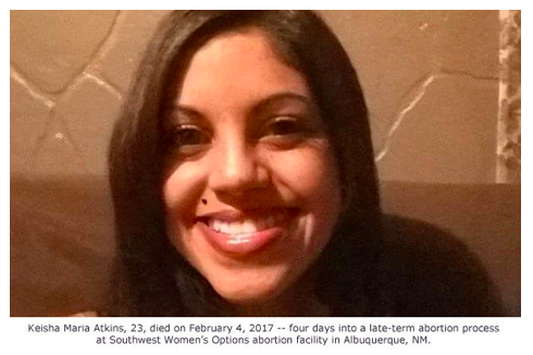
    Abortion Free New Mexico has also documented that abortion facilities across New Mexico advertise abortion pill services beyond the FDA-approved ten-week protocol, with facilities currently promoting abortion-pill abortions through 11 weeks, 11 weeks 6 days, and 12 weeks of pregnancy.AFNM has documentedmore than 50 abortion-related injuries and medical emergencies at New Mexico abortion facilities, including at least one woman’s death.

    “The Governor says this issue is personal for women. We agree,” said Tara Shaver of Abortion Free New Mexico. “That is precisely why women deserve complete information about the risks, complications, and realities of abortion pills—not political talking points that ignore the FDA’s strongest safety warning.”

    ​“An industry associated with documented injuries, medical emergencies, and at least one woman’s death should not be celebrated,” Shaver continued. “It should be subject to scrutiny, accountability, and ultimately replaced with policies that protect both women and their children.”

    Louisiana Acted. New Mexico Celebrated.

    The Governor’s statement comes amid continuing legal battles over abortion-pill distribution and renewed scrutiny of abortion-pill policies nationwide.

    Concerns raised in those cases included the removal of in-person safeguards, expanded mail-order distribution, adverse-event reporting, and whether adequate protections exist for women experiencing complications from abortion pills.

    Those concerns were significant enough that states such as Louisiana pursued legal action and supported efforts to restore greater safeguards and accountability surrounding abortion-pill distribution.

    “Louisiana acted to protect women and preserve safeguards surrounding a drug that carries the FDA’s strongest warning. New Mexico chose the opposite path,” said Shaver.

    Abortion Access Expands While Transparency Shrinks

    AFNM argues that New Mexico has increasingly positioned itself as a destination for abortion following the Dobbs decision.

    State leaders have welcomed abortion providers relocating from other states, supported taxpayer-funded abortion initiatives and abortion-related infrastructure projects, and recently enacted SB 30, eliminating statewide abortion reporting requirements.

    AFNM currently documents approximately 15 freestanding abortion facilities statewide, including facilities that relocated to New Mexico following abortion restrictions elsewhere.

    “New Mexico is no longer simply maintaining abortion access—it is actively expanding abortion infrastructure while reducing public accountability,” said Shaver.

    Statement from Tara Shaver, Abortion Free New Mexico

    “Governor Lujan Grisham says she has protected access to reproductive healthcare, but increasingly it appears that abortion access has been prioritized at the expense of women’s health and public accountability.When concerns were raised about abortion-pill safety and distribution, Louisiana pursued greater safeguards. New Mexico chose expansion. Today, abortion pills account for 63% of all abortions in New Mexico despite carrying the FDA’s Black Box Warning—the agency’s strongest safety warning—for hemorrhage, serious infection, sepsis, and other potentially life-threatening complications. Some New Mexico abortion providers continue advertising abortion-pill use beyond FDA-approved protocols.​At the same time, New Mexico has eliminated abortion reporting requirements, expanded abortion infrastructure, welcomed abortion providers from other states, and reduced public transparency. Abortion Free New Mexico has documented more than 50 abortion-related injuries and medical emergencies, including a documented woman’s death, yet state leaders continue shielding the abortion industry from meaningful oversight and accountability.If abortion is truly healthcare, it should be subject to the same transparency, safety standards, reporting requirements, and accountability expected of every other area of medicine. Instead, New Mexico is moving in the opposite direction—expanding abortion access while reducing oversight and public scrutiny.Healthcare welcomes accountability. Ideology resists it.An industry associated with documented injuries, medical emergencies, and death should not be celebrated. New Mexico should be working to ban abortion pills, ban abortions, protect women, and protect children—not celebrate the continued expansion of the abortion industry.”

    RELATED:

  • VIDEO: PLANNED PARENTHOOD ESCORTS OBSTRUCT DIALOGUE AS VOLUNTEERS OFFER ALTERNATIVES OUTSIDE ALBUQUERQUE FACILITY

    VIDEO: PLANNED PARENTHOOD ESCORTS OBSTRUCT DIALOGUE AS VOLUNTEERS OFFER ALTERNATIVES OUTSIDE ALBUQUERQUE FACILITY

    By Bud Shaver,

    ALBUQUERQUE, N.M. — Abortion Free New Mexico is highlighting what it describes as a stark contrast between abortion industry escorts and pro-life volunteers following a recent interaction outside the Planned Parenthood facility on Eubank Boulevard in Albuquerque.

    Video recorded during the outreach shows an Abortion Free New Mexico sidewalk counselor respectfully asking Planned Parenthood escorts to turn down amplified music and engage in an intelligent, respectful conversation about abortion and the alternatives available to women entering the facility.

    ▶VIEW VIDEO FOOTAGE BELOW

    Video footage recorded outside Albuquerque’s largest Planned Parenthood facility documenting interactions between Planned Parenthood escorts and volunteers offering life-affirming resources, practical assistance, and support to women facing unexpected pregnancies.

    Rather than engaging in meaningful dialogue, members of the sidewalk team  were met with mockery and ridicule. During the exchange, one escort repeatedly claimed that the volunteers were “stopping women from getting healthcare.”

    An Abortion Free New Mexico volunteer responded,

    “Abortion is not healthcare. Abortion hurts women. Abortion kills babies.”

    The escort then replied,

    “You are being ignorant.”

    The sidewalk volunteer went on to explain the extensive support available through Abortion Free New Mexico and its network of community partners, including pregnancy resources, financial assistance, baby supplies, mentoring, housing referrals, adoption information, and ongoing support for women facing unexpected pregnancies.

    According to Abortion Free New Mexico, however, the escorts’ use of umbrellas, amplified sound, and other obstructive tactics prevented many women from hearing about these life-affirming alternatives and available resources.

    “Women deserve access to information, not obstruction,” said Tara Shaver of Abortion Free New Mexico. “Our volunteers were willing to have a respectful conversation, explain their position, and share the practical help available to women in crisis. Instead of dialogue, they were met with ridicule and tactics designed to prevent women from hearing about alternatives to abortion.”

    Shaver said the encounter demonstrates two fundamentally different approaches to women facing difficult pregnancies.

    “One side showed up with umbrellas, speakers, and efforts to drown out conversations,” Shaver said. “The other showed up with resources, financial assistance, baby supplies, prayer, and a commitment to walk alongside women long after a difficult moment has passed. That is the difference between a culture of death and a culture of life.”

    The organization emphasized that its volunteers regularly offer practical assistance through its Life Fund and community partnerships, helping women access material support, mentorship, transportation assistance, pregnancy services, and other resources designed to help both mother and child thrive.

    “When escorts actively work to prevent women from hearing about alternatives, they are not expanding choices—they are limiting them,” Shaver said. “Women deserve to hear every option available to them before making a life-altering decision.”

    The incident occurred outside Albuquerque’s largest Planned Parenthood facility, where Abortion Free New Mexico says volunteers routinely encounter efforts to block communication with women entering the abortion center.

    “If abortion is truly healthcare, there should be no fear of open discussion, informed consent, or women hearing about alternatives,” Shaver said. “Our team will continue showing up with compassion, practical help, and the hope found in Jesus Christ. Every woman deserves to know that she is not alone. Every woman deserves to know that help is available.”

    Abortion Free New Mexico is encouraging the public to follow Sidewalk Team – Abortion Free New Mexico on Facebook and @sidewalkteam_AbortionFreeNM on Instagram for updates from the front lines of sidewalk outreach.

    Abortion Free New Mexico is also inviting supporters to attend its upcoming Sidewalk Outreach Training to learn how to compassionately engage women facing unexpected pregnancies and connect them with life-affirming resources. 

    ABOUT ABORTION FREE NEW MEXICO

    Abortion Free New Mexico works to end abortion through investigative research, public exposure, accountability efforts, and direct outreach to women and families. Through sidewalk counseling, pregnancy assistance, and educational initiatives, the organization seeks to build a culture where every preborn child is valued and protected.

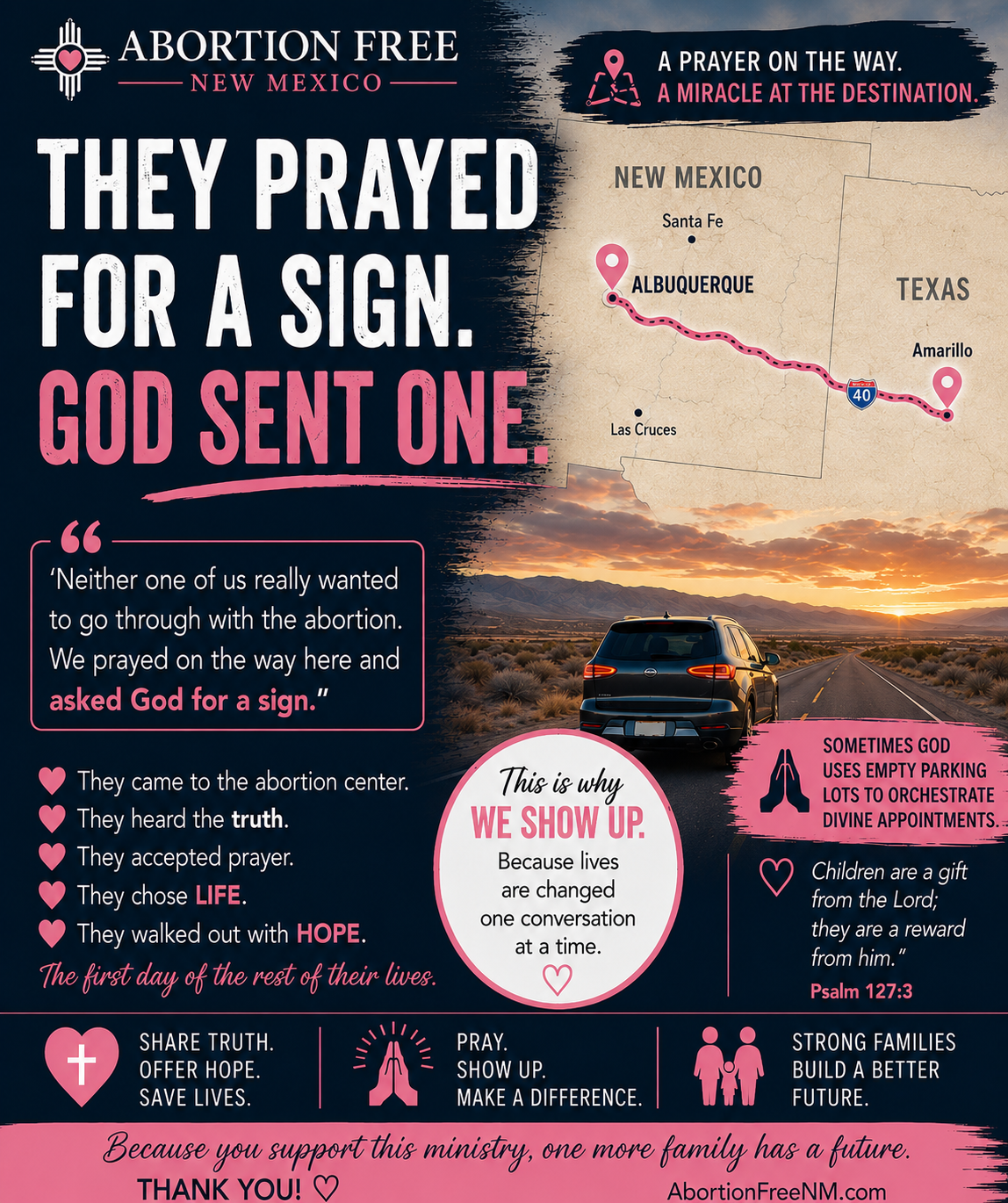
  • THEY PRAYED FOR A SIGN. GOD SENT ONE

    THEY PRAYED FOR A SIGN. GOD SENT ONE

    Dear Pro-Life Friends and Supporters,

    Today, Saturday June 6, 2026, we witnessed a powerful reminder of why we faithfully show up on the sidewalks.

    Outside one of Albuquerque’s busiest abortion facilities, Tara noticed only one vehicle in the parking lot. What she couldn’t see was that God had already arranged a divine appointment.

    A young couple from Amarillo, Texas, had driven to Albuquerque seeking an abortion. As Tara approached them with a Bible, a fetal model, and an offer to pray, tears filled the young mother’s eyes.

    When Tara asked what she believed God would want her to do, she answered immediately:

    “God would want me to keep my baby.”

    As they talked, the couple shared that during their drive they had prayed together and asked God for a sign. Neither of them truly wanted to go through with the abortion, but they couldn’t see another way forward.

    They spoke about their faith, their supportive families, and their future together. As the conversation unfolded, fear gave way to hope.

    When I asked what they planned to do, the young man smiled and said:

    “We’re not going to go through with the abortion.”

    Praise God!

    Before leaving, both of them embraced Tara in a heartfelt hug. In that moment, it was impossible not to recognize what had happened.

    A couple prayed for a sign. God sent one.

    This is why we stand on the sidewalks. Every week, men and women arrive carrying burdens, fears, and questions. Sometimes all it takes is one faithful Christian willing to offer truth, hope, prayer, and practical help.

    Could God Use You to Be the Answer to Someone’s Prayer?

    Join us for our upcoming Sidewalk Counseling Training:

    Whether you’re new to sidewalk outreach or looking to grow in confidence, we’ll equip you to engage abortion-vulnerable women and families with grace, truth, and compassion.

    The next person praying for a sign may be waiting for someone just like you.

    Please pray for this young couple and their baby—that they would stand firm, grow closer to God, and experience the love and support they need as they welcome their child into the world.

    Thank you for your prayers and faithful support. Together, we are witnessing lives saved, families strengthened, and hearts transformed by God’s grace.

    For Life,

    Bud & Tara Shaver
    Abortion Free New Mexico

     AbortionFreeNM.com

  • OPINION PART THREE: DON’T BE POLITICAL – UNLESS IT’S THE RIGHT POLITICS

    OPINION PART THREE: DON’T BE POLITICAL – UNLESS IT’S THE RIGHT POLITICS

    By Bud Shaver

    In Part Two of this series, I examined how many New Mexico churches have retreated from the public square under the familiar refrain, “We don’t want to be political.” Yet recent events reveal a contradiction that is becoming increasingly difficult to ignore. Certain churches and religious leaders are not avoiding politics at all. Rather, they appear selective about which political issues—and which politicians—receive their public attention.

    Few examples illustrate this more clearly than the ongoing debate over immigration. Across New Mexico, church leaders and religious institutions have openly engaged immigration policy, issued public statements, encouraged advocacy efforts, and criticized various immigration enforcement policies advanced by President Donald Trump and his administration. Whether one agrees with those positions is beside the point.  The reality is that these leaders believe faith has a legitimate role in shaping public policy–and they are willing to engage publicly on issues they consider matters of moral importance.

    The pattern is not limited to Catholic leaders. Episcopal leaders, mainline Protestant denominations, interfaith coalitions, and religious advocacy organizations have likewise spoken publicly against various immigration enforcement policies, often framing their positions as matters of faith, justice, and moral responsibility. Regardless of one’s view on immigration policy, these examples demonstrate that many religious leaders believe faith has an important role to play in shaping public debates and influencing public policy.

    Tara Shaver of Abortion Free New Mexico observes:

    “When church leaders publicly challenge President Trump’s immigration policies, nobody argues that faith should stay out of politics. But when Christians speak about abortion, suddenly they’re told the Church should remain neutral. The issue isn’t whether churches engage politics. The issue is why faith is welcomed into some policy debates while excluded from others involving the most basic right of all—the right to life.”

    At the same time, New Mexico has experienced one of the most dramatic expansions of abortion access in the nation. Through investigative reporting, public records requests, legislative monitoring, and field research, Abortion Free New Mexico has documented the growth of abortion facilities, taxpayer-funded abortion infrastructure, abortion tourism, interstate abortion trafficking networks, and the repeal of statewide abortion reporting requirements through SB 30.

    These developments were debated in legislative hearings, documented through public records, and extensively covered at AbortionFreeNM.com. Yet while immigration policy generated public statements, advocacy campaigns, and political engagement from many religious leaders, abortion expansion often generates comparatively little public response.

    The contradiction becomes even more striking when some of New Mexico’s most prominent Catholic politicians publicly invoke faith while advancing abortion policies that have transformed New Mexico into one of the most abortion-friendly states in America. During debate surrounding SB 30, Senator Cindy Nava publicly referenced her Catholic faith while defending legislation that repealed New Mexico’s abortion reporting requirements.

    That moment illustrated one of the central tensions explored in this article. Faith was not being excluded from the debate—it was being invoked in support of a policy that reduced public abortion transparency. Many Christians are left wondering why faith is welcomed when used to defend abortion-related policies but often criticized when used to advocate for unborn children, abortion transparency, or greater public accountability.

    At the same time, Governor Michelle Lujan Grisham and numerous legislators who publicly identify as Catholic have supported policies that include abortion expansion, abortion shield protections, taxpayer-funded abortion facilities, and the repeal of abortion reporting requirements.

    To be fair, this is not simply a Catholic-versus-Evangelical issue. Archbishop John Wester, the New Mexico bishops, Fr. Larry Brito and St. Anne Parish, Legacy Church, and many other faithful leaders deserve recognition for publicly affirming the sanctity of human life and demonstrating that courageous public witness is still possible.

    Yet many Christians are left asking an uncomfortable question: If church leaders are willing to publicly challenge presidents, federal agencies, and elected officials on immigration and other policy matters, why is there comparatively little public accountability directed toward politicians who continue advancing abortion expansion in New Mexico?

    The inconsistency is not merely about issues. It is also about accountability.

    Legacy Church in Albuquerque has consistently encouraged civic participation, hosted nationally recognized speakers such as Charlie Kirk, and welcomed Abortion Free New Mexico to conduct sidewalk outreach and counseling training seminars. Likewise, Fr. Larry Brito and St. Anne Parish in Santa Fe demonstrated a willingness to publicly defend pro-life principles despite significant criticism and controversy.

    These examples demonstrate that public engagement is possible. The concern raised in this series is not that every church is silent. Rather, the concern is that courageous public engagement on behalf of unborn children has increasingly become the exception rather than the expectation.

    As Tara Shaver concludes:

    “Some churches have demonstrated tremendous courage by engaging difficult issues regardless of the political consequences. Archbishop John Wester, the New Mexico bishops, and many Catholic leaders have consistently affirmed the sanctity of human life. Likewise, Legacy Church has demonstrated that public engagement is possible by encouraging civic participation, hosting nationally recognized speakers, and opening its doors to Abortion Free New Mexico for pro-life outreach and training.”

    “The issue isn’t whether churches engage politics. Many already do. The question is whether that same moral courage will be applied consistently—to political issues, political leaders, and public policies alike.”

    “If faith has a place in challenging presidents, it has a place in confronting abortion. If faith has a place in shaping public policy, it has a place in defending unborn children. And if faith belongs in debates about justice, it belongs in debates about life. New Mexico’s unborn children deserve a Church—and people of faith—willing to speak with the same courage, conviction, and consistency they bring to every other issue.”

    When faith is welcomed in some public debates but discouraged in others, people inevitably begin to wonder whether the standard is Scripture or politics dressed in religious language.

    That is a question New Mexico’s churches can no longer afford to ignore.

    RELATED ARTICLES:

  • EXPOSED: NEW MEXICO FAITH-BASED ABORTION ACTIVISTS TIED TO INTERSTATE FLIGHT NETWORK

    EXPOSED: NEW MEXICO FAITH-BASED ABORTION ACTIVISTS TIED TO INTERSTATE FLIGHT NETWORK

    By Bud Shaver,

    ​ALBUQUERQUE, NEW MEXICO — An explosive international report published by France’s largest newspaper is drawing global attention to New Mexico’s growing role as a hub for coordinated interstate abortion infrastructure operations — including the involvement of Albuquerque-based Faith Roots Reproductive Action, formerly known as the New Mexico Religious Coalition for Reproductive Choice.

    The report comes as SB 30 has now officially taken effect in New Mexico, eliminating statewide abortion reporting requirements and further reducing public transparency surrounding abortion activity in the state. The law effectively dismantled a longstanding system used to track anonymous abortion data and statewide abortion trends.

    At the same time, New Mexico politicians continue expanding taxpayer-funded abortion infrastructure projects while national abortion organizations increasingly coordinate transportation, lodging, and financial support systems designed to move women from pro-life states into New Mexico for abortions.

    On May 24, French newspaper Le Monde published an article titled “In the United States, a Network of Airplane Pilots Helps Women Awaiting Abortions,” detailing the operations of Elevated Access — a rapidly expanding volunteer pilot network transporting women across state lines for abortions and gender-transition procedures.

    According to the report, Elevated Access operates with approximately 500 volunteer pilots and an annual budget reportedly nearing $2 million. The organization coordinates flights for women traveling from pro-life states like Texas into abortion-friendly states such as New Mexico.

    The article states that approximately sixty abortion-rights organizations now utilize Elevated Access services, including organizations based in New Mexico.

    One of those organizations is Albuquerque-based Faith Roots Reproductive Action.

    Faith Roots — formerly operating under the name New Mexico Religious Coalition for Reproductive Choice — openly promotes abortion through religious messaging and activist faith organizing.

    Le Monde quoted Faith Roots Executive Director Amanda Diaz stating:

    “When they claim that abortion is a sin, our members respond that abortion is a right for families.”

    Diaz further acknowledged the dramatic increase in abortion-related assistance following the fall of Roe v. Wade:

    “We used to help about 20 people a month when the right to abortion was still guaranteed. Now it’s more like 60 to 70.”

    Abortion Free New Mexico (AFNM) says the article confirms that New Mexico has become deeply embedded in a sophisticated post-Roe abortion-access infrastructure involving transportation networks, activist nonprofits, abortion funds, logistical coordination systems, donor-backed organizations, and politically connected activist operations designed to move women from pro-life states into abortion-friendly jurisdictions.

    Faith Roots Reproductive Action is part of the broader Religious Coalition for Reproductive Choice network, which has historically received funding support from major progressive philanthropic organizations, including entities connected to George Soros’ Open Society Foundations and other nationally connected donor networks, according to publicly available nonprofit grant disclosures and funding records.

    Abortion Free New Mexico says the involvement of nationally connected donor networks further demonstrates that New Mexico’s abortion expansion is being fueled not only by local activism, but also by well-funded national political and ideological organizations supporting interstate abortion-access operations.

    Abortion Free New Mexico has also previously documented how celebrity-backed abortion funds, billionaire-connected donor networks, and national activist organizations are helping finance abortion travel into New Mexico through airfare assistance, lodging support, transportation coordination, and interstate logistical operations.

    Related Investigative Reports by AFNM:

    “This report exposes the disturbing reality that organizations operating under the banner of ‘faith’ are actively helping build interstate abortion pipelines into New Mexico,” ​

    said Tara Shaver, spokesperson for  Abortion Free New Mexico.

    “When abortion activists claim abortion is not a sin, they are attempting to redefine evil itself. You cannot claim the name of faith while organizing transportation networks to help kill unborn children. Abortion is violence against innocent human life, and Scripture is clear that shedding innocent blood is a sin.”

    Shaver continued,

    “These are not isolated local activists operating independently. This is part of a larger, well-funded ideological movement involving billionaire-backed donor networks, political organizations, abortion funds, transportation systems, and activist nonprofits working together to expand abortion access across state lines.”

    Abortion Free New Mexico warned that the use of religious language to justify abortion represents a direct contradiction of historic Christian teaching regarding the sanctity of human life.

    The Le Monde article also profiled a 76-year-old volunteer pilot identified as “Clyde,” who reportedly flies women between Texas and New Mexico through Elevated Access while expressing confidence that local Texas anti-trafficking ordinances will not stop their operations.

    According to the report, the pilot compared potential enforcement efforts to civil-rights-era arrests and suggested federal protections would ultimately shield abortion-related transportation activity from legal consequences.

    Abortion Free New Mexico strongly rejects those claims.

    “These activists are not merely offering rides,”

    Shaver continued.

    “They are building coordinated interstate systems designed to move women across state lines for the purpose of ending unborn human life while attempting to shield themselves behind nonprofit structures, donor networks, and political activism.”

    The organization also noted that more than 70 Texas cities, along with multiple counties, have now adopted Sanctuary City for the Unborn ordinances or related measures prohibiting abortion trafficking through private civil enforcement mechanisms.

    Earlier this monthMuleshoe, Texas became one of the latest Texas cities to criminalize abortion trafficking, with local officials voting 4–1 to pass a Sanctuary City for the Unborn ordinance.

    During public testimony before the vote, Tara Shaver of Abortion Free New Mexico warned that New Mexico’s expanding abortion infrastructure and interstate transportation systems are increasingly impacting neighboring states and exposing vulnerable women and minors to coordinated abortion-access networks operating across state lines.

    The effort was spearheaded by Mark Lee Dickson, founder of the  Sanctuary Cities for the Unborn Initiative, which has worked with communities across the nation to pass local ordinances prohibiting abortion trafficking and related abortion-support activities.

    “As more Texas cities and counties adopt ordinances prohibiting abortion trafficking and interstate abortion coordination, organizations helping facilitate these transportation networks are raising increasingly serious legal and ethical questions that deserve full public scrutiny and investigation,”

    said Shaver.

    “No organization should assume it is immune from accountability simply because it operates under nonprofit or religious branding.”

    Abortion Free New Mexico is also calling for increased scrutiny regarding whether organizations actively facilitating abortion travel and abortion-access coordination should continue receiving nonprofit tax-exempt protections.

    “Faith-based organizations helping coordinate abortion transportation networks while working to circumvent existing state laws protecting unborn children should face serious scrutiny regarding their nonprofit tax-exempt status,”

    Shaver added. ​

    “Americans should not be forced to subsidize organizations facilitating the destruction of innocent human life under the guise of charity or religion.”

    Abortion Free New Mexico is also calling for increased scrutiny regarding whether organizations actively facilitating abortion travel and abortion-access coordination should continue receiving nonprofit tax-exempt protections.

    Abortion Free New Mexico further warned that the article comes amid growing concerns over New Mexico’s emergence as a national abortion destination state.

    “As SB 30 now takes effect and New Mexico eliminates abortion reporting requirements, international media outlets are simultaneously documenting how activist transportation networks are openly coordinating abortion travel into our state,” ​

    Shaver said.

    “The abortion industry is evolving into a coordinated interstate operation, and New Mexico politicians are helping create the environment where it can thrive.

    The people of New Mexico deserve transparency regarding the organizations, donors, political networks, and transportation systems helping build an interstate abortion infrastructure centered in New Mexico.

    Public funding requires public accountability.”


    For more information and investigative reports, visit:
    Abortion Free New Mexico Newsroom

  • OPINION PART TWO: “WE DON’T WANT TO BE POLITICAL”: HOW NEW MEXICO CHURCHES SURRENDERED THE PUBLIC SQUARE

    OPINION PART TWO: “WE DON’T WANT TO BE POLITICAL”: HOW NEW MEXICO CHURCHES SURRENDERED THE PUBLIC SQUARE

    By Bud Shaver,

    Our oldest daughter recently started a Turning Point USA homeschool chapter in New Mexico and began asking churches and youth groups if she could set up an informational table encouraging students to become informed and engaged citizens grounded in biblical values.

    Church after church refused.

    Not because she was promoting hatred, violence, or false doctrine.

    They refused because they simply said:

    “We don’t want to be political.”

    That phrase may sound humble. It may sound spiritual. It may even sound peaceful.

    But it has become one of the most dangerous lies crippling the modern Church.

    And nowhere are the consequences more obvious than in New Mexico.

    Roughly 63% of New Mexico adults identify as Christian or Catholic. Yet New Mexico remains one of the most radically pro-abortion states in America while simultaneously drowning in violent crime, addiction, corruption, family breakdown, and failing education systems.​

    WalletHub recently ranked New Mexico:

    THE WORST STATE IN AMERICA TO RAISE A FAMILY (2026)

    New Mexico is also dead last in education and child welfare while ranking near the bottom nationally in health, safety, and socioeconomic stability.

    WalletHub also ranked New Mexico as having the biggest drug problem in the United States.

    These are not isolated statistics. They are symptoms of moral and cultural collapse.

    For decades, much of the Christian community — including Protestant churches and Catholic institutions — has embraced a soft Christianity that stays safely inside church walls while the culture outside collapses.

    But historic Christianity was never passive.

    The early Church confronted empires. The abolition movement was driven largely by Christians willing to challenge culture publicly. The Civil Rights Movement was led through churches and pastors willing to confront injustice despite enormous political opposition. 

    Martin Luther King Jr. did not separate faith from public action.

    Imagine if those pastors had simply said:

    “We don’t want to be political.”

    History would look very different.

    Meanwhile, abortion activists, LGBT activists, and secular progressives organize relentlessly. They register voters, recruit young leaders, shape institutions, and aggressively influence culture year-round.

    But many churches and parishes will not even encourage civic engagement, voter registration, school board involvement, or political awareness because they “don’t want to be political.”

    That is not neutrality. That is surrender.

    Tara Shaver of Abortion Free New Mexico warns:

    “When Christians retreat from political life, evil does not become less political — it simply becomes less opposed. New Mexico is now living with the consequences of a silent Church.”

    Call to Action

    With crucial elections approaching in New Mexico and national midterms on the horizon, Christians and Catholics cannot afford to remain silent.

    Encourage your church or parish to host a TPUSA homeschool chapter table, voter registration effort, civic engagement discussion, or Abortion Free New Mexico outreach event.

    Get out of the pews.
    Show up in the public square.
    Vote your values.

    Because if believers refuse to shape the culture, others already are.

    Related Reading

  • MULESHOE, TEXAS BECOMES 97TH SANCTUARY CITY FOR THE UNBORN FOLLOWING CITIZEN-LED EFFORT

    MULESHOE, TEXAS BECOMES 97TH SANCTUARY CITY FOR THE UNBORN FOLLOWING CITIZEN-LED EFFORT

    By Bud Shaver,

    MULESHOE, TEXAS — The City of Muleshoe, Texas, officially voted 4–1 to adopt a Sanctuary City for the Unborn ordinance Monday evening, May 11, 2026, becoming the 97th city nationwide and the 80th city in Texas to pass an ordinance outlawing abortion and declaring their community a Sanctuary City for the Unborn.

    The ordinance was adopted following a successful citizen initiative petition effort led by local residents and supported by the Sanctuary Cities for the Unborn initiative founded by Mark Lee Dickson.

    The ordinance prohibits:

    • Performing elective abortions and aiding or abetting elective abortions within Muleshoe city limits
    • Elective abortions on residents of Muleshoe, regardless of where the abortion occurs
    • Abortion trafficking through the City of Muleshoe
    • Mailing abortion-inducing drugs into Muleshoe
    • Criminal organizations from operating within city limits
    • Transportation or disposal of the remains of aborted unborn children across state lines into Texas

    Tara Shaver of Abortion Free New Mexico traveled to Muleshoe to testify before the city council regarding New Mexico’s growing role as a regional abortion destination following the overturning of Roe v. Wade.

    Shaver’s testimony highlighted the alarming number of Texas women traveling to Albuquerque abortion facilities, where some clinics have reportedly acknowledged that between 85% and 95% of abortion clients are Texas residents.

    Abortion Free New Mexico currently maintains a billboard in Muleshoe warning about New Mexico’s expanding abortion industry and encouraging Texas women to seek support and alternatives to abortion rather than traveling across state lines into New Mexico for abortions. The billboard also reminds residents that Texas laws exist to protect both mothers and unborn children. The campaign is part of a broader effort to raise awareness about New Mexico’s growing role as a regional abortion destination following the overturning of Roe v. Wade.

    “The billboard we fully funded and placed in Muleshoe was strategically located near the New Mexico-Texas border because that corridor has become a major pathway for women traveling into New Mexico for abortions,” said Tara Shaver of Abortion Free New Mexico. “Our goal was to reach Texas mothers before crossing state lines and remind them that Texas laws are intended to protect both women and their unborn children. New Mexico has become an abortion destination with very limited oversight, no parental notification protections for minors, and decreasing public accountability. Communities like Muleshoe are sending a message that women deserve support, protection, and real alternatives that uphold the dignity and safety of both mother and child.”

    During her testimony, Shaver also warned city leaders about the dangers posed to vulnerable minors transported across state lines into New Mexico for abortions, emphasizing that abortion can conceal abuse rather than stop it.

    “In some situations, the very person transporting a minor for an abortion may also be the person exploiting her,” Shaver said during testimony. “Abortion does not remove that abuse — it can instead cover it up and return vulnerable girls back into the same dangerous situations.”

    The Muleshoe vote represents the latest pushback against what pro-life advocates describe as an expanding abortion pipeline into New Mexico, where abortion facilities operate under some of the least restrictive abortion laws in the nation.

    Mark Lee Dickson, founder of Sanctuary Cities for the Unborn, praised the citizens of Muleshoe for their leadership and perseverance throughout the petition process.

    “Way to go, Muleshoe,” said Dickson. “This vote would not have been possible without the residents who gathered signatures and stood for the protection of pregnant mothers and unborn children. Muleshoe has now joined dozens of Texas communities taking a stand against abortion trafficking and the exploitation of vulnerable women and children.”

    According to Dickson, 

    “Since August 2023, 48 political subdivisions have passed ordinances substantially identical to the Muleshoe ordinance. The Muleshoe ordinance marks the 13th Sanctuary City for the Unborn ordinance adopted in 2026 alone.”

    Abortion Free New Mexico says the ordinance also represents a positive step toward reducing the number of women traveling into New Mexico for abortions while raising awareness about the lack of abortion oversight and accountability in the state.

    “Every mother who chooses life instead of traveling to New Mexico for an abortion is a victory for both mother and child,” Shaver added. “This movement is growing because people are realizing abortion trafficking is not compassion — real compassion protects women, minors, families, and unborn children together.”

    Abortion Free New Mexico says the Muleshoe ordinance reflects a growing national response to the increasing flow of women and minors traveling across state lines for abortions following the overturning of Roe v. Wade. The organization says communities are increasingly recognizing that protecting women and children requires both legal safeguards and public accountability — especially as New Mexico continues positioning itself as a regional abortion destination with some of the least restrictive abortion laws in the nation.

  • PLANNED PARENTHOOD REOPENS SANTA FE FACILITY AS NEW MEXICO’S ABORTION INDUSTRY EXPANDS AMID NATIONAL CLINIC CLOSURES

    PLANNED PARENTHOOD REOPENS SANTA FE FACILITY AS NEW MEXICO’S ABORTION INDUSTRY EXPANDS AMID NATIONAL CLINIC CLOSURES

    By Bud Shaver,

    SANTA FE, NEW MEXICO — Abortion Free New Mexico is sounding the alarm following the reopening of a Planned Parenthood facility in Santa Fe offering chemical abortions up to 11 weeks of pregnancy, marking the second Planned Parenthood facility to reopen in New Mexico in recent weeks.

    The expansion comes as Planned Parenthood affiliates across the country continue facing financial strain, clinic closures, and federal funding cuts. Reports published over recent years indicate Planned Parenthood facilities nationwide have closed or reduced services following Medicaid funding restrictions and broader federal defunding efforts.

    Despite those national struggles, New Mexico political leaders have continued supporting abortion expansion efforts with taxpayer resources.In 2022, the Albuquerque City Council voted to allocate $250,000 to Planned Parenthood initiatives, signaling local government support for expanding abortion access in New Mexico. Abortion Free New Mexico previously documented the Albuquerque City Council funding decision in a public report.More recently, New Mexico lawmakers have advanced taxpayer funding intended to expand abortion access and infrastructure statewide, including publicly funded abortion projects currently under development in Northern and Southern New Mexico.

    “At a time when Planned Parenthood facilities across the nation are shutting down under financial pressure, New Mexico politicians continue investing taxpayer resources into expanding the abortion industry here,” said Tara Shaver of Abortion Free New Mexico.

    The reopening of the Santa Fe Planned Parenthood facility further expands what Abortion Free New Mexico describes as a rapidly growing abortion landscape throughout the state.

    According to Abortion Free New Mexico’s latest analysis, New Mexico now has:

    • 15 freestanding abortion facilities statewide (incudes the two under development)
    • 7 abortion facilities concentrated in Albuquerque alone
    • 2 taxpayer-funded abortion projects under development in Northern and Southern New Mexico
    • Additional mail-order abortion pill access is offered remotely through the satanic temple

    Chemical abortions now account for approximately 63% of abortions both in New Mexico and nationally, reflecting a dramatic shift toward mail-order abortion pills and remote abortion distribution models.

    Abortion Free New Mexico warns that the rapid expansion of chemical abortion access is occurring as statewide abortion reporting requirements are simultaneously being dismantled, limiting public visibility into complications, trends, and outcomes.

    The organization also pointed to an anticipated U.S. Supreme Court ruling expected tomorrow that could significantly impact the future regulation and distribution of abortion drugs nationwide.

    ​Abortion Free New Mexico recently raised concerns about The Satanic Temple’s promotion of abortion pill distribution under so-called “religious ritual” claims operating through telemedicine and mail-order abortion systems.

    “If the U.S. Supreme Court allows the Fifth Circuit ruling to stand, it could significantly disrupt the mail-order abortion pill model being used by groups like The Satanic Temple to expand chemical abortion access nationwide — including in New Mexico,” said Shaver. “A ruling restoring in-person dispensing requirements would directly undermine the telemedicine and mail-order system these organizations rely on to operate.”

    Shaver continued.

    “Chemical abortions have become the driving force behind abortion expansion in New Mexico,” said Shaver. “The question now is whether there will be any meaningful oversight, accountability, or legal limitations moving forward.”

    Abortion Free New Mexico recently released a statewide “New Mexico Abortion Landscape” analysis documenting the concentration and continued expansion of abortion facilities and services throughout the state.

    RELATED: NEW MEXICO ENDS ABORTION REPORTING—RAISING QUESTIONS ABOUT OVERSIGHT AND TRANSPARENCY

  • MOTHER’S DAY MIRACLES: BECAUSE SOMEONE WAS THERE IN THIER DARKEST HOUR

    MOTHER’S DAY MIRACLES: BECAUSE SOMEONE WAS THERE IN THIER DARKEST HOUR

    ​Because someone showed up in their darkest hour… today, they celebrate Mother’s Day holding their babies.

    By Bud Shaver,

    Mother’s Day is more than simply celebrating our own mothers.

    As Mother’s Day 2026 comes to a close, we wanted to share the significance of this day through the testimonies of two new mothers who are celebrating today because someone showed up in their darkest hour.

    For many women, Mother’s Day is a reminder of the moment everything changed — when fear met compassion, when hopelessness met support, and when someone chose to walk beside them when they felt completely alone.

    This week, one of the young mothers we helped through the Abortion Free New Mexico Life Fund reached back out to us after months of silence.

    After losing her contacts while getting a new phone, she unexpectedly found our mentor’s number tucked inside an old letter just before Mother’s Day. She sent a heartfelt message thanking our team for the love and kindness shown to her during an incredibly difficult season of life.

    And then she shared photos of her beautiful baby boy, born in January in Austin, Texas.

    What once felt overwhelming is now filled with joy, healing, and hope. ​

    Another courageous young mother — just 16 years old — recently welcomed her precious baby girl in Roswell, New Mexico. Through the Life Fund, we continue to support her with practical help, encouragement, and ongoing care as she begins her journey into motherhood.

    Sometimes the greatest gift we can give a woman is simply knowing she is not alone,” said Tara Shaver of Abortion Free New Mexico. “These babies are precious reminders that when compassion shows up in someone’s darkest hour, hope can change everything.”

    These mothers are celebrating Mother’s Day today because someone was willing to step in when they felt alone.

    Because of your support, the Life Fund was able to provide real, tangible help during the first quarter of 2026:
    💙 6 moms supported
    💙 Families helped in Austin, Houston, Dallas, and Roswell
    💙 $3,729.02 in direct aid provided

    Support included:
    • Baby and nursing supplies
    • Food assistance
    • Gift cards
    • Shipping and transportation needs
    • Appliances
    • Mold remediation
    • Birthday blessings for struggling families

    Every gift helped remind a mother that her life — and her baby’s life — mattered.
    This Mother’s Day, thank you for helping turn fear into hope and uncertainty into joy.
    Because someone cared enough to show up, two mothers are holding their babies today.

    And that changes everything.

    With gratitude,
    Bud & Tara Shaver
    Abortion Free New Mexico

  • ABORTION FREE NEW MEXICO CALLS FOR IMMEDIATE HALT OF SATANIC TEMPLE ABORTION PILL DISTRIBUTION FOLLOWING FEDERAL COURT RULING

    ABORTION FREE NEW MEXICO CALLS FOR IMMEDIATE HALT OF SATANIC TEMPLE ABORTION PILL DISTRIBUTION FOLLOWING FEDERAL COURT RULING

    By Bud Shaver,

    ALBUQUERQUE, NM — Abortion Free New Mexico is calling for an immediate review and halt of abortion pill distribution practices operating in violation of federal requirements, including those associated with The Satanic Temple in New Mexico, following a federal appeals court ruling that reinstates in-person dispensing requirements for abortion drugs.

    ​The ruling—stemming from a Louisiana-led legal challenge—targets the FDA’s expanded policies that allowed abortion drugs like mifepristone to be prescribed via telehealth and distributed through the mail. The court’s decision restores requirements that these drugs be dispensed in person under medical oversight, directly challenging mail-order abortion models operating nationwide.

    🔻 WHAT JUST HAPPENED

    • Federal appeals court (5th Circuit) ruling
    • Requires abortion pill (mifepristone) to be dispensed IN PERSON
    • Blocks distribution by MAIL and TELEHEALTH
    • Reinstates prior FDA safeguards
    • Case expected to continue through appeals, potentially reaching the U.S. Supreme Court


    KEY IMPACT:
     Mail-order abortion pill distribution is now under direct legal challenge nationwideThe ruling places mail-order abortion pill distribution under direct legal challenge nationwide and creates a clear conflict between federal drug requirements and abortion pill distribution models currently operating in New Mexico.

    Operation Rescue emphasized that the ruling could restrict mail-order abortion pill distribution and challenge telehealth models currently operating in states like New Mexico.

    🔻 DOCUMENTED MODEL IN NEW MEXICO

    Public reporting and organizational materials show that The Satanic Temple’s abortion model includes:

    • Remote (telehealth) consultations
    • Distribution of abortion pills by mail
    • Framing abortion as a “religious abortion ritual”
    • No in-person dispensing prior to access

    ​THIS MODEL IS DIRECTLY IMPACTED by reinstated federal requirements.
    ​Public reporting and organizational materials indicate that The Satanic Temple has promoted an abortion access model in New Mexico that includes remote telehealth consultations, distribution of abortion pills by mail, and framing the procedure as a “religious abortion ritual,” without in-person dispensing prior to access. These elements are now directly impacted by reinstated federal safeguards.

    🔻 THE LEGAL CONFLICT

    The ruling creates a direct conflict between federal drug requirements and abortion pill distribution models currently operating in New Mexico.

    Because the case addresses federal regulation—not just state law, it raises immediate questions about whether ongoing practices are in compliance—or in defiance—of federal safeguards.

    🔻Tara Shaver, Spokeswoman for Abortion Free New Mexico issued the following statement,

    “If anyone thinks they can rebrand abortion as a ‘ritual’ to bypass federal safeguards and endanger women, they’re wrong. The Satanic Temple doesn’t get a pass. The rules don’t change based on how you frame it.”

    “You don’t get to call it a ‘ritual’ and operate outside federal law. NO EXCEPTIONS. NO EXCUSES.”

    Abortion Free New Mexico emphasized that the ruling raises immediate questions about whether abortion pill distribution practices currently operating in New Mexico are in compliance—or in defiance—of federal requirements.Abortion Free New Mexico is calling on state regulators and medical oversight bodies to take immediate action.

    “State officials must determine whether these operations are in compliance—or operating in defiance of federal requirements,” Shaver said.

    “If they are not in compliance, they should be halted immediately. 

    🔻 WHAT THIS MEANS FOR NEW MEXICO

    • Telehealth-based abortion pill distribution models are now under legal scrutiny
    • Federal requirements may conflict with current state-level practices
    • Enforcement decisions will determine whether these operations continue

    New Mexico has seen a rapid expansion of abortion access in recent years, including the use of telehealth-based abortion pill distribution models, while concerns about oversight and reporting gaps remain. This ruling places the state at the center of a broader national conflict over federal authority, state policy, and enforcement of medical standards.​

    Appeals in the case are ongoing and may ultimately be decided by the U.S. Supreme Court, meaning legal and regulatory conditions could shift quickly in the coming months. In the meantime, providers may be required to alter or cease operations depending on enforcement guidance.

    “This can’t continue. Enough is enough,” Shaver concluded.

    “If Satanic Temple ritual abortions violate federal requirements, they must be halted. No exceptions. No excuses.”

  • NEW MEXICO ENDS ABORTION REPORTING—RAISING QUESTIONS ABOUT OVERSIGHT AND TRANSPARENCY

    NEW MEXICO ENDS ABORTION REPORTING—RAISING QUESTIONS ABOUT OVERSIGHT AND TRANSPARENCY

    By Bud Shaver,

    ​ALBUQUERQUE, N.M. —
     New Mexico has officially eliminated its longstanding abortion reporting requirement after Governor Michelle Lujan Grisham signed Senate Bill 30 into law during the 2026 legislative session—removing the state’s only statutory mechanism for collecting aggregate abortion data, without establishing any replacement system–effectively ending the state’s formal abortion data reporting structure.

    The repealed law required abortion providers to submit anonymous, statistical reports within five days of a procedure. These reports did not include patient-identifying information, but provided basic public health data used to track trends across the state.​

    With the repeal now in effect, New Mexico no longer maintains a formal statewide abortion reporting requirement.

    WHAT CHANGED

    • Senate Bill 30 repealed New Mexico’s abortion reporting statute
    • The previous law required non-identifying, statistical data submission
    • The bill was signed into law by the governor in 2026
    • No replacement reporting framework was included in the legislation
    • Lawmakers acknowledged the reporting requirement had not been enforced in recent years

    WHY IT MATTERS

    The removal of the reporting requirement raises broader questions about how abortion-related data will be tracked moving forward.

    Without a reporting system, there is no standardized mechanism to evaluate:

    • Total number of procedures performed statewide
    • General gestational trends
    • Public health patterns over time

    ​This change comes as New Mexico continues to see significant shifts in its abortion landscape.

    CURRENT NEW MEXICO ABORTION LANDSCAPE 

    To understand the implications of ending statewide abortion reporting, it is necessary to examine the current landscape of abortion facilities operating in New Mexico.

    • 14 abortion facilities statewide, including 2 taxpayer-funded projects under development in northern and southern New Mexico
    • 7 located in Albuquerque alone
    • Continued expansion following the overturning of Roe v. Wade
    • Ongoing development of publicly funded abortion-related infrastructure

    ​Abortion Free New Mexico has documented this growth as part of broader changes positioning the state as a regional hub for abortion access.

    “New Mexico is not just seeing expansion—it is actively supporting it through taxpayer-funded projects in both northern and southern parts of the state,” said Tara Shaver of Abortion Free New Mexico.

    “When government-backed expansion is happening alongside the removal of reporting, it raises serious questions about transparency and accountability.”

    OVERSIGHT AND DATA GAPS

    Abortion Free New Mexico has also documentedover 50 abortion-related injuries in New Mexico, including one documented death, based on publicly available records and reporting compiled by the organization.

    With the repeal of the state’s reporting requirement—and no replacement system in place—there is now no standardized, statewide mechanism for collecting or publishing aggregate abortion data in New Mexico

    Without that framework, there is no consistent way to track:

    • The total number of procedures performed across the state
    • Broad gestational trends
    • Patterns related to complications or adverse events
    • Year-over-year changes in volume or outcomes

    While individual incidents may still surface through other channels, there is no centralized system ensuring that information is consistently collected, analyzed, and made available for public review.​
    Without that structure, it becomes unclear how trends, complications, and overall impact will be evaluated over time.

    WHAT “NO REPORTING” MEANS (AT-A-GLANCE)

    • No uniform statewide abortion data collection
    • No consistent public reporting of aggregate trends
    • No centralized tracking of complications or outcomes

    ENFORCEMENT AND OVERSIGHT CONCERNS 

    The repeal of New Mexico’s abortion reporting requirement does not resolve a past enforcement gap—it formalizes the absence of a structured statewide oversight system.

    In addition to the lack of reporting, abortion facilities in New Mexico are not regulated as ambulatory surgical centers, despite performing procedures that, in other healthcare contexts, are subject to oversight, inspection, and standardized reporting requirements.

    Abortion is frequently described by proponents as healthcare. However, unlike other areas of medicine—where increased activity brings increased transparency, oversight, and data collection—New Mexico has moved in the opposite direction by removing its only reporting requirement without replacement.

    “At its core, abortion ends human life—yet it is treated as an exception and remains one of the least transparent areas of healthcare when it comes to reporting, oversight, and accountability,” said Tara Shaver of Abortion Free New Mexico.

    “In any other area of medicine, that would be unacceptable—and that contradiction is impossible to ignore.”

    This contrast raises fundamental questions about how healthcare is defined, how oversight is applied, and why transparency is reduced in this area while maintained elsewhere.

    Without consistent reporting, classification, and oversight standards, evaluating outcomes and ensuring transparency becomes significantly more difficult.

    STATEMENT FROM ABORTION FREE NEW MEXICO

    “In any other area of healthcare or public policy, increasing activity is usually met with more reporting—not less. Why is this situation different?” said Tara Shaver of Abortion Free New Mexico.

    “If the number of procedures is increasing, shouldn’t there be more clarity—not less—about what’s happening at a statewide level? This wasn’t about private medical records—it was anonymous, statistical data. So why eliminate even that level of visibility?”

    “What replaces the role that reporting once played in helping the public understand trends, scale, and impact? You can’t have informed public policy without public data. Removing reporting doesn’t answer questions—it creates them.”

    A CALL FOR PUBLIC AWARENESS AND REVIEW

    Abortion Free New Mexico is encouraging the public, media, and policymakers to review the implications of this change and consider how data transparency plays a role in shaping informed public policy.

    ABOUT ABORTION FREE NEW MEXICO

    Abortion Free New Mexico is committed to research, documentation, and public awareness regarding abortion policy and its impact across the state. The organization also operates a compassionate outreach team, providing real-time support to women in crisis through its Life Fund, which offers tangible assistance such as transportation, housing support, and baby essentials.

  • BREAKING: PLANNED PARENTHOOD RE-OPENS ALBUQUERQUE LOCATION FOR ABORTION SERVICES

    BREAKING: PLANNED PARENTHOOD RE-OPENS ALBUQUERQUE LOCATION FOR ABORTION SERVICES

    By Bud Shaver,

    Albuquerque, NM –
     Abortion Free New Mexico (AFNM) is raising concerns following the reopening of a Planned Parenthood facility in Northeast Albuquerque, which is now providing in-person medical abortions at 9809 Candelaria Rd NE.

    According to Planned Parenthood’s website, the location—listed as the “Northeast Heights Health Center of Albuquerque, NM”—is currently open and actively providing services.

    AFNM says the re-opening reflects a broader trend of abortion expansion in New Mexico following the overturning of Roe v. Wade, driven in part by increasing out-of-state demand and policies that have positioned the state as a regional destination for abortion. The organization also points to the role of state leadership, citing taxpayer-funded initiatives and public investments that it says are accelerating the growth of abortion infrastructure.

    Rapid Expansion Since Roe v. Wade Overturn

    In 2022, when Roe v. Wade was overturned:

    Today:

    • Albuquerque now has 7 abortion facilities
    • New Mexico has 14 free-standing abortion facilities statewide 
    • Additional mail-order abortion pill services are offered remotely through The Satanic Temple.

    AFNM notes that:

    • A taxpayer-funded abortion facility is already under construction in Las Cruces, supported by approximately $10 million in state funding approved by the New Mexico Legislature and backed by Governor Michelle Lujan Grisham. State leaders have also advanced plans for a second publicly funded facility in Northern New Mexico — with an additional $10 million requested and Farmington identified among the potential locations — though final approval and construction details remain limited.

    Tara Shaver, spokeswoman for Abortion Free New Mexico issued the following statement:

    “Since Roe v. Wade was overturned, New Mexico has rapidly positioned itself as a regional destination for abortion, with out-of-state demand driving significant growth in abortion access across our state,” Shaver said.

    “This isn’t happening in a vacuum — it is being actively shaped and accelerated by state leadership. While other states are strengthening protections for life, New Mexico’s leaders are spearheading a dramatic expansion of abortion infrastructure, including the use of taxpayer dollars.”

    “We are witnessing the normalization of abortion expansion in New Mexico, with policy decisions and public funding working together to turn our state into a hub for abortion access in the region.”

    Oversight and Transparency Questions Remain

    Abortion Free New Mexico continues to raise concerns about:

    • Lack of routine health inspections for abortion facilities
    • Absence of a specific licensing category for abortion clinics
    • Limited public reporting on complications and outcomes​

    “If abortion is healthcare, why is it exempt from the same standards applied to other medical facilities?” Shaver added.

  • DECISIONS IN NEW MEXICO RAISE QUESTIONS ABOUT ZORRO RANCH, ABORTION OVERSIGHT, AND A PATTERN OF INACTION

    DECISIONS IN NEW MEXICO RAISE QUESTIONS ABOUT ZORRO RANCH, ABORTION OVERSIGHT, AND A PATTERN OF INACTION

    By Bud Shaver,

    Albuquerque, N.M. — The reopening of the Zorro Ranch investigation in 2026, alongside the creation of a state “Truth Commission,” is renewing scrutiny over longstanding questions about oversight, enforcement, and accountability in New Mexico.The renewed attention comes after the original state investigation into Zorro Ranch was closed in 2019 without charges, despite the broader national context surrounding Jeffrey Epstein and documented federal investigative activity.At the same time, separate concerns have been raised regarding abortion oversight and enforcement practices in New Mexico, including questions about how referrals, regulations, and existing authorities are applied.

    Together, these issues prompt a fundamental question: what determines when authority is used—and when it is not?

    “In multiple high-profile contexts, state officials possessed clear legal authority to act. The public record indicates that in key instances, that authority was not exercised.”
    — Tara Shaver, Abortion Free New Mexico

    2019: An Exercise of Discretion

    In 2019, the State of New Mexico discontinued its investigation into alleged criminal activity associated with Zorro Ranch, a property in Santa Fe County linked to financier Jeffrey Epstein, who had previously been convicted in Florida in 2008 for offenses involving a minor and was later charged at the federal level with sex trafficking offenses involving minors.

    Despite that prior conviction, the public record raises questions about whether that history was fully reflected in how related activity in New Mexico was evaluated or prioritized.

    Questions have also been raised about how sex offender registration laws were applied across jurisdictions, including whether Epstein’s presence and activities in New Mexico triggered any registration or reporting obligations under state law.

    Public reporting and federal investigations had identified concerns related to activity connected to the property, including potential violations involving the exploitation of minors and related criminal conduct.

    In 2019, the State of New Mexico discontinued its investigation under then–Attorney General Hector Balderas.

    Public explanations indicated that federal prosecutors requested the state defer to an ongoing federal investigation.

    However, under principles of concurrent jurisdiction, such requests do not limit a state’s independent authority to investigate potential violations of state law.

    As Attorney General, Balderas retained full discretion to continue or expand the state’s investigation.

    The decision to discontinue the case was his.

    There is no indication in the public record that a court order required the state to stand down.

    The outcome reflects a discretionary decision not to proceed with a state-level investigation.

    This raises a broader question: was the decision not to pursue a state-level investigation influenced in any way by political considerations?

    “The issue isn’t just what is happening—it’s whether anyone is willing to examine it. Authority means nothing if it’s not used.”
    — Tara Shaver, Abortion Free New Mexico

    If authority existed, and action did not follow, the question is not only what happened—but why.

    Pre-2019 Context

    If the 2019 decision reflects an exercise of discretion, it also raises a related question: what occurred in the years leading up to that decision?

    The 2019 discontinuation did not occur in isolation. It followed a prolonged period in which no sustained state-level investigation is reflected in the public record, despite federal authorities identifying activity connected to New Mexico as early as 2006.

    Federal investigative activity during that period included witness interviews, documented allegations, and the identification of locations associated with potential criminal conduct, including the Zorro Ranch property.

    Yet the available public record does not reflect a comprehensive or sustained state-level investigation corresponding to that timeline.

    This absence is notable given that state authorities maintained jurisdiction over potential violations of New Mexico law throughout that period.

    If authority existed over more than a decade—and no sustained action is reflected in the record—the question extends beyond a single decision in 2019.

    It raises a broader issue: whether enforcement authority was exercised consistently at any point during that timeframe.

    As Tara Shaver has stated,

    “The issue isn’t authority—it’s whether it’s used.”

    Who Held the Authority

    If the public record reflects limited sustained enforcement over more than a decade, the next question is straightforward: who had the authority to act during that time?Reporting by Alisa Valdes-Rodriguez identifies a pattern of overlapping roles, relationships, and institutional authority among key officials during the period when no meaningful state investigation moved forward.

    Those individuals include:

    • Former Attorney General Hector Balderas (D), who made the 2019 decision to discontinue the investigation
    • Former Attorney General Gary King (D), whose family sold Zorro Ranch to Jeffrey Epstein and who, according to reporting, received campaign contributions linked to Epstein-associated entities while serving in office. Newly released records also indicate King had direct contact regarding use of Epstein’s private aircraft during his 2014 campaign and received more than $15,000 in contributions tied to Epstein.
    • Former Governor Bill Richardson (D), identified in reporting as having documented associations with Epstein and who oversaw the state’s law enforcement structure during a period when no state-level investigation advanced. His name was later removed from a UNM Hospital building following renewed scrutiny tied to those disclosures.
    • Former Santa Fe County Sheriff Greg Solano (D), whose office held jurisdiction over Zorro Ranch and who, according to reporting, received a campaign contribution from Epstein but conducted no known investigation. In a separate case, Solano was later charged with more than 200 counts of embezzlement involving the sale of public law enforcement equipment.

    Each of these positions carried direct authority to initiate, pursue, or coordinate enforcement actions under New Mexico law.

    These were the officials with the authority to act.
    The public record reflects that such authority was not exercised.

    While multiple officials held authority over time, the 2019 decision to discontinue the Zorro Ranch investigation ultimately rested with then–Attorney General Hector Balderas.

    Federal Referral and Investigative Origin

    If questions exist regarding how state authority was exercised in the context of Zorro Ranch, a related question emerges: how were similar oversight responsibilities handled in other areas where concerns were formally raised—including in the area of abortion-related practices?To fully understand the scope of oversight questions in New Mexico, it is necessary to examine how related concerns were addressed at the federal level—and what followed.​

    Between 2015 and 2016, the U.S. House Select Panel on Infant Lives conducted a congressional investigation into fetal tissue procurement practices across the United States. That investigation resulted in criminal and regulatory referrals to federal and state authorities for further review.

    Those referrals were not developed in isolation.They were informed, in part, by investigative documentation and public records research, including work conducted by Abortion Free New Mexico.According to national reporting, including coverage by the National Catholic Register, documentation obtained through these efforts contributed to congressional review of fetal tissue procurement practices involving New Mexico institutions, including the University of New Mexico.

    These materials became part of the evidentiary record reviewed at the federal level and contributed to the issuance of congressional referrals for further investigation and potential enforcement action.

    From Referral to Responsibility

    As with the earlier context, these referrals did not resolve the issues on their own—they required action at the state level.

    Where state jurisdiction applied, responsibility for review and enforcement rested with state authorities.

    Available records indicate that these referrals did not result in state enforcement action.​

    “The central question is whether those concerns were fully examined at the state level, or whether existing policy positions—including New Mexico leadership’s support for abortion— influenced how those matters were evaluated,” stated Tara Shaver of Abortion Free New Mexico.

    From Authority to Accountability: A Pattern Observed

    For Abortion Free New Mexico, these developments reflect more than isolated decisions—they point to a pattern observed over years of investigative work led by Tara Shaver.​

    That work has included:

    • Public records investigations involving state agencies and public institutions
    • Submission of formal complaints and documentation of regulatory concerns
    • Legislative engagement related to oversight and transparency
    • Coordination with national organizations and federal review bodies

    Through these efforts, Abortion Free New Mexico has documented recurring questions about how authority is exercised in practice, particularly in cases involving multiple institutions and overlapping jurisdictions.

    This body of work has contributed to broader scrutiny of New Mexico’s role in national abortion policy, research, and regulatory oversight, including activity connected to public institutions such as the University of New Mexico.

    “The issue is not just what is happening—it’s whether anyone is willing to examine it.”— Tara Shaver

    Now Apply That Same Question Elsewhere

    For Abortion Free New Mexico, the same oversight questions extend beyond past investigations and into current abortion policy and practice.

    New Mexico has become one of the most active abortion destinations in the country, with approximately21,000 abortions in 2023, including a significant number of patients traveling from out of state.At the same time, state leadership has articulated policy priorities focused on safeguarding and expanding abortion access, particularly in response to restrictions enacted in other states. Abortion Free New Mexico has also raised concerns about oversight practices, including how reported complications are addressed and whether clinic oversight—including inspections—is consistently applied.In practical terms, these factors can limit formal oversight mechanisms and raise broader questions about how existing authority is exercised in practice.​

    The organization’s investigative work has included examination of programs and research connected to the University of New Mexico, including questions related to compliance, documentation, and institutional oversight.

    “New Mexico leadership has made its priorities clear—safeguarding and expanding abortion access, particularly as other states restrict it. When reported abortion complications do not result in clear enforcement or consistent oversight, people will ask whether accountability is being applied consistently—or whether the system is effectively shielding the industry from scrutiny,” stated Tara Shaver of Abortion Free New Mexico.

    Then and Now: Authority and Priorities

    As attention turns to past decisions, it is equally important to examine how authority is being exercised today.New Mexico Attorney General Raúl Torrez has expressed support for the state’s current abortion framework while also reopening aspects of the Zorro Ranch investigation in 2026. That contrast raises broader questions about how enforcement priorities are determined—and whether they are applied consistently.New Mexico’s current policy direction maintains expanded abortion access with limited regulatory structure, raising questions about how those priorities intersect with oversight.

    “Public officials can hold policy views,”Shaver said.
    “But the responsibility to ensure accountability should remain consistent, regardless of the issue.”

    Same System. Same Outcome

    The issue is not whether the cases are identical, but whether the same pattern appears when oversight is expected—and whether authority is used when it exists.

    In one instance, state authority over alleged criminal activity at Zorro Ranch was clear for years, yet no sustained investigation advanced, and the case was ultimately discontinued in 2019.

    In another, concerns were elevated to the federal level and formally referred for review following the U.S. House Select Panel on Infant Lives investigation. That evidence included documentation connected to New Mexico institutions, developed in part through investigative work associated with Abortion Free New Mexico.

    Those referrals were intended to prompt further review. However, available records indicate no resulting state enforcement action, leaving it unclear to what extent those concerns were fully examined.Across both situations, the pattern is consistent:

    • Authority identified
    • Concerns documented
    • Jurisdiction established
    • Action unclear or absent


    ​Different issues. Same outcome: limited accountability.

    A Broader Question About Independence and Accountability 

    When oversight occurs within systems where leadership, institutions, and policy priorities are closely aligned, questions about independence naturally arise.

    In the case of Zorro Ranch, concerns centered on relationships and influence within overlapping circles of authority. Those dynamics were largely implicit.

    By contrast, in abortion policy, New Mexico’s leadership has openly articulated support for expanding access through legislation, funding, and integration within public institutions.

    These priorities are stated—not inferred.

    That distinction sharpens the question:​

    If oversight appeared limited where influence was implicit, what should be expected where policy priorities are explicit?

    Why This Matters Now

    With aspects of the Zorro Ranch investigation being revisited in 2026, attention is shifting:

    What wasn’t done before—and why?
    And are similar patterns still occurring today?

    ​“Authority means nothing if it isn’t used. When leaders openly state their support for expanding abortion access—and when overlapping relationships and institutional ties exist within the same systems responsible for oversight—people will reasonably ask whether those factors influence what gets investigated, what doesn’t, and how decisions are made, including the decision to close the Zorro Ranch investigation.”— Tara Shaver, Abortion Free New Mexico

    About Abortion Free New Mexico

    Abortion Free New Mexico (AFNM) works to promote transparency and accountability regarding abortion policy and the abortion industry in New Mexico through investigative research, public records analysis, and public policy engagement.

    AFNM’s work has been cited in state-level discussions, legislative engagement, and national reporting, including issues related to fetal tissue procurement and oversight practices.

    The organization continues to advocate for greater transparency, consistent enforcement of existing laws, and accountability across all institutions involved in abortion-related practices.

    More information and investigative reports are available at: AbortionFreeNM.com

  • 78 SCHOOL-BASED HEALTH CLINICS IDENTIFIED IN NEW MEXICO AS UNDERCOVER VIDEO RAISES QUESTIONS ABOUT ABORTION REFERRALS FOR MINORS

    78 SCHOOL-BASED HEALTH CLINICS IDENTIFIED IN NEW MEXICO AS UNDERCOVER VIDEO RAISES QUESTIONS ABOUT ABORTION REFERRALS FOR MINORS

    Key Findings

    • New Mexico operates roughly 78 school-based health clinics located in or near public schools statewide

    • The state currently has no parental consent requirement and no parental notification law for minors seeking abortions​

    • Some school-based clinics operate through partnerships with outside medical providers, including university-affiliated programs

    By Bud Shaver,

    Albuquerque, N.M. — New Mexico’s lack of parental notification requirements for abortion is drawing renewed scrutiny following the release of undercover videos suggesting school-based health clinics may be discussing abortion “options” with students during the school day.

    The investigation has drawn attention to the statewide network of health clinics operating inside public schools, including significant concentrations within Albuquerque Public Schools.

    The undercover footage, recorded at Highland High School in Albuquerque, raises additional questions about how school-based health clinics may be discussing pregnancy and abortion options, as well as transgender hormone therapy, with students during the school day.​

    The footage, reported by Townhall Media at Highland High School in Albuquerque, describes what the outlet characterized as school systems enabling discussions about abortion and gender-related medical issues through in-house health clinics, where students may be called out of class for private consultations about pregnancy “options,”  including abortion.

    📄 Read the Townhall report:
    Undercover Videos Reveal New Mexico Schools Enable Trans, Abortion Activism With In-House Health Clinics.

    Why This Matters

    New Mexico currently has no parental notification requirement and no parental consent law for minors seeking abortions, placing the state among the least restrictive abortion policy environments in the country.

    “Most parents assume they would be informed if their daughter were facing a serious medical decision,” said Tara Shaver of Abortion Free New Mexico.

    ​“In New Mexico, that basic safeguard doesn’t exist. A minor can obtain an abortion without her parents ever being notified. Parents deserve transparency when outside medical providers are operating clinics inside public schools.”

    Shaver said the issue becomes even more concerning when medical clinics operated by outside providers function inside public schools, where students may receive counseling or referrals related to abortion or transgender-related services.

    The policy landscape has drawn additional attention following undercover videos involving school-based health clinics in Albuquerque.

    Lack of Parental Notification Laws

    Abortion Free New Mexico notes that New Mexico has some of the least restrictive abortion laws in the country.

    The state has:
    • No parental consent requirement
    • No parental notification law
    • Few regulatory safeguards governing abortion providers compared to many other states


    Many states require parental notification or consent before minors obtain abortions, but New Mexico currently has neither requirement.

    “When a state removes parental notification safeguards while also allowing medical clinics inside schools, parents are left completely in the dark,” Shaver said.

    Statewide Network of School-Based Health Clinics

    School-based health clinics in New Mexico are typically operated through partnerships between public schools and outside medical providers, including community health organizations and university-affiliated medical programs.

    Some clinics operate through partnerships connected to the University of New Mexico health system, which participates in several school-based health initiatives in Albuquerque.

    Abortion Free New Mexico’s investigative map highlights:

    • ​Approximately 78 school-based health clinics statewide
    • Large concentrations in Albuquerque and other urban areas
    • Programs operated through partnerships with university medical systems, community health providers and tribal health providers 
    • Click here for the full NEW MEXICO SBHC DIRECTORY 

    “When medical services involving minors move inside public schools- including potential referrals for abortion– parents deserve transparency.” — Tara Shaver

    Largest Concentration Located in Albuquerque

    Abortion Free New Mexico notes that Albuquerque Public Schools hosts the largest (26) concentration of school-based health clinics in the state.

    ​Several of these clinics operate through partnerships with outside medical providers and university-affiliated health programs.


    “Most parents assume they would be informed if their daughter were facing a serious medical decision. In New Mexico, that basic safeguard doesn’t exist.”

    — Tara Shaver, Abortion Free New Mexico

    Under current New Mexico law, minors can obtain abortions without parental consent or notification.

    Calls for Federal Review of Taxpayer Funding

    Abortion Free New Mexico also says the issue raises broader questions about how federal taxpayer funds may be flowing into programs connected to abortion-related services in New Mexico.

    The state is among the most federally dependent in the country, receiving billions of dollars annually through programs such as Medicaid, federal education funding, and public health grants.​

    AFNM says that reliance on federal funding makes it important to ensure that taxpayer dollars are not indirectly supporting programs connected to abortion referrals in school-based clinics.

    ​“Given New Mexico’s reliance on federal funding, federal agencies should review whether taxpayer dollars are supporting programs connected to abortion referrals in school-based clinics,” the organization said.

    The group said a federal review could help determine whether existing safeguards and funding restrictions are being properly followed.Background:

    Abortion Free New Mexico leaders have previously documented concerns involving taxpayer funding and abortion programs connected to the University of New Mexico health system.

    📄 Background reports

    About Abortion Free New Mexico

    Abortion Free New Mexico works to promote transparency and accountability regarding abortion policy and the abortion industry in New Mexico through investigative research, public records analysis, and public policy engagement.

    More information and investigative reports are available at: AbortionFreeNM.com

  • UNDERCOVER VIDEO REPORT RAISES NEW QUESTIONS ABOUT CROSS-STATE ABORTION NETWORK IN NEW MEXICO

    UNDERCOVER VIDEO REPORT RAISES NEW QUESTIONS ABOUT CROSS-STATE ABORTION NETWORK IN NEW MEXICO

    By Bud Shaver,

    Albuquerque, New Mexico— Abortion Free New Mexico is commending investigative reporting by the New Mexico Sentinel after the outlet published an undercover video report showing how a New Mexico abortion clinic allegedly assists Texas residents — including minors — in circumventing Texas abortion restrictions.

    The investigation raises new questions about cross-state abortion access, oversight, and the role New Mexico clinics play in serving patients from states with abortion bans.

    https://youtu.be/Chcoe1xp4cM

    The report documents conversations in which clinic staff appear to explain how Texas patients can travel to New Mexico to obtain abortions that would be illegal in their home state.

    New Mexico has some of the most permissive abortion laws in the country, allowing abortion at all stages of pregnancy and placing few statewide restrictions on the procedure.​

    According to undercover footage published by the New Mexico Sentinel, a worker at Valley Abortion Group in Albuquerque described the clinic’s policy regarding late-term abortions:

    “We go up to 34 weeks… so technically there is almost no deadline.”
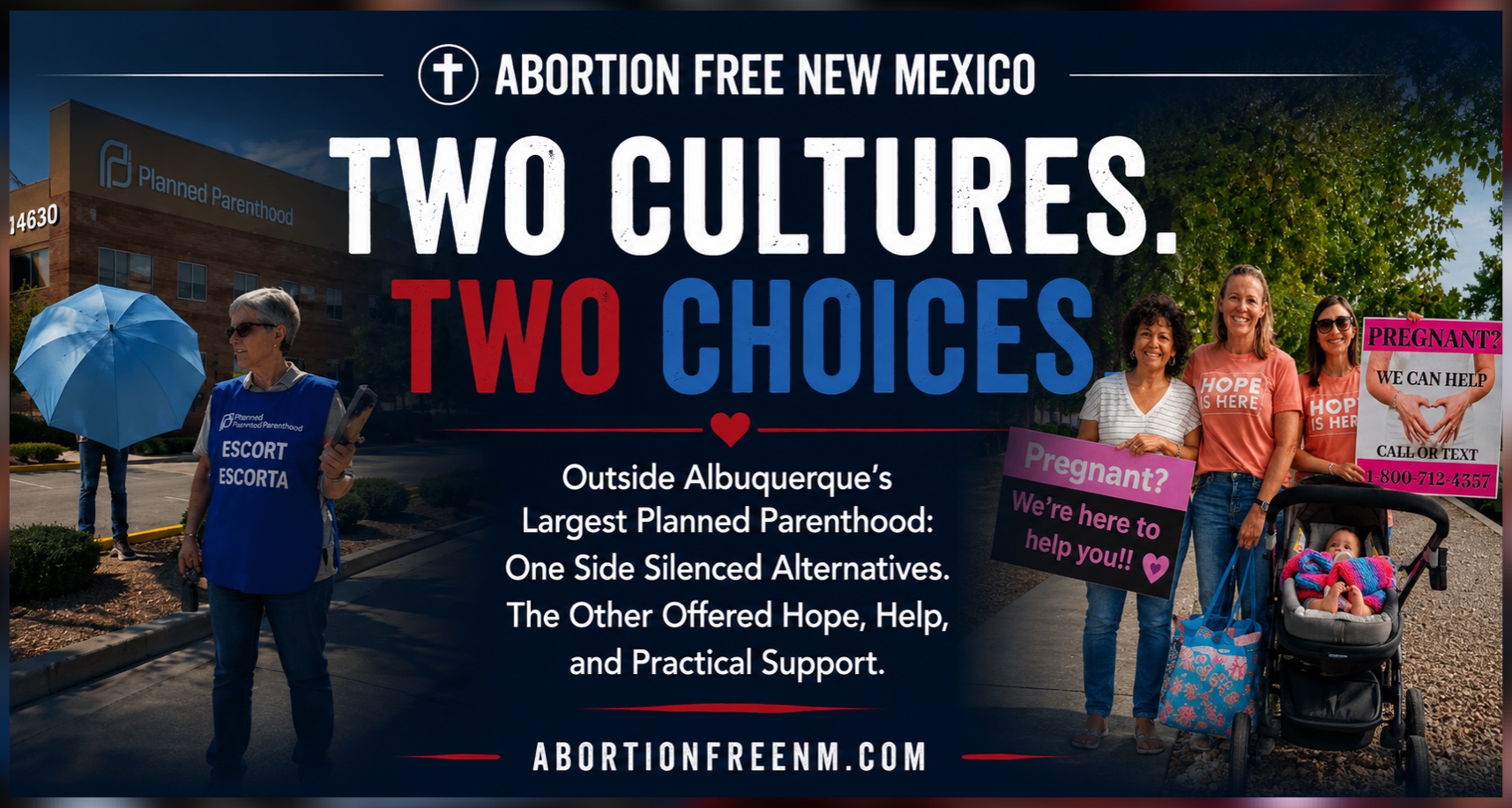
    — Valley Abortion Group worker, undercover recording obtained by the New Mexico Sentinel

    According to Tara Shaver, spokesperson for Abortion Free New Mexico, the Sentinel investigationreinforces years of investigative research by the organization documenting how New Mexico has increasingly become a regional hub for abortion providers expanding services to out-of-state patients.​

    Shaver said the Sentinel’s reporting brings national attention to concerns AFNM has raised for years about cross-state abortion access and limited regulatory oversight in New Mexico.

    “We commend the Sentinel for bringing public attention to what our research has been documenting for years,” said Tara Shaver of Abortion Free New Mexico. “New Mexico’s lack of oversight has created a system where abortion businesses can openly market to patients from other states — including vulnerable minors — while operating with minimal regulatory scrutiny.”

    AFNM Research Previously Documented Expansion

    In a recent investigative report, Abortion Free New Mexico exposed the opening of a queer-led abortion facility in Albuquerque known as Valley Abortion Group. The center advertises abortions in all stages of pregnancy, including procedures late in pregnancy

    The organization warned at the time that the facility represented part of a growing trend of abortion providers relocating or expanding operations into New Mexico following abortion bans in neighboring states.​

    AFNM researchers also documented how some providers are positioning New Mexico as a destination for abortion patients traveling from states like Texas.The undercover footage published by the New Mexico Sentinel appears to confirm those concerns, documenting conversations in which clinic staff allegedly explain how patients from states like Texas can travel to New Mexico to obtain abortions that would be illegal in their home state.

    Evidence of a Growing “Abortion Tourism” Pipeline

    Abortion Free New Mexico has repeatedly warned that the rapid expansion of abortion services tied to interstate travel raises serious oversight and public safety questions.

    A separate AFNM report highlighted what the group described as a growing “abortion tourism” infrastructure, including abortion funds, transportation networks, and clinic expansion designed to accommodate large numbers of out-of-state patients.​

    National data has also shown a significant increase in abortions occurring in states where the procedure remains broadly legal after the Dobbs decision, with patients traveling from states that enacted restrictions.  

    “The Sentinel investigation reinforces what we have been warning about,”Shaver said.
    “New Mexico is rapidly becoming the epicenter of a cross-state abortion industry — yet state leaders continue to refuse meaningful oversight or transparency.”

    The findings raise urgent questions about regulatory oversight, patient safety, and the role New Mexico now plays in the rapidly expanding interstate abortion network.

    Calls for Transparency and Oversight

    Abortion Free New Mexico is calling for state officials and regulators to answer several urgent questions raised by the Sentinel’s report:

    • Are New Mexico clinics advising minors from other states on how to bypass parental involvement laws?
    • What regulatory oversight exists for clinics marketing services to out-of-state patients?
    • Are state agencies tracking complications or medical emergencies associated with this influx of patients?
    • What role do abortion funds and interstate networks play in transporting patients into New Mexico?​

    AFNM says these questions deserve immediate investigation by state officials.

    “If abortion is being promoted as healthcare, then it should be held to the same transparency and accountability standards as every other medical industry,” said Tara Shaver of Abortion Free New Mexico. “When New Mexico is becoming a national destination for abortion providers and patients, the public has a right to know how this system is operating.”

    About Abortion Free New Mexico

    Abortion Free New Mexico is dedicated to exposing the abortion industry in New Mexico through investigative research, public records, and policy analysis. The organization also operates a sidewalk outreach team in Albuquerque that regularly and compassionately reaches out to women outside abortion facilities, including the Valley Abortion Group late-term abortion facility, offering support, resources, and alternatives.​

    More information and reports are available at:
    AbortionFreeNM.com

  • LATE-TERM ABORTIONIST SUSAN ROBINSON DIES, RENEWING FOCUS ON NEW MEXICO’S ROLE IN U.S. ABORTION INDUSTRY

    LATE-TERM ABORTIONIST SUSAN ROBINSON DIES, RENEWING FOCUS ON NEW MEXICO’S ROLE IN U.S. ABORTION INDUSTRY

    By Bud Shaver,

    Albuquerque, New Mexico — Dr. Susan Robinson, a physician known for performing abortions later in pregnancy and who worked with providers in Albuquerque, has died. Her death is drawing renewed attention to New Mexico’s role in the national abortion industry and Albuquerque’s connection to one of the country’s most widely known facilities offering the procedure.

    ​Robinson’s death was confirmed in a public statement by abortion provider Dr. Shelly Sella, who worked alongside Robinson providing third-trimester abortion services in both Wichita, Kansas, and Albuquerque, New Mexico.

    “Dr. Susan Robinson died this morning, less than a year from her cancer diagnosis,” Sella wrote in a public post. “Susan was my friend and colleague in third trimester abortion care, both in Wichita and Albuquerque… Together, we helped create a model of abortion care that lives on in our mentees.”
    Robinson was widely known within abortion advocacy circles and was part of a small group of physicians who continued performing abortions later in pregnancy after the 2009 killing of Kansas abortion provider George Tiller. Following Tiller’s death, only a limited number of facilities in the United States continued publicly advertising the procedure, with Albuquerque emerging as one of the locations most frequently referenced in national reporting.

    (After George Tiller’s death in 2009, a small network of physicians continued performing abortions later in pregnancy, including providers who traveled to Albuquerque, New Mexico.)

    According to statements from abortion providers themselves, Robinson and other physicians, including Sella, traveled from California to Albuquerque on a rotating basis to perform abortions later in pregnancy, helping sustain the practice at facilities such as Curtis Boyd’s Southwestern Women’s Options.

    Only a small number of facilities in the United States publicly advertise abortions later in pregnancy, and Albuquerque has long been one of those locations.

    Following the overturning of Roe v. Wade in 2022, several states enacted abortion restrictions or bans. At the same time, New Mexico political leaders, including Governor Michelle Lujan Grisham, promoted policies expanding abortion access in the state, positioning New Mexico as a destination for patients traveling from states where abortion laws had changed.

    The expansion of access, combined with the absence of common-sense restrictions on abortion procedures in New Mexico, has drawn increasing national attention to what Abortion Free New Mexico’s investigative reporting has identified as a growing pattern of “abortion tourism” into the state.

    National journalists have frequently cited Curtis Boyd’s Southwestern Women’s Options when covering abortions later in pregnancy in the United States, particularly after the death of George Tiller. Boyd’s clinic became a focal point in reporting about where such procedures continued to be performed in the years that followed.

    Curtis Boyd himself has been a prominent national figure in late-term abortion, practicing for decades and helping establish Albuquerque as a location where abortions later in pregnancy continued to be performed after Tiller’s death.

    The clinic later drew additional scrutiny after Abortion Free New Mexico exposed the 2017 death of Keisha Atkins, a young woman who died following a late-term abortion procedure at Southwestern Women’s OptionsThe case drew national attention and led to a civil lawsuit involving the clinic and medical providers connected to the procedure.

    In the years that followed, Boyd sold Southwestern Women’s Options to the owner of Texas-based Alamo Women’s Clinic and later relocated to Florida, marking a significant transition for one of the most widely known facilities performing abortions later in pregnancy.

    Tara Shaver, spokesperson for Abortion Free New Mexico, said Robinson’s passing highlights the broader history of the abortion industry’s concentration in New Mexico.

    “Dr. Susan Robinson was part of a small but influential group of physicians who helped sustain the late-term abortion industry in America,” Shaver said.“Her connection to Albuquerque underscores how New Mexico has become a focal point for abortions performed late in pregnancy.”

    Shaver noted that Abortion Free New Mexico has spent years documenting the growth of the abortion industry in the state through investigative reports, public records requests, and policy analysis

    “For nearly two decades, Abortion Free New Mexico leaders have been warning that New Mexico was becoming what many now describe as the late-term abortion capital of America,”Shaver said. “Through investigative reporting, public records research, and on-the-ground documentation, our work has helped bring national attention to the policies, providers, and practices that allowed this industry to expand in our state.”

    ​According to the Guttmacher Institute’s provider survey, approximately 21,000 abortions occurred in New Mexico in 2023, with a significant number involving patients traveling from other states.​

    Shaver said Robinson’s passing may also prompt renewed questions about the future of late-term abortion providers operating in the United States and whether additional physicians will continue the practice in states like New Mexico.

    “Dr. Robinson was part of a small network of physicians who ensured that abortions later in pregnancy continued in the United States after George Tiller’s death,” said Tara Shaver of Abortion Free New Mexico. “Her work is part of the larger story of how New Mexico became a national hub for these procedures. The public deserves transparency about that history and about the policies that made it possible.”

    Abortion Free New Mexico says it will continue documenting abortion industry practices and public policy developments in the state throughinvestigative reporting, public records research, and community outreach.​

    The history of providers such as Tiller, Boyd, and Robinson — combined with New Mexico’s post-Roe policy landscape — continues to place Albuquerque at the center of national conversations about where abortions later in pregnancy are performed in the United States.

    About Abortion Free New Mexico

    Abortion Free New Mexico is dedicated to investigative research, public education, and peaceful outreach regarding abortion practices and policies in New Mexico.

    Through public records investigations, policy analysis, and on-the-ground outreach, the organization documents the growth of the abortion industry in the state and its national impact.

  • A Story of Hope from the Sidewalk: Nathan “Gift of God”

    A Story of Hope from the Sidewalk: Nathan “Gift of God”

    By Bud Shaver,

    Albuquerque, New Mexico — On March 2, 2026, a beautiful baby boy named Nathan was born — a living testimony to what God can do when His people show up faithfully.

    Last November, one of our Abortion Free New Mexico sidewalk outreach teams encountered a young couple outside an abortion facility in New Mexico. The couple spoke only Spanish and could not communicate in English, creating an immediate language barrier.

    Earlier that day, they had visited one abortion center and were then directed to a sister location. When they arrived there, our sidewalk outreach team encountered them again.

    Despite the language barrier, our volunteers were able to communicate using Google Translate, compassion, and practical support. Through that conversation, they shared encouragement, resources, and the hope found in the Gospel of Jesus Christ.

    At the time, the mother was 24 weeks pregnant.

    In the midst of difficult circumstances, she made a courageous decision.

    She chose life.

    The family lives in Dallas, Texas, and since that day they have received ongoing support from a caring mentor who has helped provide many of the items needed to welcome their baby into the world.

    Now, months later, we rejoice to share that baby Nathan has been born healthy.

    His name is fitting.

    Nathan means “Gift of God.”

    “Nathan is here today because someone stood on the sidewalk and offered hope. When Christians show up with compassion and truth, lives can change forever.”
    — Tara Shaver, Abortion Free New Mexico

    Stories like this remind us why sidewalk outreach matters so deeply.

    When believers stand outside abortion facilities, they are not simply protesting injustice. They are offering hope, practical help, and the truth of the Gospel to women and families who may feel they have no other option.

    Too often those sidewalks are places where tiny lives are lost and hearts are wounded forever.

    But it does not have to be that way.

    When the Church steps out in faith and believers show up with compassion and courage, lives can be saved and families can be transformed.

    Baby Nathan is living proof.​

    Thank you for your continued prayers and support for this ministry.

    Join the Mission

    The sidewalks remain a ripe mission field, and there are many more mothers and babies who need hope, help, and the truth of the Gospel.

    Nathan is here today because someone showed up.

    The next life saved may depend on who shows up next.

    Please prayerfully consider how God may be calling you to get involved.

    Join Our Sidewalk Outreach Team

    Learn more about our mission and how you can stand with us on the sidewalks:

    👉 Join Our Team

    Upcoming Sidewalk Outreach Training

    📅 March 19
    🕙 10:00 AM – 3:00 PM

    Participants will learn how to:

    Join us and learn how to:

    • Offer compassionate support to women in crisis
    • Share practical resources
    • Communicate effectively in difficult situations
    • Share the Gospel with wisdom and compassion

    📝 RSVP here:
    https://form.jotform.com/241195253691156

    ✚ Abortion Free New Mexico
    Standing for Life. Sharing the Gospel

    ​🌐 AbortionFreeNM.com

    Nathan is here today because someone was willing to step onto the sidewalk.

    The next life saved may depend on who shows up next.

    Read Abortion Free New Mexico’s latest report: 

    Baby Nathan’s birth after a sidewalk encounter highlights the unique approach of Abortion Free New Mexico, combining sidewalk outreach, investigative reporting, and legal action to expose and challenge abortion practices in the state as New Mexico becomes a regional abortion destination.

    Read the full report: FROM SIDEWALK RESCUES TO DOJ COMPLAINTS: PRO-LIFE GROUP EXPANDS PRESSURE ON NEW MEXICO ABORTION INDUSTRY

  • AMERICA ON THE BRINK — WHERE DOES NEW MEXICO LEADERSHIP STAND?

    AMERICA ON THE BRINK — WHERE DOES NEW MEXICO LEADERSHIP STAND?

    New Mexico at a Crossroads: Sovereignty, Public Safety, and Child Well-Being Under Scrutiny

    By Bud Shaver,

    Albuquerque, New Mexico — As global instability rises and national security concerns intensify, leadership choices are no longer abstract. Border enforcement, violent crime, energy independence, constitutional rights, and the protection of children are not theoretical debates — they are immediate realities shaping New Mexico’s future.

    At moments of national seriousness, presence matters. While the nation gathered for the State of the Union to confront escalating global and domestic challenges, all but one member of New Mexico’s Democrat delegation chose not to attend. The absence was widely noted.

    This was not passive absence.
    It was a deliberate political statement.

    President Trump’s address emphasized economic nationalism, border security, energy independence, and what he described as renewed “America First” strength. He highlighted tax cuts, deregulation, domestic manufacturing growth, tougher trade enforcement, stricter immigration policy, expanded support for law enforcement and the military, and stronger domestic energy production — framing his agenda as restoring sovereignty and stability through strength.

    In a time of elevated border pressure and global uncertainty, those themes defined the national conversation.

    The contrast was unmistakable.
    “When the nation confronts crisis, leaders show up. Choosing not to is not neutrality — it’s a declaration.
    Tara Shaver of Abortion Free New Mexico said posture communicates priorities:“In serious times, presence signals alignment. Boycott signals opposition. Voters notice the difference.”

     (Boycotting American Progress? – State of Disunion)

    New Mexico is not a distant observer in national policy debates. It is a border state. Federal immigration enforcement decisions directly impact communities across the state — from rural counties to urban centers. Yet recent legislative sessions advanced measures limiting certain forms of cooperation with federal immigration authorities. Counties seeking stronger alignment with federal enforcement efforts have reported resistance and, in some cases, financial pressure.

    At a time when border security remains a top national concern, Shaver argues that voters deserve clarity on the state’s direction.

    “If strengthening sovereignty is essential in dangerous times, why is New Mexico moving away from it?”

    Energy policy presents another contradiction. New Mexico’s public education system and state budget rely heavily on oil and gas revenue. Historic budget surpluses in recent years have been fueled by domestic energy production. Those revenues support schools, infrastructure, and public services across the state.

    Yet alongside that reliance, policy pressure continues targeting the very industry funding those programs. Relying on energy revenue while politically constraining domestic production reflects a serious policy contradiction.

    Public safety further intensifies the concern. New Mexico consistently ranks among the highest states nationally in violent crime. Communities continue to face persistent safety challenges. Meanwhile, legislative sessions prioritized expanded firearm restrictions — proposals slowed or narrowed only after public scrutiny.

    Shaver contends that priorities matters.

    “When crime ranks among the highest in America, targeting constitutional rights of law-abiding citizens is not leadership — it’s misdirected priorities.”

    (New Mexico on the Brink – What New Mexicans Need vs What Democrats Are Doing)

    Children, Outcomes, and Contradiction

    Perhaps the most sobering contradiction involves children.

    According to the Annie E. Casey Foundation’s national rankingsNew Mexico has consistently ranked near 50th in child well-being indicators, including education and economic stability metrics. Literacy proficiency and graduation readiness remain persistent statewide concerns.

    At the same time, New Mexico has positioned itself as one of the most permissive abortion states in the country, expanding access and reducing certain reporting requirements. According to the Guttmacher Institute’s 2023 provider survey estimate, New Mexico reported approximately 21,000 abortions in a single year, including a significant number involving out-of-state patients.

    Shaver addressed the contradiction directly:

    “New Mexico leadership says it cares about children — but continues expanding abortion while our state ranks near last in child well-being. You cannot claim to protect children while expanding policies that end their lives before birth.”

    She continued:

    “If children matter, every child matters — including the child in the womb.”

    The organization argues this is not merely ideological. It is about coherence. If public policy claims to prioritize children, measurable improvements should follow.

    Accountability Remains a Defining Issue

    Accountability was a recurring concern throughout this legislative session. Multiple proposals affecting transparency, reporting standards, and enforcement oversight raised questions about whether public scrutiny is expanding — or contracting.

    As national conversations intensify around elite networks and political responsibility, one fact remains:

    Zorro Ranch was not in Washington, D.C. — it was in Santa Fe County, New Mexico.

    Jeffrey Epstein operated there for years. Public records show the ranch was purchased in 1993 from the family of former Democratic Governor Bruce King — a documented real estate transaction. That fact alone does not imply wrongdoing by the King family. However, it confirms that Epstein’s operations were rooted in this state.

    Former Democratic Governor Bill Richardson was later publicly named in reporting tied to Epstein, and amid controversy, the University of New Mexico removed his name from a campus building.

    These developments underscore a broader point: when national scrutiny intensifies, New Mexico cannot assume distance from the issue.​

    Shaver said accountability must be consistent.

    “If transparency is demanded nationally, it must be applied locally. Accountability cannot be selective. If oversight is the standard, it begins at home.”​

    During this legislative session, AFNM’s reports raised additional concerns about transparency, reporting requirements, and regulatory enforcement in other policy areas as well. Shaver argues that accountability is not partisan — it is structural.

    “Public trust is not built by shielding institutions from scrutiny. It is built by allowing scrutiny and welcoming independent review.”

    When oversight appears limited and public questions remain unresolved, confidence erodes. And when confidence erodes, accountability becomes more urgent — not less.

    Election Integrity and Sovereign Authority Under Review

    Beyond border policy and public safety metrics, additional questions have emerged surrounding election integrity and sovereign authority.

    New Mexico does not require documentary proof of citizenship to register to vote. While federal law prohibits non-citizens from voting in federal elections, registration processes rely primarily on attestation rather than mandatory document verification.​

    In addition, access to voter rolls has remained shielded from certain independent audit efforts. State officials maintain that existing safeguards are sufficient. However, critics argue that verification strengthens confidence, while limitation of independent review weakens public trust.

    Shaver framed the issue as one of transparency rather than accusation.

    “If our system is secure, why resist greater transparency?”Shaver asked.
    “Confidence in elections comes from verification, not assurances.”

    The organization emphasizes that raising questions about verification is not an allegation of fraud, but rather a call for strengthened public confidence during a time of heightened national sensitivity around election security.​

    In moments of instability, transparency becomes stabilizing.

    Law Enforcement Eligibility Expansion (SB 364)

    In 2025, New Mexico enacted legislation allowing illegal aliens to qualify for law enforcementpositions.

    Supporters argue the change expands the applicant pool and reflects modern workforce realities. Critics, however, argue that the policy alters long-standing citizenship expectations for positions carrying sovereign authority.

    Law enforcement officers exercise arrest power, use-of-force authority, and public trust responsibilities. For generations, those roles have been closely associated with citizenship status.

    Shaver raised concerns about the timing and optics of the policy shift.

    “Law enforcement carries sovereign authority — arrest power, use of force, public trust,” Shaver stated.
    “Why are we lowering citizenship expectations at the very moment national security concerns are rising?”

    The organization argues that such changes, when combined with broader debates over immigration enforcement cooperation, warrant public scrutiny and open discussion.

    ​(Hard Questions for New Mexico Leaders)

    A Broader Pattern of Direction

    When examined individually, each of these issues can be debated on its own terms. But when viewed collectively, a consistent contrast emerges — particularly in relation to President Trump’s stated America First agenda.

    President Trump has framed his national priorities around border enforcement, domestic energy production, strengthened law enforcement standards, election verification, constitutional protections, and opposition to abortion expansion. In each of those areas, New Mexico’s current leadership has advanced policies that move in a different direction.

    On immigration enforcement, cooperation has been limited in a border state. On energy, regulatory pressure has increased despite record revenue dependence. On firearms policy, additional restrictions have been prioritized while violent crime remains elevated. On abortion, infrastructure has expanded even as child well-being rankings remain near the bottom nationally. On election integrity, expanded verification proposals encounter resistance framed as unnecessary.

    Taken together, these are not minor disagreements. They represent a sustained policy divergence.

    Tara Shaver says voters should evaluate that divergence carefully.

    “President Trump has been clear about his America First priorities,” she said.
    “New Mexico leadership has been equally clear about moving in a different direction. Voters deserve to ask whether that direction is producing better outcomes for families here at home.”

    The question, she argues, is not about personalities but priorities.

    If the national agenda emphasizes sovereignty, domestic production, constitutional defense, and stronger enforcement — and state leadership consistently advances alternatives — then voters are justified in asking what framework is guiding those decisions.

    “When policy repeatedly conflicts with border security, energy strength, law enforcement standards, and protection of children, people are going to ask: What vision is driving this?” Shaver said.

    The organization reiterates that its concerns are framed around measurable outcomes and governance direction, not personal allegations.

    As America confronts global instability, domestic unrest, and rising security questions, the cumulative pattern of policy choices in New Mexico is drawing increased scrutiny.

    • Border enforcement questioned.
    • Energy production pressured.
    • Violent crime elevated.
    • Child well-being near last.
    • Abortion expanded.
    • Election verification debated.
    • Sovereign authority standards adjusted.
    • All but one member of the delegation absent during a defining national address.

    Shaver says the cumulative pattern is what voters must evaluate.

    “These are not isolated policies. They reflect ideological alignment. And alignment determines outcomes.”

    America faces serious global and domestic challenges. In serious times, governance priorities matter. Transparency should not be feared. Verification should not be resisted. Sovereignty should not be diluted. Children should not be overlooked. Public safety should not remain stagnant.

    These are not partisan slogans. They are foundational expectations of accountable leadership.

    All eyes are on New Mexico.

    Leadership is measured not by slogans, but by results. Not by symbolism, but by substance.

    The question before New Mexicans is not abstract.

    Will New Mexico leadership fortify the state — strengthen sovereignty, improve child outcomes, enhance public safety, and increase transparency — or continue policies that fail to improve measurable results at a moment when America stands on the brink?

    That is the debate now unfolding in New Mexico.

  • AFTER NIH FUNDING BAN, UNM FACES QUESTIONS OVER DOCUMENTED USE OF ABORTED BABIES IN MEDICAL RESEARCH

    AFTER NIH FUNDING BAN, UNM FACES QUESTIONS OVER DOCUMENTED USE OF ABORTED BABIES IN MEDICAL RESEARCH

    Federal funding shift intensifies scrutiny of UNM’s December 2025 tissue oversight policy and past congressional findings involving aborted baby tissue transfers.
    By Bud Shaver,


    Albuquerque, New Mexico –In January 2026, the National Institutes of Health publicly announced that it will no longer fund research involving fetal tissue obtained from elective abortions. The decision affects all NIH grants and contracts and marks significant shift in federal research funding standards for publicly funded institutions nationwide. According to NIH data, dozens of such projects were funded as recently as fiscal year 2024.Just weeks earlier, on December 9, 2025, the University of New Mexico Health Sciences Center finalized its policy outlining oversight of human tissue in research — a policy released following an IPRA request filed by Tara Shaver of Abortion Free New Mexico.That policy now publicly confirms what federal investigators previously had to compel through subpoenasUNM operates under a formal institutional framework governing the acquisition, transfer, and use of tissue from aborted babies in medical research within a taxpayer-funded university.With NIH ending federal funding for such research, Abortion Free New Mexico (AFNM) is demanding immediate public disclosure regarding UNM’s compliance — including whether any federally funded projects are affected and how the university is ensuring adherence to the updated federal standard.

    This is not speculation,” said Tara Shaver, spokesperson for Abortion Free New Mexico. “It is written institutional policy.”

    UNM’s 2025 Policy Formalizes Governance of Aborted Baby Tissue

    UNM’s “Oversight of Human Tissue in Research” policy outlines:

    • Acquisition of tissue from aborted babies through external entities
    • Required assurances of separate abortion and donation consent
    • Transfer agreements
    • Internal oversight through the Human Tissue Oversight Committee
    • Institutional Review Board review
    • Scientific review processes

    The policy does not prohibit the use of tissue from aborted babies. It regulates how that tissue is acquired, stored, and used within university research programs.

    “This is not theoretical,” Shaver said. “UNM has codified how tissue from aborted babies is brought into its laboratories and used in medical research.”

    A History That Required Subpoenas

    UNM’s relationship with a late-term abortion provider was examined by the U.S. House Select Investigative Panel on Infant Lives in 2016.​

    That investigation documented:

    • Repeated transfers of organs and tissue from aborted babies;
    • Procurement logs detailing gestational ages and specific organs;
    • Research programs involving dissection of fetal brains;
    • Formal criminal referrals to the New Mexico Attorney General and federal authorities.

    Those records surfaced only after congressional subpoenas were issued — despite earlier representations suggesting certain procurement documentation did not exist.

    “At the time, I was told procurement records did not exist,” Shaver said. “It took federal subpoenas for those documents to surface.”

    Shaver previously stated publicly:

    “I think they lack transparency, and it’s because they have things to hide. If you don’t have anything to hide, you’re going to put it all out there and show just how ethical you are.”

    No state charges followed the congressional referral.

    But the documented use of aborted babies in medical research — and the history of non-disclosure — remains part of the public record.

    State Law Concerns Were Referred for Investigation

    Concerns regarding potential violations of New Mexico law were initially raised by Tara Shaver of Abortion Free New Mexico and later examined during the U.S. House Select Investigative Panel on Infant Lives inquiry.​

    The panel did not limit its findings to federal oversight concerns. It referred potential violations of New Mexico law to the Office of the New Mexico Attorney General.

    According to publicly reported documents, potential state law concerns referenced included the Jonathan Spradling Revised Uniform Anatomical Gift Act and the Maternal and Fetal Experimentation Act.

    The congressional panel provided evidentiary materials to the New Mexico Attorney General’s office as part of its referral.

    No state charges were ultimately filed.


    NIH Ends Funding —  UNM Compliance Must Be Clarified

    In January 2026, NIH announced that it will no longer fund research involving tissue from aborted babies obtained through elective abortions.For a publicly funded research university, that represents a major funding shift.Yet UNM has not publicly clarified:

    • Whether any NIH-funded research involving tissue from aborted babies is ongoing;
    • Whether such projects have been modified or terminated;
    • Whether alternative funding streams are being used;
    • How compliance with the updated federal funding restriction is being verified.

    “When federal standards change this dramatically, public institutions must respond transparently,” Shaver said. “Silence is not compliance.”

    🔎 OFFICIAL POLICY CONFIRMS FRAMEWORK

    UNM’s December 9, 2025 Standard Operating Procedure formalizes oversight of human fetal tissue acquisition and research — months before NIH ended federal funding for such research.

    📌 TIMELINE OF FACTS

    From subpoenas to federal funding bans — the record shows a pattern that now demands documented compliance.

    Public Funding Requires Immediate Accountability

    UNM is supported by:

    • State taxpayer appropriations
    • Federal research grants
    • Public institutional funding

    The NIH’s January 2026 decision reflects a clear federal position: American tax dollars should not be used to fund research involving fetal tissue obtained from elective abortions.That principle applies at every level of government.​

    New Mexico tax dollars should not subsidize research that relies on the bodies of aborted babies.

    If federal funding has been halted for this category of research, the public deserves clear and documented confirmation that neither federal nor state taxpayer funds — directly or indirectly — are continuing to support it.

    “When organs from aborted babies are transferred into UNM laboratories for medical experiments at a taxpayer-funded institution, transparency is not optional,” Shaver said. “Internal committees are not a substitute for public accountability.”

    When funding standards shift this dramatically, public institutions must respond immediately and transparently.

    Delay only deepens concern.

    ​AFNM is calling on UNM leadership to:

    • Publicly confirm whether any NIH-funded research involving tissue from aborted babies is ongoing;
    • Clarify how its December 2025 protocol has been updated to reflect NIH’s 2026 funding shift;
    • Release aggregate, non-identifying information regarding current research involving tissue from aborted babies;
    • Provide assurance that no prohibited federal funds are being used.

    UNM’s December 2025 policy formalizes the institutional framework governing the acquisition and use of tissue from aborted babies in medical research. With federal funding standards now changed, the responsibility to demonstrate compliance rests with the institution.

    Transparency should not have to be extracted through federal investigation.​

    The burden is on UNM to prove compliance clearly, immediately, and publicly.

    “The American people should not have to rely on congressional subpoenas to find out what their public universities are doing,” Shaver said. “If UNM is fully compliant with the NIH funding ban, it should say so clearly — and prove it. If it isn’t, the public deserves to know that immediately. Transparency delayed is transparency denied.”

  • THE EPSTEIN INVESTIGATION AND SELECTIVE ACCOUNTABILITY

    THE EPSTEIN INVESTIGATION AND SELECTIVE ACCOUNTABILITY

    Is New Mexico leadership ready for global scrutiny?​By Bud Shaver,

    Albuquerque, New Mexico — As New Mexico proceeds with its investigation connected to Jeffrey Epstein’s former Zorro Ranch, Abortion Free New Mexico (AFNM) is raising serious concerns about institutional credibility, selective accountability, and structural conflicts of interest within the state’s long-standing political infrastructure.

    For nearly a century, New Mexico has operated under sustained Democratic legislative control. During that time, the state has consistently ranked near the bottom nationally in education outcomes and has struggled with persistent crime challenges.

    Now the public is being asked to trust that this same political infrastructure will conduct a fearless, independent, and transparent investigation into one of the most notorious criminal networks in modern history.

    Jeffrey Epstein maintained property and operations at Zorro Ranch in New Mexico for years. Civil litigation and survivor testimony have alleged exploitation connected to that property. The national outrage surrounding Epstein was not only about criminal acts — it was about institutional failure: failure to investigate aggressively, failure to confront power, and failure to expose wrongdoing in real time.

    AFNM is not alleging that state officials enabled Epstein.

    But it is asking a serious question:

    If transparency has been reduced in politically sensitive areas, why should unquestioned trust now be assumed in a high-profile investigation involving power and influence?

    Abortion Policy, Reduced Oversight, and Moral Framing

    In recent legislative sessions, pro-abortion leaders have expanded abortion policy while simultaneously diminishing oversight and narrowing public transparency safeguards.

    • Uniform statewide abortion reporting has been reduced.
    • Public statistical visibility has diminished.
    • Shield protections have expanded.
    • Oversight efforts have been reframed as hostility rather than accountability.

    At the same time, moral and religious language has been publicly invoked in defense of abortion expansion policy.During testimony on SB 30, Senator Cindy Nava (D) stated:

    “As one of the only four women on this committee, as a Catholic and as an immigrant, I think it’s important to note that the majority of those speaking on this issue are men… I want to thank you, Senator Wirth, for bringing this legislation forward because our voices certainly aren’t interpreted by statements that gentlemen make.”

    Click here or on the post below to watch Senator Cindy Nava (D) during SB 30 testimony. The video begins directly at her remarks.

    ​Following that hearing, Senator Nava became a sponsor of the legislation.

    AFNM emphasizes three elements that contribute to public skepticism:

    • The invocation of Catholic identity in support of abortion expansion policy — in clear contradiction to longstanding Catholic doctrine on the sanctity of life.
    • The framing of male opposition as less legitimate in public debate.
    • The fact that SB 30 — reducing abortion reporting safeguards — was introduced and advanced by male legislative leadership.

    Both the invocation of Catholic identity in contradiction to Church teaching and the selective disqualification of dissent based on gender undermine credibility.

    Relying on male legislative leadership to introduce and advance abortion expansion legislation — while dismissing male opposition as illegitimate — exposes a contradiction that weakens institutional trust.

    When abortion expansion, diminished oversight, and contradictory moral framing converge, skepticism is not partisan — it is the predictable result of inconsistent governance.

    Catholic Doctrine and Public Accountability

    The Catholic Church’s teaching on abortion is longstanding and unequivocal. The Catechism affirms that human life must be respected and protected from conception and that direct abortion constitutes grave moral matter.

    In 2017, the Catholic bishops of New Mexico — including Archbishop John C. Wester — publicly stated that it is not appropriate for Catholic elected officials to invoke their Catholic faith while advocating for abortion policy. The bishops clarified that support for abortion is “not morally permissible” and that presenting personal opinions contrary to Church teaching creates confusion and scandal among the faithful.​AFNM does not claim the authority to render canonical or ecclesiastical judgments; however, the doctrinal tension is publicly documented. When Catholic identity is invoked in legislative debate while advancing abortion expansion in direct conflict with longstanding Church teaching, the inconsistency is not merely political — it is theological.

    Statement from Tara Shaver

    “When pro-abortion leaders expand abortion policy, sponsor bills that shield accountability and reduce transparency, rebuke the faith community, lecture men for speaking on life issues — even as male leaders introduce and advance those same bills — and invoke their Catholic faith in support of abortion policy, it reveals both a structural conflict of interest and a profound conflict of integrity. When moral claims and legislative action diverge, skepticism is not extreme — it is warranted. And when moral reasoning is inconsistent, the public is justified in closely examining the integrity of the laws that result.”
    — Tara Shaver, Spokesperson, Abortion Free New Mexico

    A Credibility Test for Leadership — Beyond New Mexico

    New Mexico’s long-standing political leadership has shaped the state’s governance structure for decades. During that time, the state has frequently ranked near the bottom nationally in key education indicators, including reading and math proficiency scores, and has consistently faced elevated violent crime rates compared to national averages.

    These are documented, publicly reported statistics.

    While many factors contribute to complex social outcomes, these measurable outcomes reflect institutional performance and oversight culture.

    Now, that same political infrastructure is asking the public — and the nation — to trust that it will conduct a fearless, independent investigation into allegations connected to one of the most notorious criminal networks in modern history.

    The implications extend far beyond New Mexico.

    Epstein’s network drew national and international scrutiny. Allegations tied to Zorro Ranch are not confined to local politics. The need for accountability, prosecutorial rigor, and institutional independence carries national and global consequences.

    When leadership has:

    • Diminished transparency safeguards in one policy arena,
    • Expanded politically protected sectors in another,
    • Struggled to improve measurable outcomes in education,
    • And faced persistently high crime rates,


    skepticism does not arise from partisanship — it arises from performance history.

    ​“When abortion expansion, diminished oversight, and contradictory moral framing converge, skepticism is not partisan — it is the predictable result of inconsistent governance,” Shaver stated.

    “If this investigation is to restore confidence — not just in New Mexico, but nationally and internationally — leaders must demonstrate transparency that exceeds the minimum standard. When credibility is on the line, independence should be invited, not feared.”

    Ultimately, the question is simple:

    Will New Mexico demonstrate the level of independence required when power, influence, and global scrutiny converge — or will it repeat the institutional hesitations the Epstein case has already exposed?

    Credibility will not be measured by statements.

    It will be measured by evidence.

    Final Conclusion

    New Mexico’s leadership is now asking the public — and the world — to trust that it will conduct a fearless, independent investigation into allegations tied to one of the most notorious criminal networks in modern history.

    But context matters.

    In the most recent legislative session, transparency was not expanded — it was narrowed. Reporting safeguards were reduced. Oversight mechanisms were weakened. Public visibility was diminished.

    When transparency contracts in one arena while leaders ask for unquestioned trust in another, skepticism is not partisan — it is rational.

    Credibility cannot be declared — it must be proven. It is proven through independent investigators free from political conflicts, full subpoena authority with documented evidence, public hearings and sworn testimony, written prosecutorial findings, disclosed conflicts of interest, and a final report grounded in verifiable documentation — not narrative summaries.

    Transparency must be proactive. Oversight must be visible. Accountability must be measurable. Anything less invites doubt.

    And when the stakes extend beyond state borders — when national and international confidence are on the line — anything less is unacceptable.

  • THE 2026 LEGISLATIVE STACK: REDUCED EXPOSURE. REDUCED TRANSPARENCY. EXPANDED ABORTION ACCESS.

    THE 2026 LEGISLATIVE STACK: REDUCED EXPOSURE. REDUCED TRANSPARENCY. EXPANDED ABORTION ACCESS.

    Is This the Legacy the Governor Wants to Solidify?
    By Bud Shaver,

    Santa Fe, New Mexico

    –The 2026 legislative session is being promoted as a year of healthcare reform.But when the full legislative stack is examined, one sector appears to benefit more than any other:

    The abortion industry.This session delivered:

    • Interstate licensure expansion (SB 1 and related compacts)
    • Malpractice liability refinements under HB 99
    • Elimination of uniform statewide abortion reporting under SB 30
    • Existing shield law protections left intact

    Individually, these bills are framed as reform.

    Collectively, they expand access, stabilize liability, preserve insulation, and remove transparency — within one specific sector.​

    No other healthcare industry received that combination.

    HB 99: Liability Carefully Protected

    House Judiciary, under Chair Rep. Christine Chandler (D), spent hours refining malpractice language in HB 99.

    • Eleven amendments were considered.
    • Definitions were debated line by line.
    • Exposure standards were meticulously examined.​

    ​Liability protections were treated as serious business.

    They were refined.
    They were structured.
    They were protected.

    SB 30: Transparency Eliminated After Being Fast-Tracked

    In contrast, SB 30 — eliminating uniform statewide abortion reporting beginning in 2026 — was fast-tracked through the Senate and given only a single hearing in House Judiciary before advancing.

    • Testimony was limited.
    • Survivors were cut off mid-statement.
    • No serious transparency amendments were adopted.
    • The bill advanced swiftly.

    While liability exposure was refined for hours, abortion transparency was removed in minutes.​

    That contrast defines the session.

    Where Were the Amendments?

    During HB 99, amendments flowed.

    During SB 30, they did not.

    AFNM asks:​

    • Why were eleven amendments debated on liability but none seriously pursued to preserve abortion transparency?
    • Why did Republicans not attempt to amend SB 30 to retain reporting safeguards?
    • Why eliminate reporting instead of enforcing it?

    “When liability protections were at stake, lawmakers refined and amended,” Shaver said. “When transparency protections were at stake, they were removed.”

    The Data Question

    According to the Guttmacher Institute’s 2023 provider survey estimate:​

    • Approximately 21,000 abortions occurred in New Mexico
    • Roughly 71% of patients traveled from out of state

    Abortion providers were 

    capable of submitting that data to a private organization.

    But SB 30 eliminates mandatory reporting to the State of New Mexico.

    The issue is not burden.
    The issue is who receives the data.

    When reporting becomes voluntary, verification disappears.

    Abortion Clinics and Regulatory Gaps

    Hospitals are inspected.
    Nursing homes are inspected.​
    Ambulatory surgical centers are inspected.

    Abortion facilities in New Mexico do not operate under a distinct abortion-clinic licensing and inspection structure requiring routine state inspections comparable to hospitals.

    With SB 30:

    • Uniform statewide abortion reporting disappears
    • Verification becomes harder
    • Public access to official data vanishes

    “Healthcare transparency and inspection standards should be consistent,” said Tara Shaver of Abortion Free New Mexico. “If abortion is healthcare, then it should meet the same reporting and inspection expectations as other regulated medical sectors.”

    Abortion Providers Stand to Gain the Most

    Combine the full 2026 policy structure:​

    • Expanded interstate workforce access
    • Maintained shield law protections
    • Refined malpractice exposure
    • Eliminated mandatory abortion reporting
    • No distinct abortion-clinic inspection framework

    The result:

    • Access expands.
    • Liability stabilizes.
    • Transparency shrinks.
    • Inspection remains limited.

    That structural convergence disproportionately benefits abortion providers.

    Independent physicians may benefit from malpractice reform.

    Abortion providers benefit from malpractice reform, shield protections, expanded entry pathways, and reduced oversight — simultaneously.

    No other healthcare sector receives that convergence.

    “When those shifts happen together in one sector,” Shaver said, “the public has every right to ask who really benefits.”

    The Legacy Question

    Governor Michelle Lujan Grisham has framed medical malpractice reform as a defining part of her legacy.

    But reform is judged by outcomes.

    “If this session’s healthcare reform becomes the Governor’s legacy,” said Tara Shaver of Abortion Free New Mexico, “then that legacy will include expanded access for abortion providers, refined liability protections for abortion providers, preserved shield protections for abortion providers — and the elimination of abortion reporting to the public.”

    She continued:

    “Is insulating the abortion industry while eliminating transparency what the Governor wants solidified as her legacy? Because that is what this legislative stack accomplishes.”

    Why This Matters

    This is not about partisan rhetoric.

    It is about how oversight  is structured.

    When high-volume abortion services operate in a state that:

    • Expands interstate access
    • Limits out-of-state consequences
    • Refines liability exposure
    • Eliminates mandatory reporting
    • Lacks a distinct inspection framework

    Oversight contracts while protection expands.

    That is measurable.
    That is policy.
    That is legacy.

    Questions That Demand Answers

    • Why eliminate mandatory abortion reporting instead of enforcing compliance?
    • Why refine liability exposure while reducing transparency?
    • Why does abortion operate without a distinct inspection structure?
    • Why did amendments flow on liability but not on transparency?
    • Is this combination of protections and reduced oversight intentional?​

    “Reduced exposure. Reduced transparency. Expanded abortion access,” Tara Shaver said. “If that is the structure being constructed, then the abortion industry is the clear beneficiary — and the public deserves honesty about it.”​

  • SB 30 ELIMINATING ABORTION FACILITY REPORTING CLEARS HOUSE AFTER SINGLE HEARING — NOW TO GOVERNOR

    SB 30 ELIMINATING ABORTION FACILITY REPORTING CLEARS HOUSE AFTER SINGLE HEARING — NOW TO GOVERNOR

    AFNM: “You Cannot Eliminate Reporting and Tell the Public to Trust the System”

    By Bud Shaver,

    Albuquerque, New Mexico — Senate Bill 30 has cleared the New Mexico House after receiving only one House committee hearing and now heads to Governor Michelle Lujan Grisham’s desk.

    Abortion Free New Mexico (AFNM) says both the substance of the bill and the speed of its advancement reveal a troubling pattern:

    “When scrutiny increases, transparency decreases.”

    SB 30 eliminates longstanding uniform statewide abortion reporting requirements, which required providers to report each induced abortion to the state registrar.

    🔎 Provider Estimates Exist — Public Verification Lags​

    (Five Years. No Accountability.)

    The Guttmacher Institute’s 2023 abortion provider surveyestimated that approximately ~21,000 abortions were provided in New Mexico clinics in 2023, including significant out-of-state travel.Those totals are derived from direct abortion facility surveys and provider reporting.

    Yet without timely public updates through a consistent abortion facility reporting framework, independent verification of current statewide totals becomes difficult.​

    New Mexico lawmakers labeled abortion facility reporting “too burdensome.” But facilities are already collecting and submitting detailed data for national survey estimates. The issue is not paperwork — it is public visibility.

    AFNM maintains that the core issue is not whether the data exists — it does — but whether the public is allowed to see it.

    “The public should not have to rely on outside estimates to understand what is happening inside our own state,” said Tara Shaver, spokesperson for Abortion Free New Mexico.

    Rather than strengthening transparency, SB 30 eliminates the reporting requirement entirely.

    “You cannot eliminate the facility reporting requirement and simultaneously tell the public to trust the system,” she added.

    🗣 ‘Too Burdensome’ — Or Too Visible?

    Supporters of SB 30 repeatedly described abortion facility reporting requirements as “too burdensome.”

    AFNM argues the claim collapses under scrutiny.

    If facilities already track and submit detailed data for national surveys, then the administrative burden argument is difficult to sustain.

    “Reporting is not a burden — it is accountability. Abortion providers already collect extensive data voluntarily. What they object to is not record-keeping, but public accountability,” Shaver testified.

    The data exists. The question is who gets to see it.

    “SB 30 does not reduce bureaucracy; it reduces transparency.”

    One Committee. Suppressed Testimony. Party-Line Vote.

    SB 30 advanced out of the House Judiciary Committee after receiving only one committee hearing, presided over by Rep. Christine Chandler (D), Chair of the House Judiciary Committee.

    According to AFNM’s documented reporting on the hearing, opposition testimony was tightly restricted:

    • Only five opposition speakers were permitted to testify
    • Each speaker was limited to 90 seconds
    • Witnesses were cut off mid-sentence
    • A woman attempting to share testimony related to sexual abuse and trafficking was interrupted before completing her remarks
    • Tara Shaver was not permitted to testify despite registering and preparing formal remarks

    AFNM says the hearing did not reflect open deliberation but procedural control over dissenting voices.

    “One-party control becomes dangerous when it turns into one-party suppression,” Shaver said following the hearing.

    “I followed the rules. I registered to testify. I prepared remarks. I was blocked from speaking. That is not open government.”

    The bill was subsequently advanced on a party-line vote.​

    “When legitimate questions about statutory compliance are met with procedural acceleration instead of clarification, people begin to lose faith in the integrity of the process,” Shaver said.

    Under current one-party control in Santa Fe, AFNM argues major policy outcomes increasingly appear settled before meaningful public deliberation occurs.

    🚑Injuries Documented — Emergency Record Access Restricted Under Current Democrat Leadership

    AFNM says its transparency concerns are grounded in documented emergency incidents connected to abortion facilities.​

    Over the past several years, AFNM has documented:

    • Multiple abortion-related emergency transports
    • 911 dispatch confirmations
    • One reported death following an abortion procedure

    These incidents were identified using publicly accessible emergency dispatch records and formal public records requests.However, AFNM says that under current Democrat leadership in New Mexico, public access to previously obtainable emergency dispatch records has been restricted.AFNM argues that the convergence should concern the public:

    • Public abortion statistics lack timely updates
    • Emergency dispatch record access has been restricted
    • Abortion clinics are not classified as ambulatory surgical centers subject to comparable inspection frameworks

    As official access has narrowed, AFNM says it now exclusively relies on firsthand eyewitness documentation from our team of trained sidewalk outreach volunteers who observe ambulance transports from abortion facilities.

    “When women are injured, when a death is reported, when federal investigators uncover information the state denied — and the legislative response is to erase reporting requirements — that should alarm every New Mexican,” said Tara Shaver, spokesperson for Abortion Free New Mexico.

    “If everything is safe, lawful, and properly regulated, transparency should not be threatening,” she added

    AFNM maintains that when public reporting systems go dormant, emergency access narrows, and statutory reporting requirements are repealed — all under unified Democrat control — the cumulative effect is reduced public oversight.

    “Transparency should expand when scrutiny increases. Instead, we are watching it contract.”

    🧬 A Pattern of Secrecy

    AFNM also cites prior federal investigation findings involving UNM fetal tissue procurement records, which were initially denied before being confirmed through congressional inquiry.AFNM argues this reflects a broader pattern:

    • Public records delayed or denied
    • Reporting systems left dormant
    • Emergency record access narrowed
    • Reporting requirements eliminated​

    “Each time transparency exposes something uncomfortable, the guardrails move,” Shaver said.

    📉 From Enforcement to Elimination

    AFNM argues that under current one-party control in New Mexico, oversight concerns are increasingly addressed not through compliance enforcement — but through statutory revision.

    “When scrutiny increases, transparency should expand. Instead, we are watching it contract.”
    — Tara Shaver

    🖊 Governor’s Signature Expected

    Governor Lujan Grisham has consistently supported expansive abortion policy. AFNM expects SB 30 will be signed into law.

    If enacted, the bill will remove uniform statewide abortion reporting requirements beginning in 2026.

    “Transparency is not the enemy of healthcare. It is the foundation of it,” Shaver said.

    📣  Contact Governor Michelle Lujan Grisham and ask her to veto SB 30

    AFNM is encouraging citizens, medical professionals, and faith leaders to respectfully contact the Governor’s office and request that SB 30 be rejected.

    About Abortion Free New Mexico

    Abortion Free New Mexico documents abortion policy, oversight, and public accountability issues across the state.

    In addition to research and policy work, AFNM provides compassionate support to abortion-vulnerable women through its Life Fund, offering financial assistance, material aid, and long-term care throughout pregnancy and beyond.

    AFNM says its mission is rooted in both accountability and compassion — advocating for transparency while walking alongside women facing difficult circumstances.​

    🔗 AbortionFreeNM.com

  • DECORUM COLLAPSES AS DEMOCRATS FORCE SB 30 FORWARD — CODIFYING A VIOLATION OF STATE LAW

    DECORUM COLLAPSES AS DEMOCRATS FORCE SB 30 FORWARD — CODIFYING A VIOLATION OF STATE LAW

    Testimony Blocked. Survivors Cut Off. Missing Abortion Data Ignored. Bill Advances on Party-Line Vote.

    By Bud Shaver,

    Santa Fe, New Mexico — What took place in the House Judiciary Committee was not open debate — it was one-party rule in full display. Under Democrat leadership, committee power is being used not just to manage hearings but to control them, suppress dissent, and advance policy with minimal public scrutiny.

    This heavy-handed approach reflects what Abortion Free New Mexico documented in our recent report, A Pattern of Secrecy: Abortion Oversight Shrinks Under Democrat Control, which outlines how Democratic leadership has systematically eroded transparency in areas ranging from emergency response records to statewide abortion reporting — even as taxpayer dollars support abortion services without accessible data on how those funds are being used. 

    Opposition testimony on SB 30 was tightly restricted to just five speakers, each given only 90 seconds — and witnesses were cut off mid-sentence, including a woman sharing powerful testimony about surviving sexual abuse and assisting trafficking victims.

    Tara Shaver of Abortion Free New Mexico followed the required process, registered to testify, and prepared formal remarks. She was not permitted to speak.

    This was not neutral moderation. It was procedural force used to suppress dissent.

    Five opposition speakers. Ninety seconds each. Survivors silenced. Then a party-line vote advancing SB 30 out of committee.

    When majority power is used to block testimony, restrict public input, and fast-track legislation without addressing unresolved statutory violations, citizens are left to ask whether committees exist for deliberation — or domination.

    FROM IGNORED LAW TO CODIFIED SECRECY

    Under existing New Mexico law, every induced abortion performed in the state is supposed to be reported to the state registrar within five days.  ​

    Yet New Mexico abortion statistics have not been publicly reported since 2019 — meaning the public can’t see annual totals, demographic trends, or procedural data, even though the statute requires it.  

    During the hearing, Representative Alan Martínez (R) asked who is responsible for the missing data. A Planned Parenthood representative responded that responsibility lies with the Registrar at the New Mexico Department of Health, the official charged with compiling and publishing vital statistics.

    Instead of enforcing compliance with the law already on the books, SB 30 would eliminate the abortion reporting requirement entirely.

    If the law hasn’t been followed, why remove it instead of enforcing it?

    Rather than restoring transparency, SB 30 transforms an unresolved statutory lapse into permanent policy.

    STATEMENT FROM TARA SHAVER

    “One-party control becomes dangerous when it turns into one-party suppression. The gavel should not be a weapon. I followed the rules — I registered to testify, I prepared remarks — and I was blocked from speaking. That is not open government. If abortion reporting hasn’t been published since 2019, the answer is investigation and enforcement — not deleting the statute so the violation disappears. When millions in taxpayer dollars fund abortion each year but reporting of that data is hidden and now deleted, that is one-party suppression of oversight. New Mexicans should not tolerate laws being ignored and then erased to cover the failure.”

    WHAT HAPPENS NEXT

    SB 30 now faces one more House committee hearing before advancing to the House floor. If approved there, the bill will proceed to the Governor’s desk.

    The remaining committee hearing represents one of the final opportunities for lawmakers to demand enforcement instead of erasure.

    The House floor vote will place every representative on record.​

    The Governor’s decision will determine whether transparency is restored — or permanently removed from statute.

    QUESTIONS FOR NEW MEXICO

    Should citizens accept:

    • Registered speakers being denied the opportunity to testify?
    • Survivors cut off mid-statement?
    • Statutory reporting requirements ignored for years?
    • A bill eliminating transparency advancing on a party-line vote?
    • Tax dollars funding abortion services while the public is kept in the dark about the data?

    Responsible governance requires more than majority power. It requires accountability.

    CONCLUSION

    This is no longer about a single bill. It is about a governing pattern.When hearings are tightly controlled, testimony is restricted, statutory mandates go unenforced, and transparency requirements are erased rather than upheld, it signals a shift from oversight to insulation.SB 30 represents more than a policy change — it represents a choice between enforcing the law or rewriting it to accommodate noncompliance.New Mexicans deserve open hearings, lawful process, and full public transparency — especially when taxpayer dollars and vulnerable lives are involved.

    The next committee hearing will test whether lawmakers choose enforcement or erasure.
    The House floor vote will put every representative on record.
    The Governor’s signature will determine whether transparency survives — or disappears.