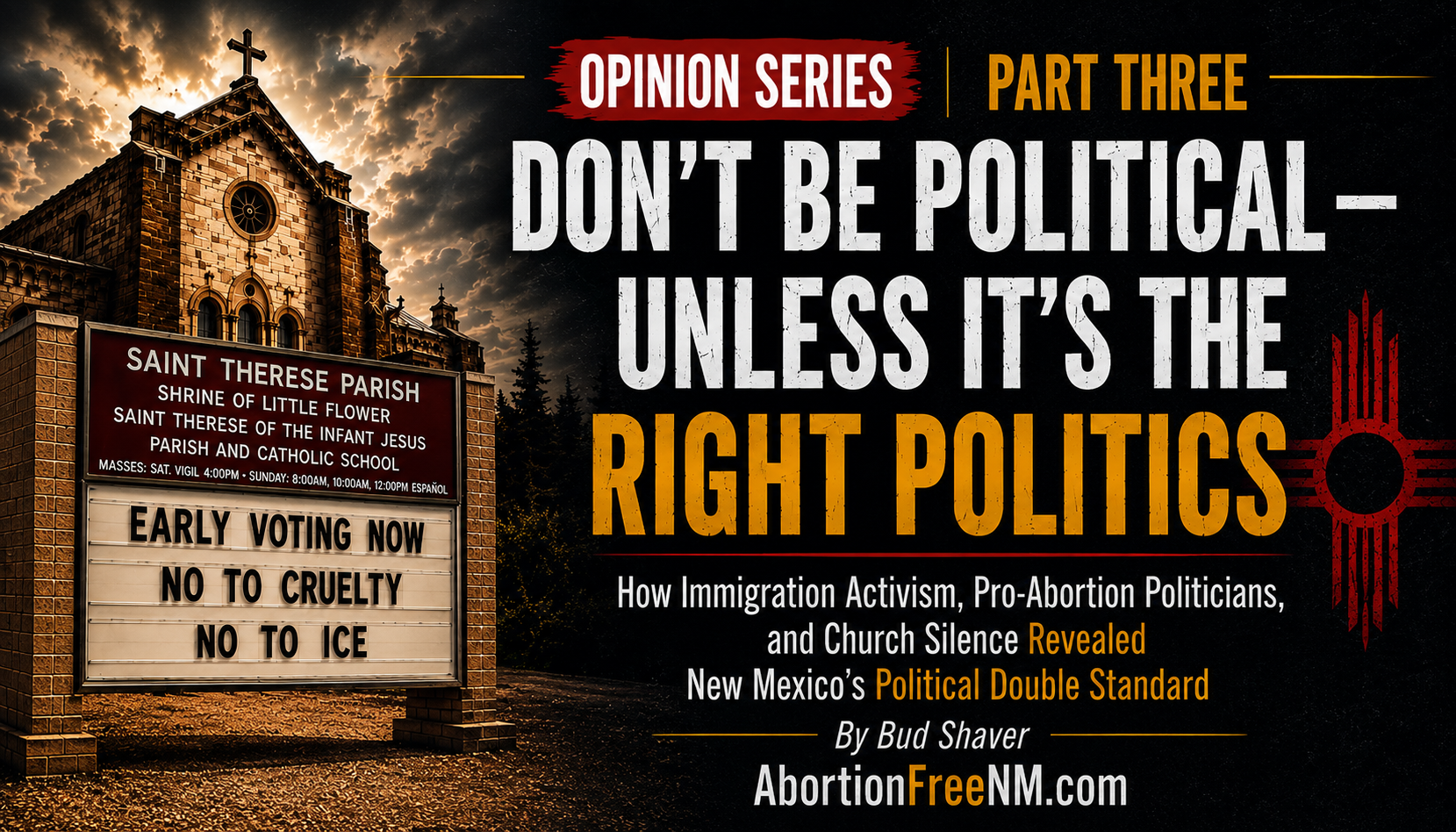
OPINION PART THREE: DON’T BE POLITICAL – UNLESS IT’S THE RIGHT POLITICS
By Bud Shaver
In Part Two of this series, I examined how many New Mexico churches have retreated from the public square under the familiar refrain, “We don’t want to be political.” Yet recent events reveal a contradiction that is becoming increasingly difficult to ignore. Certain churches and religious leaders are not avoiding politics at all. Rather, they appear selective about which political issues—and which politicians—receive their public attention.
Few examples illustrate this more clearly than the ongoing debate over immigration. Across New Mexico, church leaders and religious institutions have openly engaged immigration policy, issued public statements, encouraged advocacy efforts, and criticized various immigration enforcement policies advanced by President Donald Trump and his administration. Whether one agrees with those positions is beside the point. The reality is that these leaders believe faith has a legitimate role in shaping public policy–and they are willing to engage publicly on issues they consider matters of moral importance.
The pattern is not limited to Catholic leaders. Episcopal leaders, mainline Protestant denominations, interfaith coalitions, and religious advocacy organizations have likewise spoken publicly against various immigration enforcement policies, often framing their positions as matters of faith, justice, and moral responsibility. Regardless of one’s view on immigration policy, these examples demonstrate that many religious leaders believe faith has an important role to play in shaping public debates and influencing public policy.
Tara Shaver of Abortion Free New Mexico observes:
“When church leaders publicly challenge President Trump’s immigration policies, nobody argues that faith should stay out of politics. But when Christians speak about abortion, suddenly they’re told the Church should remain neutral. The issue isn’t whether churches engage politics. The issue is why faith is welcomed into some policy debates while excluded from others involving the most basic right of all—the right to life.”
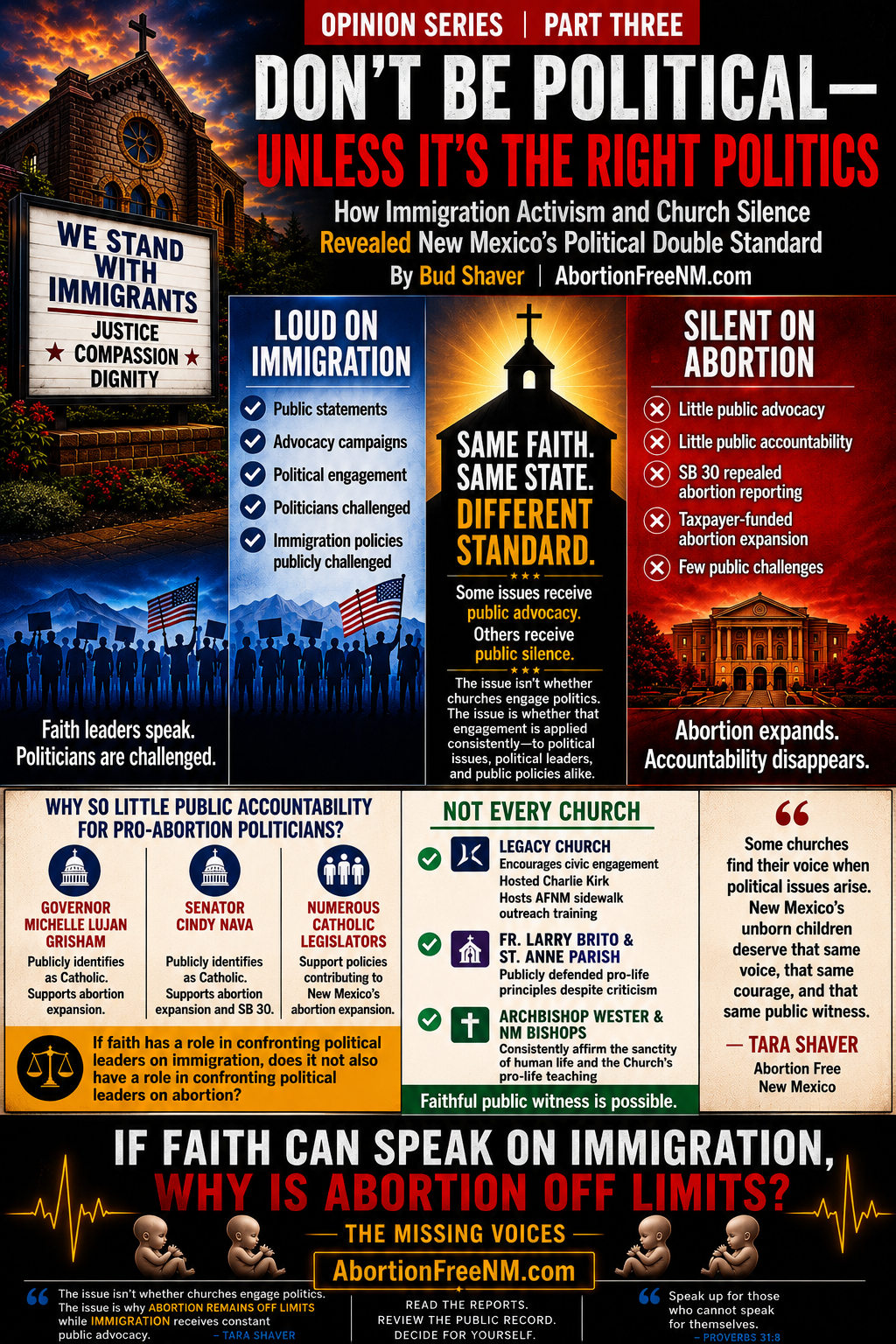
At the same time, New Mexico has experienced one of the most dramatic expansions of abortion access in the nation. Through investigative reporting, public records requests, legislative monitoring, and field research, Abortion Free New Mexico has documented the growth of abortion facilities, taxpayer-funded abortion infrastructure, abortion tourism, interstate abortion trafficking networks, and the repeal of statewide abortion reporting requirements through SB 30.
These developments were debated in legislative hearings, documented through public records, and extensively covered at AbortionFreeNM.com. Yet while immigration policy generated public statements, advocacy campaigns, and political engagement from many religious leaders, abortion expansion often generates comparatively little public response.
The contradiction becomes even more striking when some of New Mexico’s most prominent Catholic politicians publicly invoke faith while advancing abortion policies that have transformed New Mexico into one of the most abortion-friendly states in America. During debate surrounding SB 30, Senator Cindy Nava publicly referenced her Catholic faith while defending legislation that repealed New Mexico’s abortion reporting requirements.
That moment illustrated one of the central tensions explored in this article. Faith was not being excluded from the debate—it was being invoked in support of a policy that reduced public abortion transparency. Many Christians are left wondering why faith is welcomed when used to defend abortion-related policies but often criticized when used to advocate for unborn children, abortion transparency, or greater public accountability.
At the same time, Governor Michelle Lujan Grisham and numerous legislators who publicly identify as Catholic have supported policies that include abortion expansion, abortion shield protections, taxpayer-funded abortion facilities, and the repeal of abortion reporting requirements.
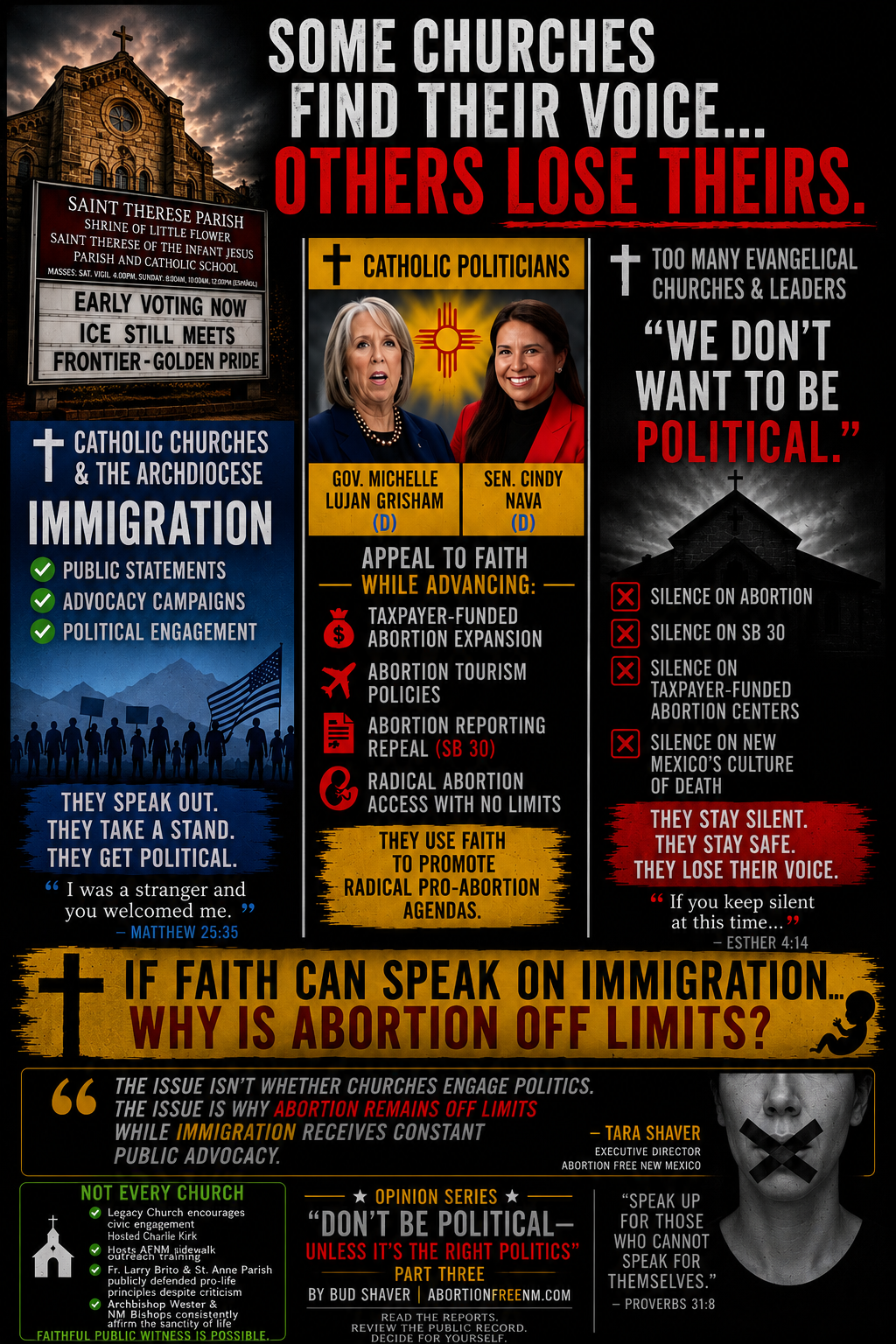
To be fair, this is not simply a Catholic-versus-Evangelical issue. Archbishop John Wester, the New Mexico bishops, Fr. Larry Brito and St. Anne Parish, Legacy Church, and many other faithful leaders deserve recognition for publicly affirming the sanctity of human life and demonstrating that courageous public witness is still possible.
Yet many Christians are left asking an uncomfortable question: If church leaders are willing to publicly challenge presidents, federal agencies, and elected officials on immigration and other policy matters, why is there comparatively little public accountability directed toward politicians who continue advancing abortion expansion in New Mexico?
The inconsistency is not merely about issues. It is also about accountability.
Legacy Church in Albuquerque has consistently encouraged civic participation, hosted nationally recognized speakers such as Charlie Kirk, and welcomed Abortion Free New Mexico to conduct sidewalk outreach and counseling training seminars. Likewise, Fr. Larry Brito and St. Anne Parish in Santa Fe demonstrated a willingness to publicly defend pro-life principles despite significant criticism and controversy.
These examples demonstrate that public engagement is possible. The concern raised in this series is not that every church is silent. Rather, the concern is that courageous public engagement on behalf of unborn children has increasingly become the exception rather than the expectation.
As Tara Shaver concludes:
“Some churches have demonstrated tremendous courage by engaging difficult issues regardless of the political consequences. Archbishop John Wester, the New Mexico bishops, and many Catholic leaders have consistently affirmed the sanctity of human life. Likewise, Legacy Church has demonstrated that public engagement is possible by encouraging civic participation, hosting nationally recognized speakers, and opening its doors to Abortion Free New Mexico for pro-life outreach and training.”
“The issue isn’t whether churches engage politics. Many already do. The question is whether that same moral courage will be applied consistently—to political issues, political leaders, and public policies alike.”
“If faith has a place in challenging presidents, it has a place in confronting abortion. If faith has a place in shaping public policy, it has a place in defending unborn children. And if faith belongs in debates about justice, it belongs in debates about life. New Mexico’s unborn children deserve a Church—and people of faith—willing to speak with the same courage, conviction, and consistency they bring to every other issue.”
When faith is welcomed in some public debates but discouraged in others, people inevitably begin to wonder whether the standard is Scripture or politics dressed in religious language.
That is a question New Mexico’s churches can no longer afford to ignore.
RELATED ARTICLES:
You May Also Like
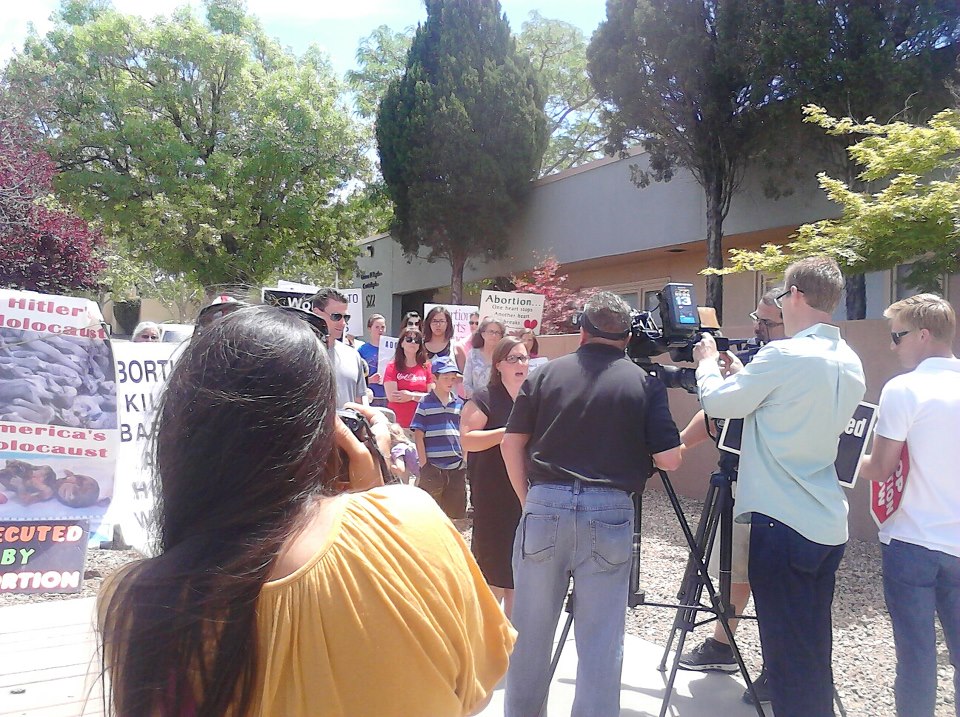
Press Conference And Rally Spreads The Word About Late-Term Abortions In Albuquerque
Reality Check: We’re at War Against Incarnate Evil