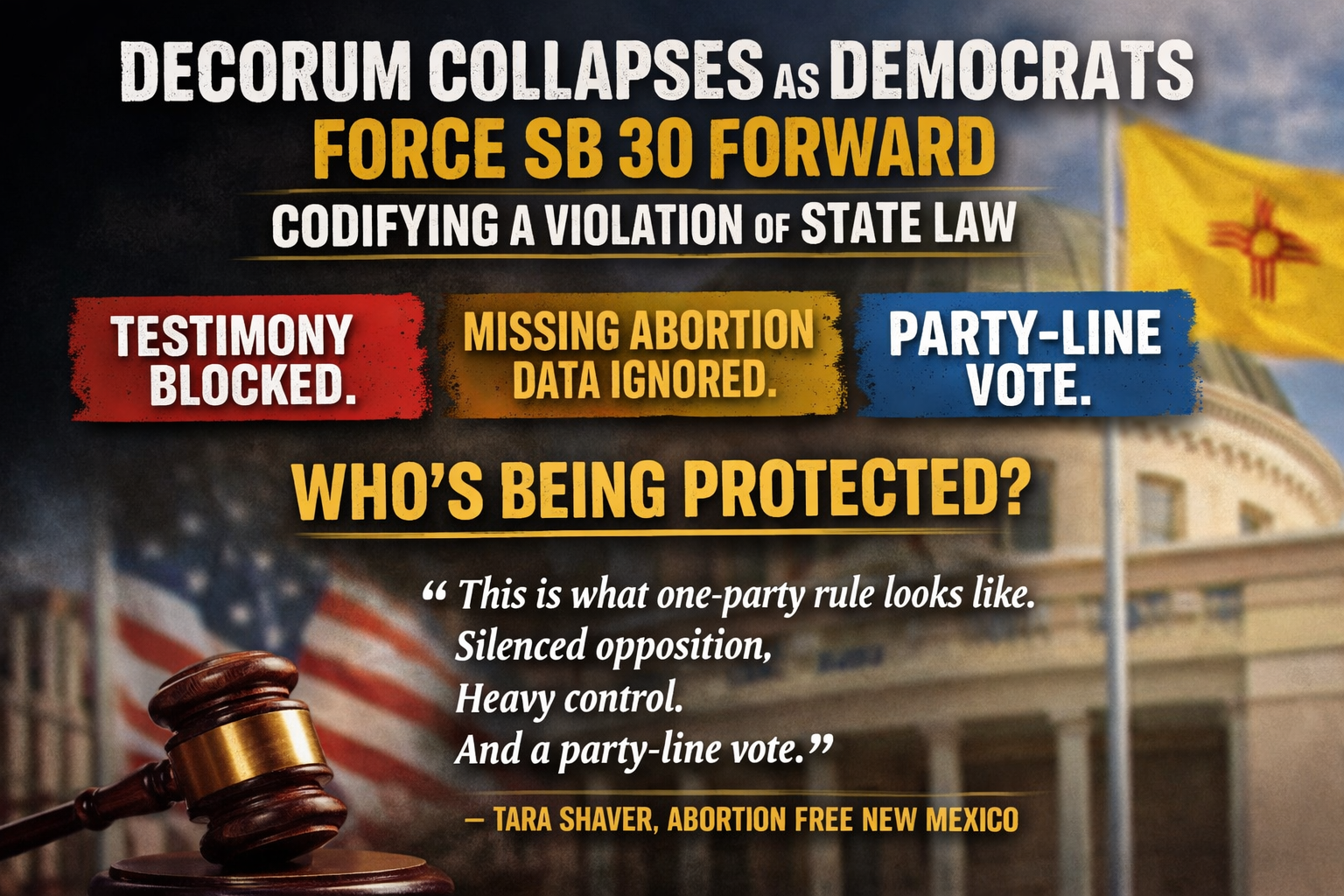
Testimony Blocked. Survivors Cut Off. Missing Abortion Data Ignored. Bill Advances on Party-Line Vote.
By Bud Shaver,
Santa Fe, New Mexico — What took place in the House Judiciary Committee was not open debate — it was one-party rule in full display. Under Democrat leadership, committee power is being used not just to manage hearings but to control them, suppress dissent, and advance policy with minimal public scrutiny.
This heavy-handed approach reflects what Abortion Free New Mexico documented in our recent report, A Pattern of Secrecy: Abortion Oversight Shrinks Under Democrat Control, which outlines how Democratic leadership has systematically eroded transparency in areas ranging from emergency response records to statewide abortion reporting — even as taxpayer dollars support abortion services without accessible data on how those funds are being used.
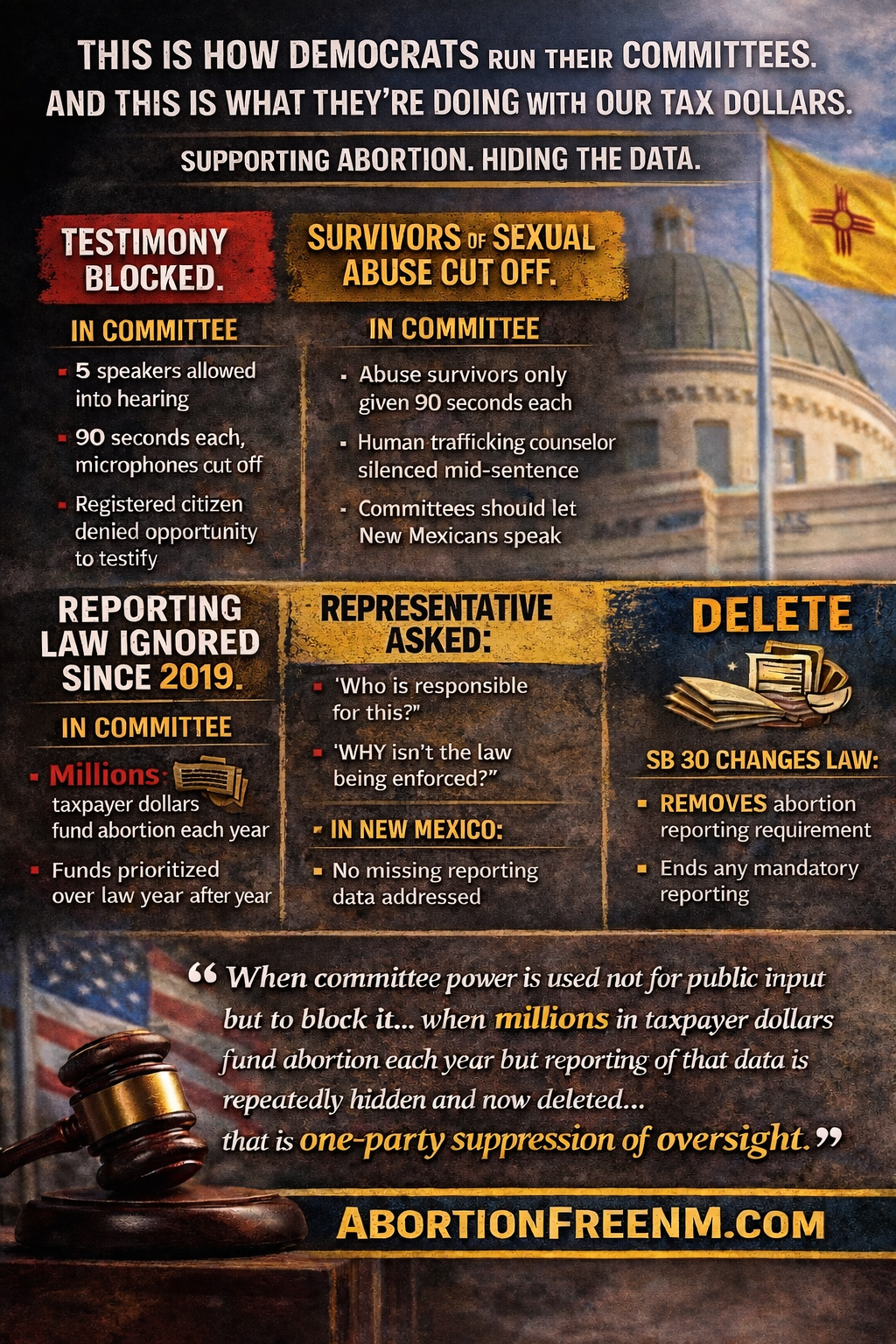
Opposition testimony on SB 30 was tightly restricted to just five speakers, each given only 90 seconds — and witnesses were cut off mid-sentence, including a woman sharing powerful testimony about surviving sexual abuse and assisting trafficking victims.
Tara Shaver of Abortion Free New Mexico followed the required process, registered to testify, and prepared formal remarks. She was not permitted to speak.
This was not neutral moderation. It was procedural force used to suppress dissent.
Five opposition speakers. Ninety seconds each. Survivors silenced. Then a party-line vote advancing SB 30 out of committee.
When majority power is used to block testimony, restrict public input, and fast-track legislation without addressing unresolved statutory violations, citizens are left to ask whether committees exist for deliberation — or domination.
FROM IGNORED LAW TO CODIFIED SECRECY
Under existing New Mexico law, every induced abortion performed in the state is supposed to be reported to the state registrar within five days.
Yet New Mexico abortion statistics have not been publicly reported since 2019 — meaning the public can’t see annual totals, demographic trends, or procedural data, even though the statute requires it.
During the hearing, Representative Alan Martínez (R) asked who is responsible for the missing data. A Planned Parenthood representative responded that responsibility lies with the Registrar at the New Mexico Department of Health, the official charged with compiling and publishing vital statistics.
Instead of enforcing compliance with the law already on the books, SB 30 would eliminate the abortion reporting requirement entirely.
If the law hasn’t been followed, why remove it instead of enforcing it?
Rather than restoring transparency, SB 30 transforms an unresolved statutory lapse into permanent policy.
STATEMENT FROM TARA SHAVER
“One-party control becomes dangerous when it turns into one-party suppression. The gavel should not be a weapon. I followed the rules — I registered to testify, I prepared remarks — and I was blocked from speaking. That is not open government. If abortion reporting hasn’t been published since 2019, the answer is investigation and enforcement — not deleting the statute so the violation disappears. When millions in taxpayer dollars fund abortion each year but reporting of that data is hidden and now deleted, that is one-party suppression of oversight. New Mexicans should not tolerate laws being ignored and then erased to cover the failure.”
WHAT HAPPENS NEXT
SB 30 now faces one more House committee hearing before advancing to the House floor. If approved there, the bill will proceed to the Governor’s desk.
The remaining committee hearing represents one of the final opportunities for lawmakers to demand enforcement instead of erasure.
The House floor vote will place every representative on record.
The Governor’s decision will determine whether transparency is restored — or permanently removed from statute.
QUESTIONS FOR NEW MEXICO
Should citizens accept:
• Registered speakers being denied the opportunity to testify?
• Survivors cut off mid-statement?
• Statutory reporting requirements ignored for years?
• A bill eliminating transparency advancing on a party-line vote?
• Tax dollars funding abortion services while the public is kept in the dark about the data?
Responsible governance requires more than majority power. It requires accountability.
CONCLUSION
This is no longer about a single bill. It is about a governing pattern.When hearings are tightly controlled, testimony is restricted, statutory mandates go unenforced, and transparency requirements are erased rather than upheld, it signals a shift from oversight to insulation.SB 30 represents more than a policy change — it represents a choice between enforcing the law or rewriting it to accommodate noncompliance.New Mexicans deserve open hearings, lawful process, and full public transparency — especially when taxpayer dollars and vulnerable lives are involved.
The next committee hearing will test whether lawmakers choose enforcement or erasure.
The House floor vote will put every representative on record.
The Governor’s signature will determine whether transparency survives — or disappears.
About the Author