By Bud Shaver,
Albuquerque, N.M. — The reopening of the Zorro Ranch investigation in 2026, alongside the creation of a state “Truth Commission,” is renewing scrutiny over longstanding questions about oversight, enforcement, and accountability in New Mexico.The renewed attention comes after the original state investigation into Zorro Ranch was closed in 2019 without charges, despite the broader national context surrounding Jeffrey Epstein and documented federal investigative activity.At the same time, separate concerns have been raised regarding abortion oversight and enforcement practices in New Mexico, including questions about how referrals, regulations, and existing authorities are applied.
Together, these issues prompt a fundamental question: what determines when authority is used—and when it is not?
“In multiple high-profile contexts, state officials possessed clear legal authority to act. The public record indicates that in key instances, that authority was not exercised.”
— Tara Shaver, Abortion Free New Mexico
2019: An Exercise of Discretion
In 2019, the State of New Mexico discontinued its investigation into alleged criminal activity associated with Zorro Ranch, a property in Santa Fe County linked to financier Jeffrey Epstein, who had previously been convicted in Florida in 2008 for offenses involving a minor and was later charged at the federal level with sex trafficking offenses involving minors.
Despite that prior conviction, the public record raises questions about whether that history was fully reflected in how related activity in New Mexico was evaluated or prioritized.
Questions have also been raised about how sex offender registration laws were applied across jurisdictions, including whether Epstein’s presence and activities in New Mexico triggered any registration or reporting obligations under state law.
Public reporting and federal investigations had identified concerns related to activity connected to the property, including potential violations involving the exploitation of minors and related criminal conduct.
In 2019, the State of New Mexico discontinued its investigation under then–Attorney General Hector Balderas.
Public explanations indicated that federal prosecutors requested the state defer to an ongoing federal investigation.
However, under principles of concurrent jurisdiction, such requests do not limit a state’s independent authority to investigate potential violations of state law.
As Attorney General, Balderas retained full discretion to continue or expand the state’s investigation.
The decision to discontinue the case was his.
There is no indication in the public record that a court order required the state to stand down.
The outcome reflects a discretionary decision not to proceed with a state-level investigation.
This raises a broader question: was the decision not to pursue a state-level investigation influenced in any way by political considerations?
“The issue isn’t just what is happening—it’s whether anyone is willing to examine it. Authority means nothing if it’s not used.”
— Tara Shaver, Abortion Free New Mexico
If authority existed, and action did not follow, the question is not only what happened—but why.
Pre-2019 Context
If the 2019 decision reflects an exercise of discretion, it also raises a related question: what occurred in the years leading up to that decision?
The 2019 discontinuation did not occur in isolation. It followed a prolonged period in which no sustained state-level investigation is reflected in the public record, despite federal authorities identifying activity connected to New Mexico as early as 2006.
Federal investigative activity during that period included witness interviews, documented allegations, and the identification of locations associated with potential criminal conduct, including the Zorro Ranch property.
Yet the available public record does not reflect a comprehensive or sustained state-level investigation corresponding to that timeline.
This absence is notable given that state authorities maintained jurisdiction over potential violations of New Mexico law throughout that period.
If authority existed over more than a decade—and no sustained action is reflected in the record—the question extends beyond a single decision in 2019.
It raises a broader issue: whether enforcement authority was exercised consistently at any point during that timeframe.
As Tara Shaver has stated,
“The issue isn’t authority—it’s whether it’s used.”
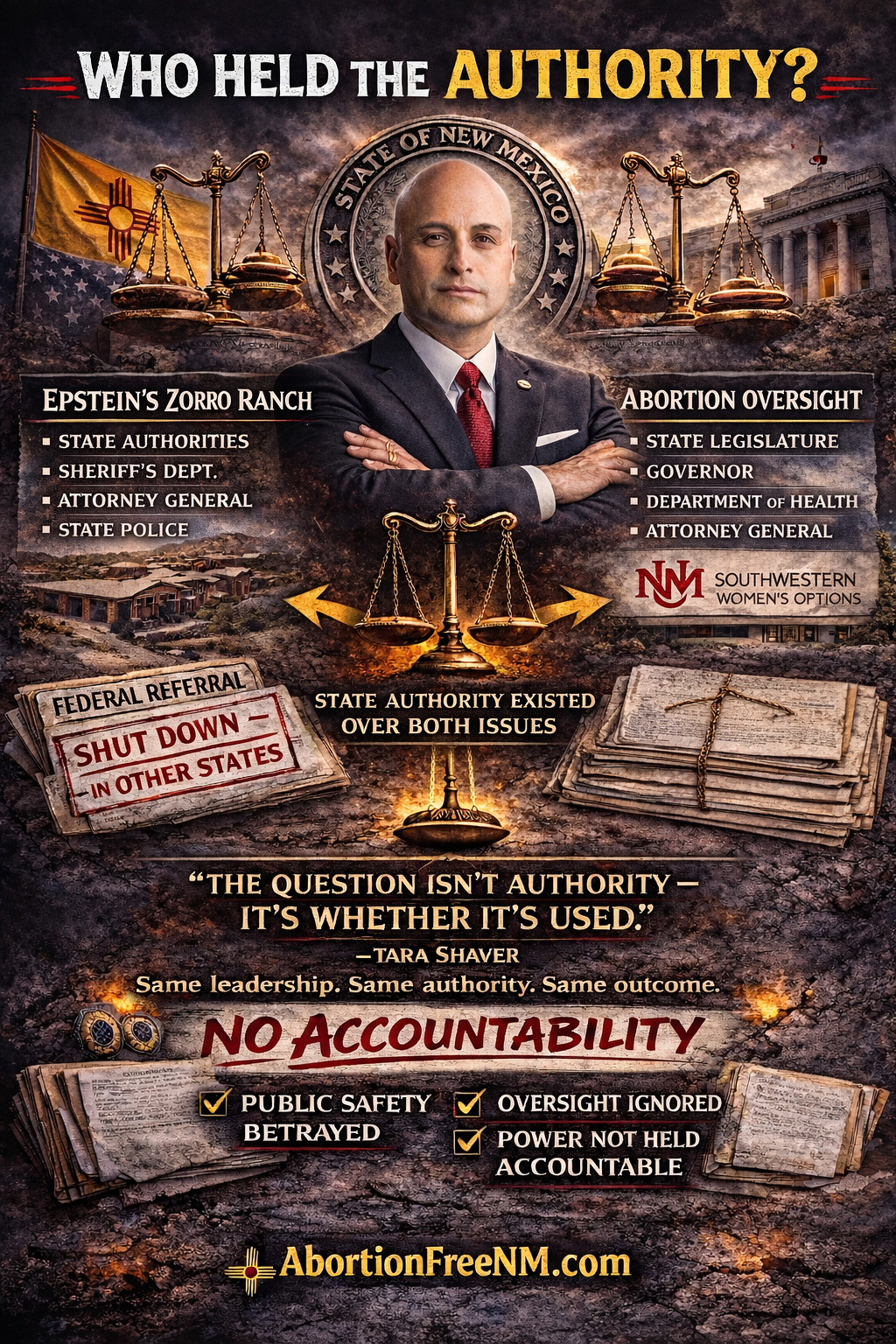
Who Held the Authority
If the public record reflects limited sustained enforcement over more than a decade, the next question is straightforward: who had the authority to act during that time?Reporting by Alisa Valdes-Rodriguez identifies a pattern of overlapping roles, relationships, and institutional authority among key officials during the period when no meaningful state investigation moved forward.
Those individuals include:
- Former Attorney General Hector Balderas (D), who made the 2019 decision to discontinue the investigation
- Former Attorney General Gary King (D), whose family sold Zorro Ranch to Jeffrey Epstein and who, according to reporting, received campaign contributions linked to Epstein-associated entities while serving in office. Newly released records also indicate King had direct contact regarding use of Epstein’s private aircraft during his 2014 campaign and received more than $15,000 in contributions tied to Epstein.
- Former Governor Bill Richardson (D), identified in reporting as having documented associations with Epstein and who oversaw the state’s law enforcement structure during a period when no state-level investigation advanced. His name was later removed from a UNM Hospital building following renewed scrutiny tied to those disclosures.
- Former Santa Fe County Sheriff Greg Solano (D), whose office held jurisdiction over Zorro Ranch and who, according to reporting, received a campaign contribution from Epstein but conducted no known investigation. In a separate case, Solano was later charged with more than 200 counts of embezzlement involving the sale of public law enforcement equipment.
Each of these positions carried direct authority to initiate, pursue, or coordinate enforcement actions under New Mexico law.
These were the officials with the authority to act.
The public record reflects that such authority was not exercised.
While multiple officials held authority over time, the 2019 decision to discontinue the Zorro Ranch investigation ultimately rested with then–Attorney General Hector Balderas.
Federal Referral and Investigative Origin
If questions exist regarding how state authority was exercised in the context of Zorro Ranch, a related question emerges: how were similar oversight responsibilities handled in other areas where concerns were formally raised—including in the area of abortion-related practices?To fully understand the scope of oversight questions in New Mexico, it is necessary to examine how related concerns were addressed at the federal level—and what followed.
Between 2015 and 2016, the U.S. House Select Panel on Infant Lives conducted a congressional investigation into fetal tissue procurement practices across the United States. That investigation resulted in criminal and regulatory referrals to federal and state authorities for further review.
Those referrals were not developed in isolation.They were informed, in part, by investigative documentation and public records research, including work conducted by Abortion Free New Mexico.According to national reporting, including coverage by the National Catholic Register, documentation obtained through these efforts contributed to congressional review of fetal tissue procurement practices involving New Mexico institutions, including the University of New Mexico.
These materials became part of the evidentiary record reviewed at the federal level and contributed to the issuance of congressional referrals for further investigation and potential enforcement action.
From Referral to Responsibility
As with the earlier context, these referrals did not resolve the issues on their own—they required action at the state level.
Where state jurisdiction applied, responsibility for review and enforcement rested with state authorities.
Available records indicate that these referrals did not result in state enforcement action.
“The central question is whether those concerns were fully examined at the state level, or whether existing policy positions—including New Mexico leadership’s support for abortion— influenced how those matters were evaluated,” stated Tara Shaver of Abortion Free New Mexico.
From Authority to Accountability: A Pattern Observed
For Abortion Free New Mexico, these developments reflect more than isolated decisions—they point to a pattern observed over years of investigative work led by Tara Shaver.
That work has included:
- Public records investigations involving state agencies and public institutions
- Submission of formal complaints and documentation of regulatory concerns
- Legislative engagement related to oversight and transparency
- Coordination with national organizations and federal review bodies
Through these efforts, Abortion Free New Mexico has documented recurring questions about how authority is exercised in practice, particularly in cases involving multiple institutions and overlapping jurisdictions.
This body of work has contributed to broader scrutiny of New Mexico’s role in national abortion policy, research, and regulatory oversight, including activity connected to public institutions such as the University of New Mexico.
“The issue is not just what is happening—it’s whether anyone is willing to examine it.”— Tara Shaver
Now Apply That Same Question Elsewhere
For Abortion Free New Mexico, the same oversight questions extend beyond past investigations and into current abortion policy and practice.
New Mexico has become one of the most active abortion destinations in the country, with approximately21,000 abortions in 2023, including a significant number of patients traveling from out of state.At the same time, state leadership has articulated policy priorities focused on safeguarding and expanding abortion access, particularly in response to restrictions enacted in other states. Abortion Free New Mexico has also raised concerns about oversight practices, including how reported complications are addressed and whether clinic oversight—including inspections—is consistently applied.In practical terms, these factors can limit formal oversight mechanisms and raise broader questions about how existing authority is exercised in practice.
The organization’s investigative work has included examination of programs and research connected to the University of New Mexico, including questions related to compliance, documentation, and institutional oversight.
“New Mexico leadership has made its priorities clear—safeguarding and expanding abortion access, particularly as other states restrict it. When reported abortion complications do not result in clear enforcement or consistent oversight, people will ask whether accountability is being applied consistently—or whether the system is effectively shielding the industry from scrutiny,” stated Tara Shaver of Abortion Free New Mexico.
Then and Now: Authority and Priorities
As attention turns to past decisions, it is equally important to examine how authority is being exercised today.New Mexico Attorney General Raúl Torrez has expressed support for the state’s current abortion framework while also reopening aspects of the Zorro Ranch investigation in 2026. That contrast raises broader questions about how enforcement priorities are determined—and whether they are applied consistently.New Mexico’s current policy direction maintains expanded abortion access with limited regulatory structure, raising questions about how those priorities intersect with oversight.
“Public officials can hold policy views,”Shaver said.
“But the responsibility to ensure accountability should remain consistent, regardless of the issue.”
Same System. Same Outcome
The issue is not whether the cases are identical, but whether the same pattern appears when oversight is expected—and whether authority is used when it exists.
In one instance, state authority over alleged criminal activity at Zorro Ranch was clear for years, yet no sustained investigation advanced, and the case was ultimately discontinued in 2019.
In another, concerns were elevated to the federal level and formally referred for review following the U.S. House Select Panel on Infant Lives investigation. That evidence included documentation connected to New Mexico institutions, developed in part through investigative work associated with Abortion Free New Mexico.
Those referrals were intended to prompt further review. However, available records indicate no resulting state enforcement action, leaving it unclear to what extent those concerns were fully examined.Across both situations, the pattern is consistent:
- Authority identified
- Concerns documented
- Jurisdiction established
- Action unclear or absent
Different issues. Same outcome: limited accountability.
A Broader Question About Independence and Accountability
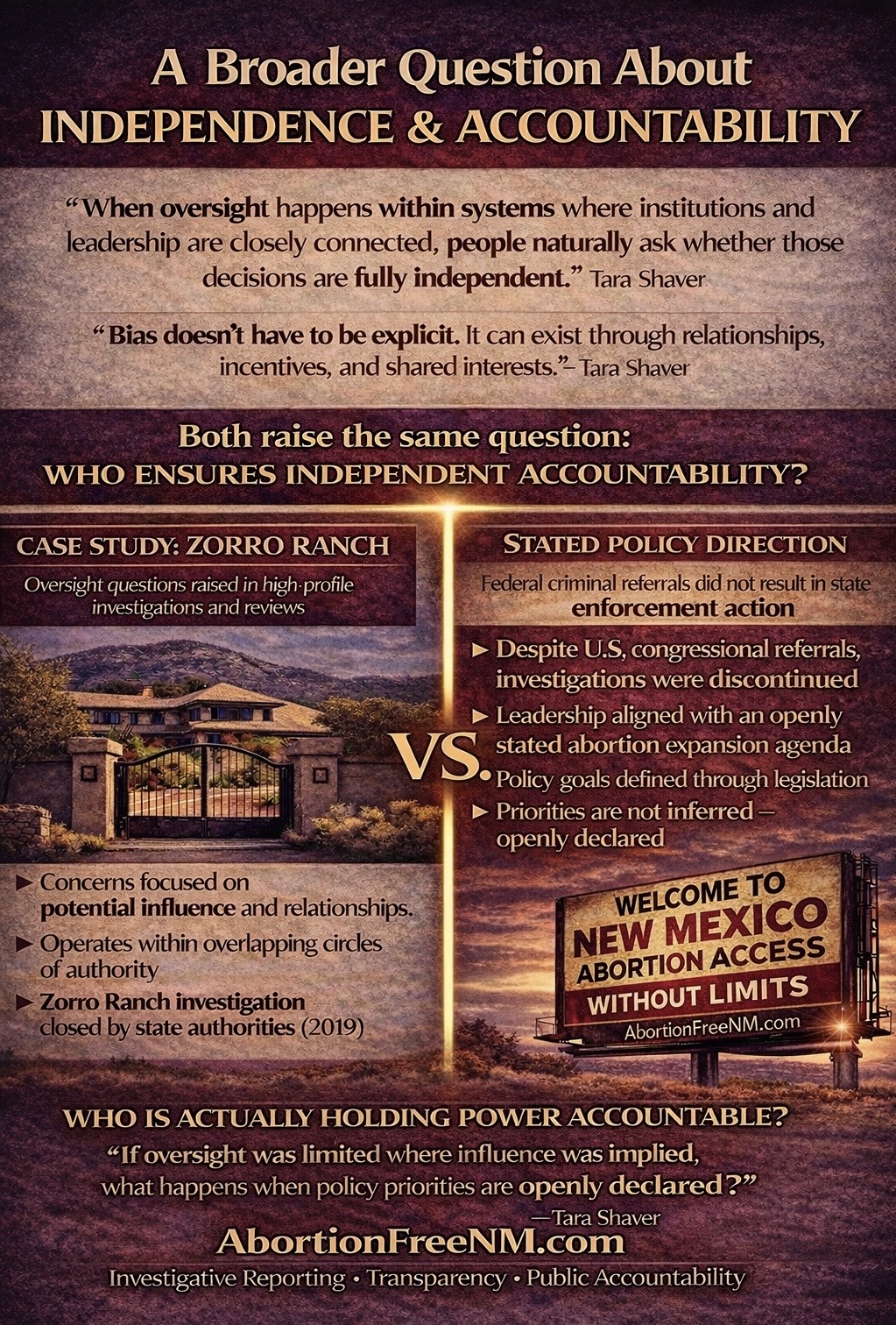
When oversight occurs within systems where leadership, institutions, and policy priorities are closely aligned, questions about independence naturally arise.
In the case of Zorro Ranch, concerns centered on relationships and influence within overlapping circles of authority. Those dynamics were largely implicit.
By contrast, in abortion policy, New Mexico’s leadership has openly articulated support for expanding access through legislation, funding, and integration within public institutions.
These priorities are stated—not inferred.
That distinction sharpens the question:
If oversight appeared limited where influence was implicit, what should be expected where policy priorities are explicit?
Why This Matters Now
With aspects of the Zorro Ranch investigation being revisited in 2026, attention is shifting:
What wasn’t done before—and why?
And are similar patterns still occurring today?
“Authority means nothing if it isn’t used. When leaders openly state their support for expanding abortion access—and when overlapping relationships and institutional ties exist within the same systems responsible for oversight—people will reasonably ask whether those factors influence what gets investigated, what doesn’t, and how decisions are made, including the decision to close the Zorro Ranch investigation.”— Tara Shaver, Abortion Free New Mexico
About Abortion Free New Mexico
Abortion Free New Mexico (AFNM) works to promote transparency and accountability regarding abortion policy and the abortion industry in New Mexico through investigative research, public records analysis, and public policy engagement.
AFNM’s work has been cited in state-level discussions, legislative engagement, and national reporting, including issues related to fetal tissue procurement and oversight practices.
The organization continues to advocate for greater transparency, consistent enforcement of existing laws, and accountability across all institutions involved in abortion-related practices.
More information and investigative reports are available at: AbortionFreeNM.com
About the Author