
THE 2026 LEGISLATIVE STACK: REDUCED EXPOSURE. REDUCED TRANSPARENCY. EXPANDED ABORTION ACCESS.
Is This the Legacy the Governor Wants to Solidify?
By Bud Shaver,
Santa Fe, New Mexico
–The 2026 legislative session is being promoted as a year of healthcare reform.But when the full legislative stack is examined, one sector appears to benefit more than any other:
The abortion industry.This session delivered:
- Interstate licensure expansion (SB 1 and related compacts)
- Malpractice liability refinements under HB 99
- Elimination of uniform statewide abortion reporting under SB 30
- Existing shield law protections left intact
Individually, these bills are framed as reform.
Collectively, they expand access, stabilize liability, preserve insulation, and remove transparency — within one specific sector.
No other healthcare industry received that combination.
HB 99: Liability Carefully Protected
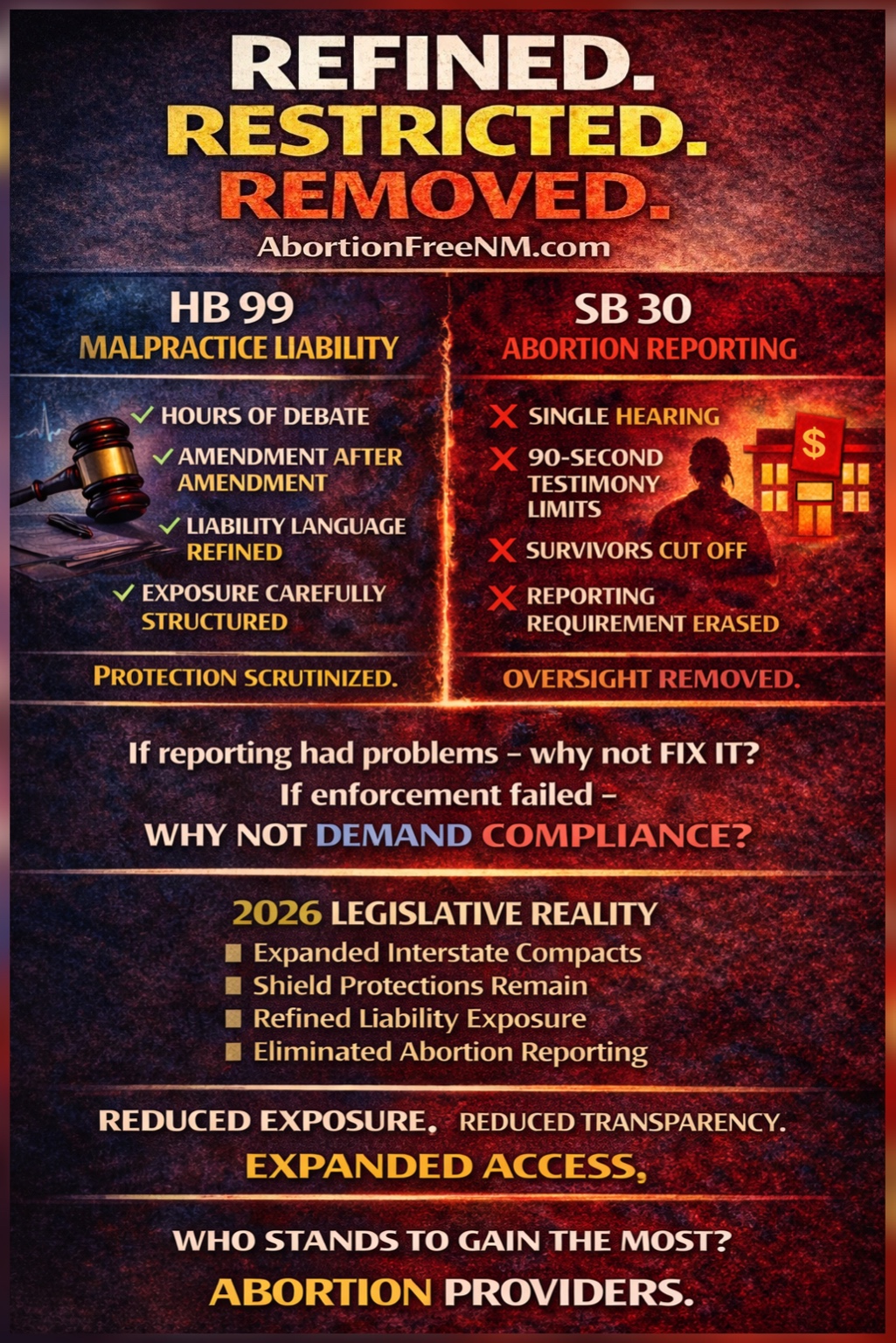
House Judiciary, under Chair Rep. Christine Chandler (D), spent hours refining malpractice language in HB 99.
- Eleven amendments were considered.
- Definitions were debated line by line.
- Exposure standards were meticulously examined.
Liability protections were treated as serious business.
They were refined.
They were structured.
They were protected.
SB 30: Transparency Eliminated After Being Fast-Tracked
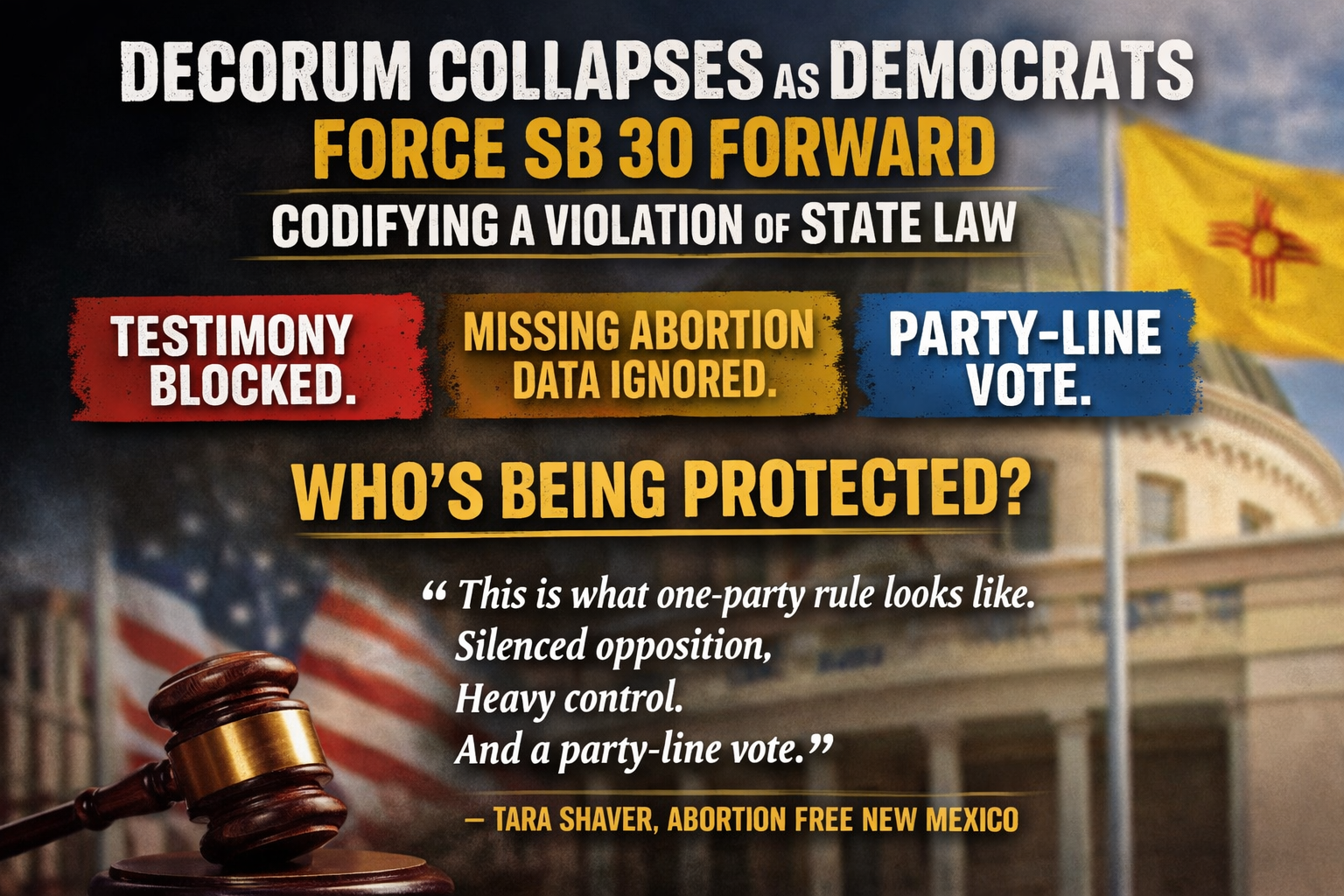
In contrast, SB 30 — eliminating uniform statewide abortion reporting beginning in 2026 — was fast-tracked through the Senate and given only a single hearing in House Judiciary before advancing.
- Testimony was limited.
- Survivors were cut off mid-statement.
- No serious transparency amendments were adopted.
- The bill advanced swiftly.
While liability exposure was refined for hours, abortion transparency was removed in minutes.
That contrast defines the session.
Where Were the Amendments?
During HB 99, amendments flowed.
During SB 30, they did not.
AFNM asks:
- Why were eleven amendments debated on liability but none seriously pursued to preserve abortion transparency?
- Why did Republicans not attempt to amend SB 30 to retain reporting safeguards?
- Why eliminate reporting instead of enforcing it?
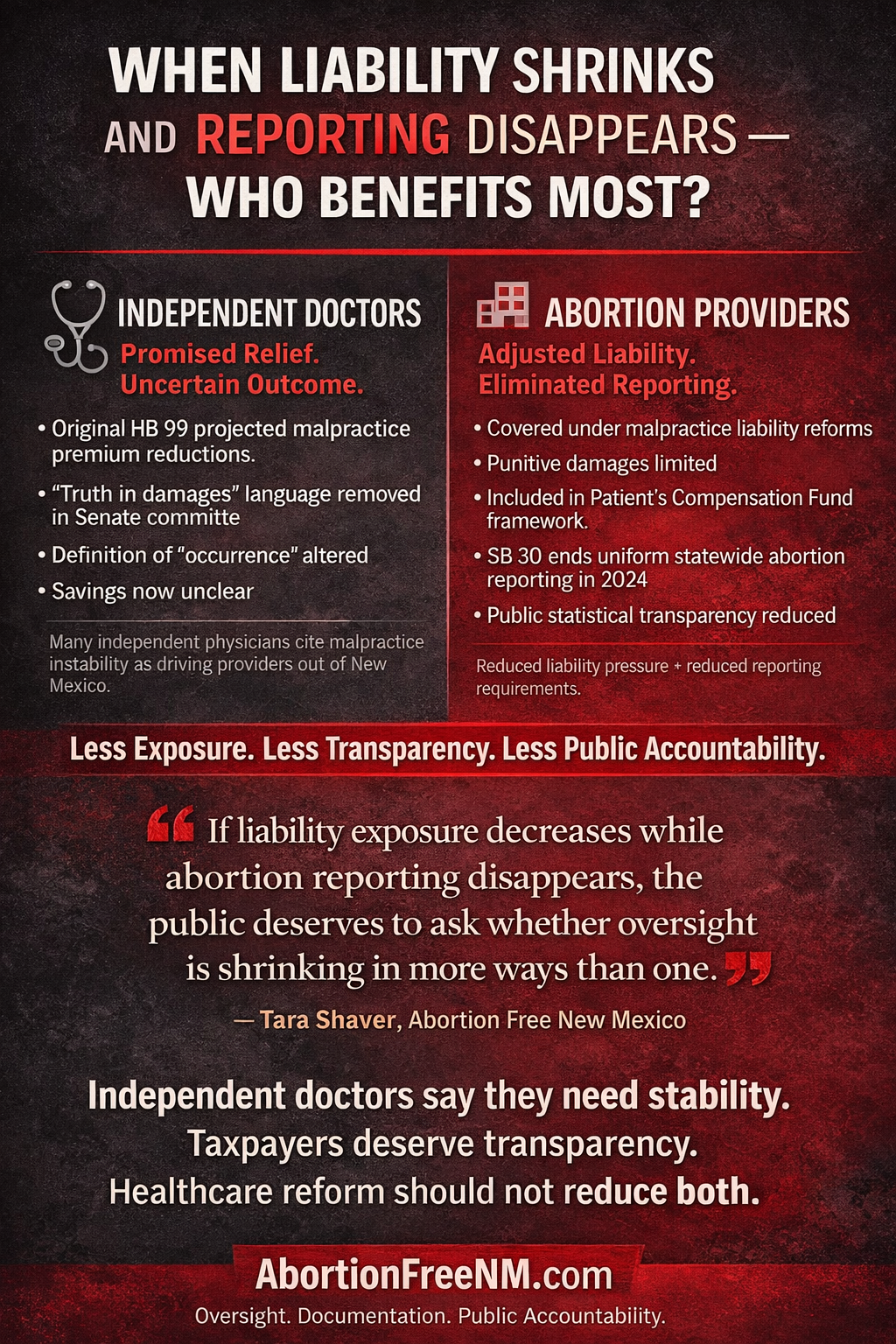
“When liability protections were at stake, lawmakers refined and amended,” Shaver said. “When transparency protections were at stake, they were removed.”
The Data Question
According to the Guttmacher Institute’s 2023 provider survey estimate:
- Approximately 21,000 abortions occurred in New Mexico
- Roughly 71% of patients traveled from out of state
Abortion providers were
capable of submitting that data to a private organization.
But SB 30 eliminates mandatory reporting to the State of New Mexico.
The issue is not burden.
The issue is who receives the data.
When reporting becomes voluntary, verification disappears.
Abortion Clinics and Regulatory Gaps
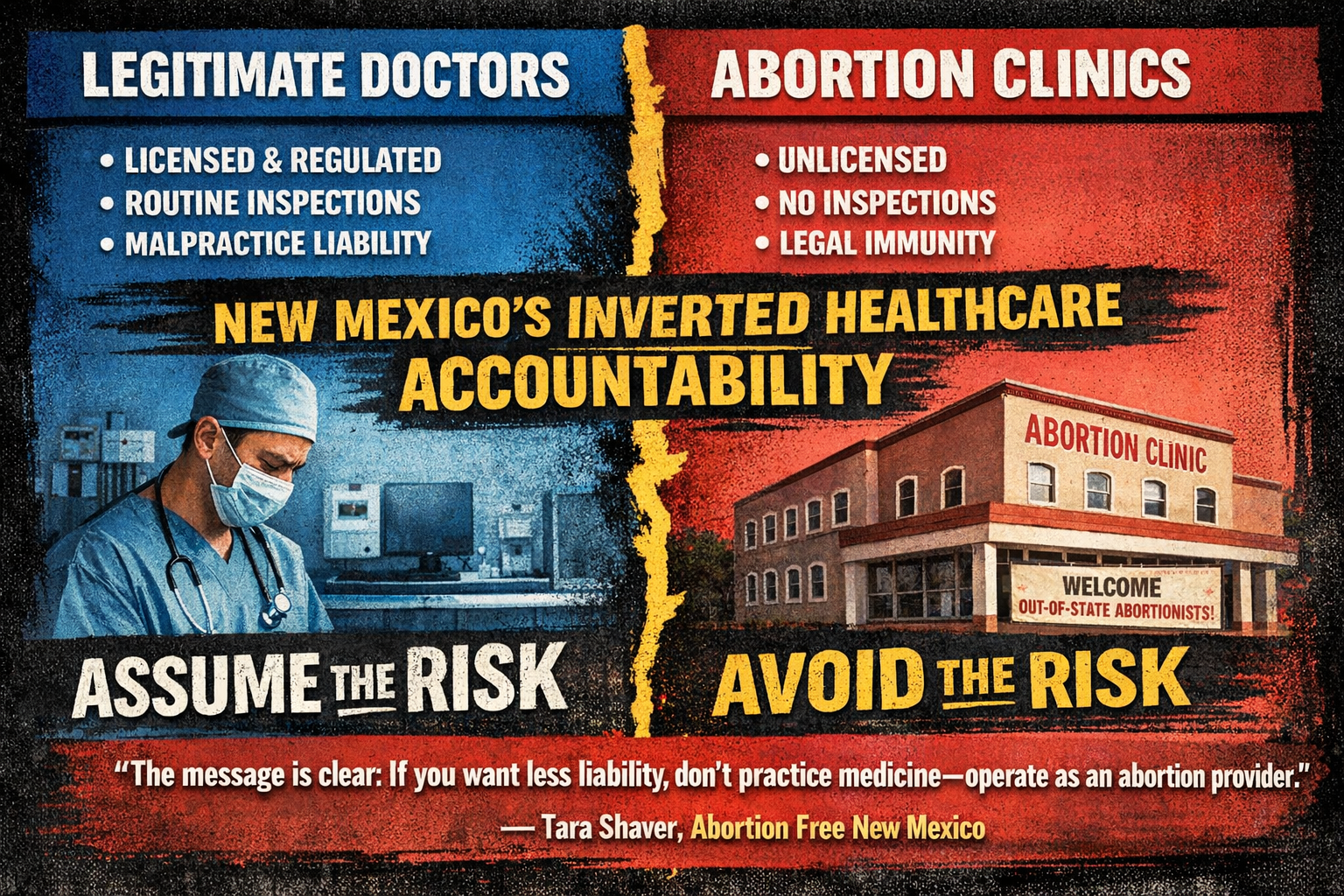
Hospitals are inspected.
Nursing homes are inspected.
Ambulatory surgical centers are inspected.
Abortion facilities in New Mexico do not operate under a distinct abortion-clinic licensing and inspection structure requiring routine state inspections comparable to hospitals.
With SB 30:
- Uniform statewide abortion reporting disappears
- Verification becomes harder
- Public access to official data vanishes
“Healthcare transparency and inspection standards should be consistent,” said Tara Shaver of Abortion Free New Mexico. “If abortion is healthcare, then it should meet the same reporting and inspection expectations as other regulated medical sectors.”
Abortion Providers Stand to Gain the Most
Combine the full 2026 policy structure:
- Expanded interstate workforce access
- Maintained shield law protections
- Refined malpractice exposure
- Eliminated mandatory abortion reporting
- No distinct abortion-clinic inspection framework
The result:
- Access expands.
- Liability stabilizes.
- Transparency shrinks.
- Inspection remains limited.
That structural convergence disproportionately benefits abortion providers.
Independent physicians may benefit from malpractice reform.
Abortion providers benefit from malpractice reform, shield protections, expanded entry pathways, and reduced oversight — simultaneously.
No other healthcare sector receives that convergence.
“When those shifts happen together in one sector,” Shaver said, “the public has every right to ask who really benefits.”
The Legacy Question
Governor Michelle Lujan Grisham has framed medical malpractice reform as a defining part of her legacy.
But reform is judged by outcomes.
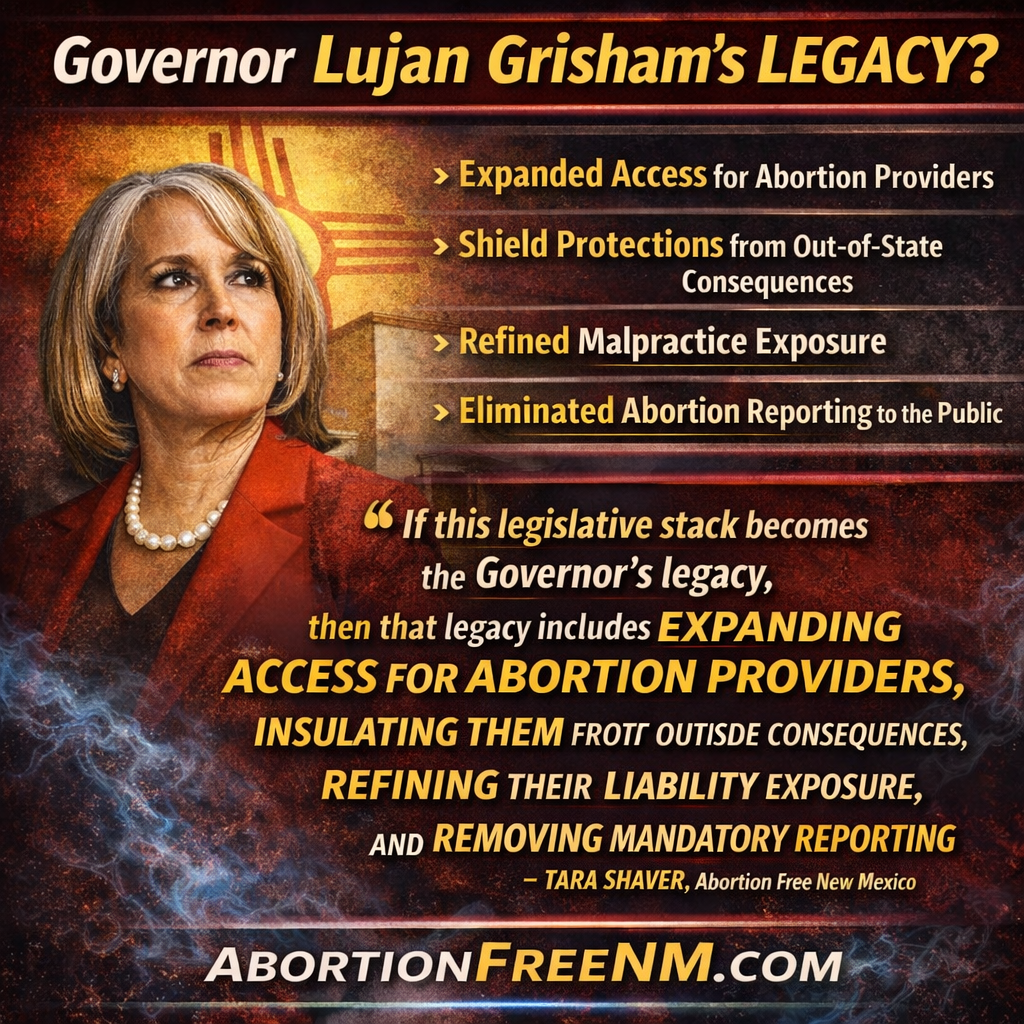
“If this session’s healthcare reform becomes the Governor’s legacy,” said Tara Shaver of Abortion Free New Mexico, “then that legacy will include expanded access for abortion providers, refined liability protections for abortion providers, preserved shield protections for abortion providers — and the elimination of abortion reporting to the public.”
She continued:
“Is insulating the abortion industry while eliminating transparency what the Governor wants solidified as her legacy? Because that is what this legislative stack accomplishes.”
Why This Matters
This is not about partisan rhetoric.
It is about how oversight is structured.
When high-volume abortion services operate in a state that:
- Expands interstate access
- Limits out-of-state consequences
- Refines liability exposure
- Eliminates mandatory reporting
- Lacks a distinct inspection framework
Oversight contracts while protection expands.
That is measurable.
That is policy.
That is legacy.
Questions That Demand Answers
- Why eliminate mandatory abortion reporting instead of enforcing compliance?
- Why refine liability exposure while reducing transparency?
- Why does abortion operate without a distinct inspection structure?
- Why did amendments flow on liability but not on transparency?
- Is this combination of protections and reduced oversight intentional?
“Reduced exposure. Reduced transparency. Expanded abortion access,” Tara Shaver said. “If that is the structure being constructed, then the abortion industry is the clear beneficiary — and the public deserves honesty about it.”

You May Also Like

NEW MEXICO VS. COLORADO: GREEN CHILE RIVALRY ECLIPSED BY RACE TO THE TOP IN ABORTION
Part 1: Nationwide Project With Operation Rescue