By Bud Shaver,
Albuquerque, New Mexico — As Senate Bill 30
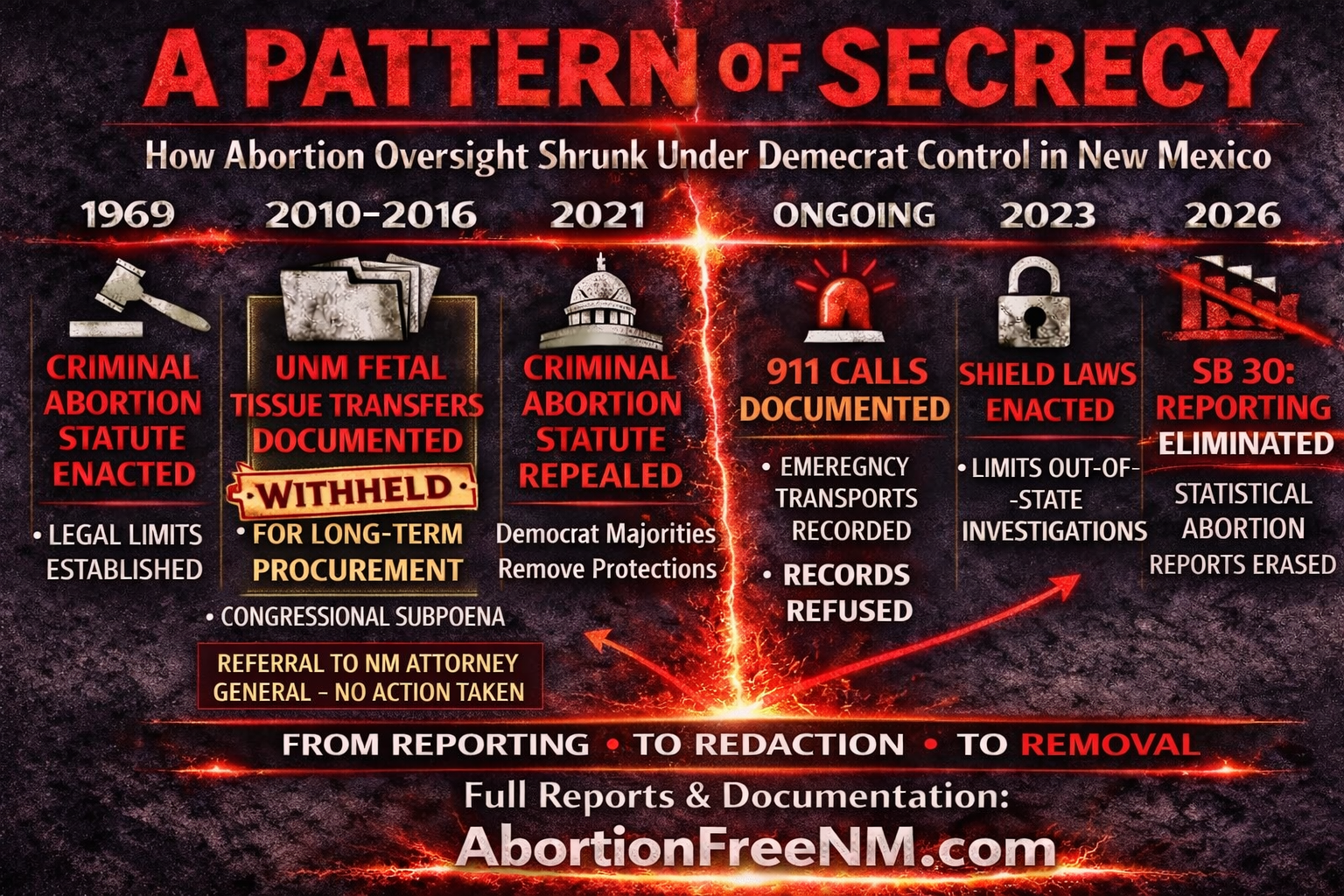
(SB 30) heads to its first House committee hearing today, Abortion Free New Mexico (AFNM) says a clear pattern has emerged in New Mexico: when abortion-related oversight questions arise, transparency contracts rather than expands.
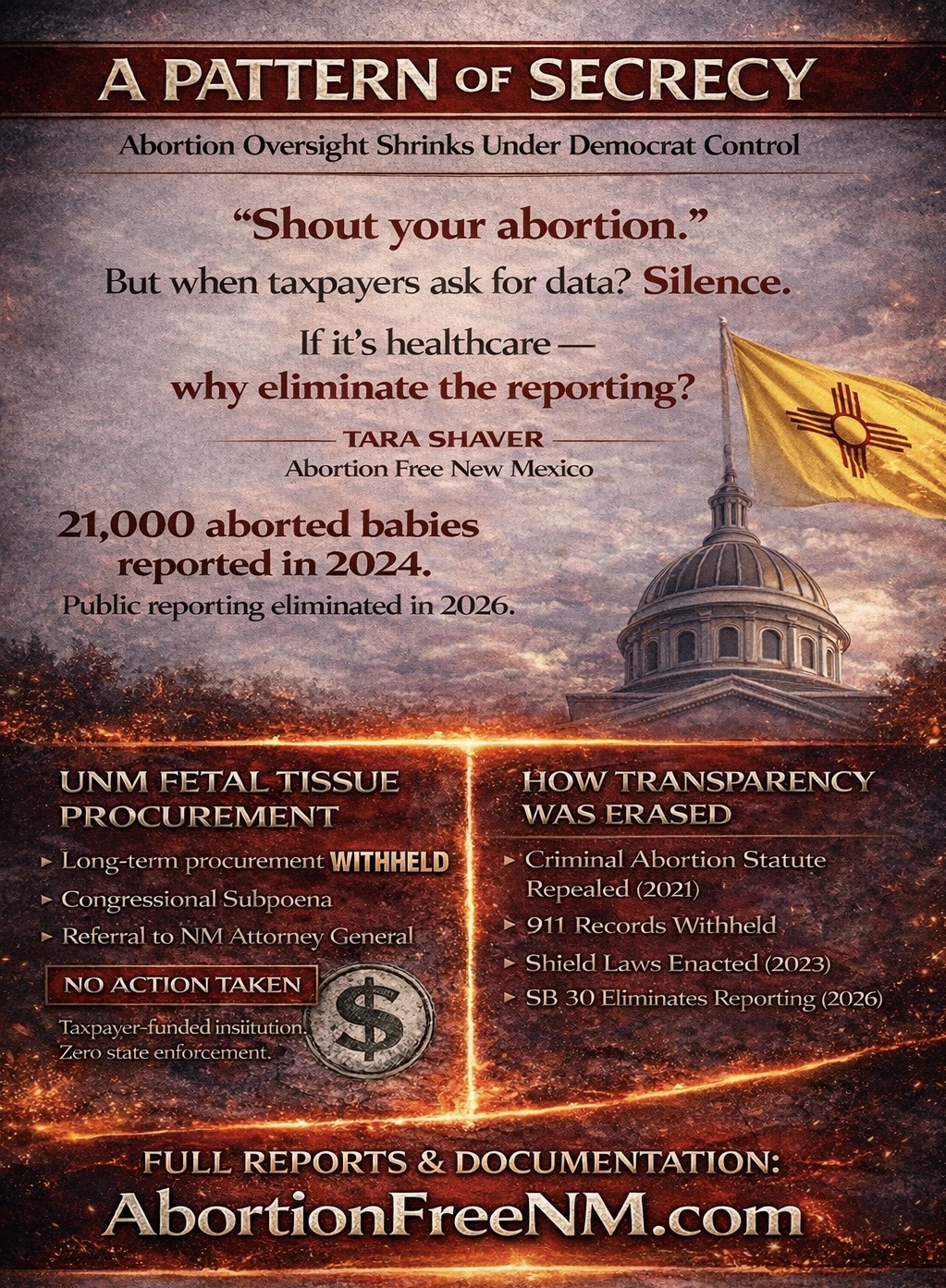
“For years, whenever we uncover abortion-related injuries or raise questions about aborted babies used in medical research, the response isn’t investigation — it’s obstruction,” said Tara Shaver, spokesperson for Abortion Free New Mexico. “If there is nothing to hide, why is transparency always the first thing to go?”
AFNM points to three areas where access to public information has contracted: emergency response records, university procurement documentation, and statewide abortion reporting data.
🚨Emergency Records: 911 Calls No Longer Released Under Current Democrat Leadership
After documenting emergency transports from abortion facilities, AFNM submitted public records requests seeking redacted 911 recordings from the City of Albuquerque.Under the current Democrat leadership of the City of Albuquerque, certain redacted 911 recordings are no longer being released.
“It is unknown what injuries were incurred because the City of Albuquerque refuses to release redacted 911 calls,” Shaver previously stated.
Without access to those records, AFNM says the public cannot independently assess the nature or severity of medical emergencies occurring at facilities operating openly within the city.
Transparency should not depend on who holds office,” Shaver said. “When access to basic emergency records contracts, public confidence erodes.”
AFNM says the shift away from releasing redacted emergency records represents a significant contraction in public transparency and limits independent verification of injury-related incidents.
🏛 University Records: Federal Subpoenas Required
A dispute involving the University of New Mexico (UNM) escalated to federal scrutiny
during the 2016 U.S. House Select Investigative Panel on Infant Lives inquiry.Public records requests sought fetal tissue procurement documentation related to UNM’s Health Sciences Center and Southwestern Women’s Options (SWWO). UNM declined to provide certain requested materials, stating that documents either did not exist or were not subject to disclosure under state law.
At the time, Tara Shaver criticized the university’s public-records responses.
“I think they lack transparency, and it’s because they have things to hide,” Shaver said at the time. “If you don’t have anything to hide, you’re going to put it all out there and show just how ethical you are.”
The dispute became part of the 2016 U.S. House Select Investigative Panel on Infant Lives inquiry.
According to the panel’s published findings:
- UNM’s Health Sciences Center maintained a working relationship with SWWO involving the transfer of fetal tissue for research purposes.
- Tissue procurement reportedly occurred regularly over a span of years.
- The investigation also described instances in which UNM medical students dissected brains of aborted fetuses as part of university-affiliated summer research programs.
- The panel highlighted close associations between the university and abortion providers, including shared faculty roles and overlapping professional relationships.
- Congressional investigators issued subpoenas.
- The panel referred findings to the New Mexico Attorney General and federal authorities.
AFNM notes that despite the referral, the New Mexico Attorney General ultimately took no action.UNM denied wrongdoing and publicly asserted compliance with applicable state and federal law.
“When federal subpoenas are required to obtain university records — and the state ultimately takes no action — it reinforces concerns about diminished accountability,” Shaver said. “Taxpayer-funded institutions should not require federal intervention before transparency questions are answered.”
📜 SB 30: Eliminating Statewide Abortion Reporting
AFNM says Senate Bill 30 represents the latest step in what it describes as a broader contraction of abortion oversight.For nearly five decades, New Mexico required abortion providers to submit statistical reports to the state — providing the only uniform statewide abortion data collected through statutory reporting requirements.
The reports did not identify individual patients but provided aggregate data regarding:
- Annual abortion totals
- Demographic patterns
- Procedural categories
- Public health statistics
SB 30 would eliminate those reporting requirements entirely.
The bill has already passed the New Mexico Senate and now heads to its first of two House committeesbefore potentially advancing to the House floor and the governor’s desk.AFNM has published a series of reports documenting the evolution of SB 30:🔗 SB 30 ADVANCES: LAWMAKERS ADMIT ABORTION REPORTING LAW IS BEING IGNORED — VOTE TO ERASE IT INSTEADThis report documented committee testimony in which a bill sponsor acknowledged that elements of the current abortion reporting statute were not being followed or enforced — raising questions about compliance with existing law.
🔗 ACT NOW: SB 30 ADVANCES AS SPONSORS PIVOT TO FEAR-BASED ARGUMENTS
This report detailed how, after compliance concerns were publicly raised, sponsors shifted the focus of debate toward fear-based arguments, emphasizing potential targeting or harassment of providers rather than addressing enforcement and data transparency.🔗 Hypocrisy on Display: NM Senate Calls Gun Regulations “Public Safety” — But Abortion Reporting “Too Burdensome”
This report highlighted what AFNM described as a policy contradiction: regulatory requirements are defended as necessary for public safety in other sectors, while abortion reporting is characterized as burdensome.
AFNM argues that in most regulated areas of healthcare, reporting and documentation are foundational components of patient safety, compliance, and public accountability.
“Eliminating reporting doesn’t increase safety — it reduces transparency,” Shaver said. “Medical transparency should not be optional.”
If enacted, SB 30 would end decades of publicly available statewide abortion data.
Legislative Action
AFNM encourages lawmakers to reject SB 30 and maintain longstanding reporting requirements that provide uniform statewide data. Members of the public who value transparency are encouraged to contact their representatives and participate in the legislative process.
Summary Conclusion
From 911 recordings no longer being released, to federal subpoenas required for university documentation, to a state referral that resulted in no action, and now to eliminating statewide abortion reporting requirements, AFNM says the pattern is consistent: when scrutiny increases, transparency decreases.
“When oversight mechanisms steadily shrink under one-party control, that is not a coincidence,” Shaver said. “Oversight is not harassment. Reporting is not extremism. Transparency is the foundation of public trust.”
Leave a Reply